The Star Who Shared the Stage: A Story About Humility
In the bustling town of Meadowbrook, where the cobblestone streets wound like ribbons between pastel cottages and the air always smelled of freshly baked bread, there lived a rabbit named Ruby who possessed a gift that made everyone who heard it stop in their tracks.
Ruby could sing.
Not just sing—her voice was magic. When she opened her mouth, notes floated out like golden butterflies, dancing on the breeze and settling into hearts with a warmth that made eyes tear up and smiles bloom. She could sing lullabies that soothed crying babies, ballads that made old farmers remember their youth, and joyful tunes that sent children spinning in circles, laughing until they collapsed in the grass.
Ruby lived in a cozy burrow at the edge of town with her mother, her father, and her seven brothers and sisters. The burrow was small and humble, with earthen walls lined with soft moss and furniture made from discarded items the rabbits had found and lovingly restored. An old wooden crate served as their dining table. A collection of smooth stones, carefully arranged, provided seating. Shelves built from twisted branches held their few possessions—root vegetables, dried herbs, and books borrowed from the town library.
Ruby's family was poor, but they were rich in love. Every evening, after a simple supper of clover and carrots, the rabbits would gather in their main room, and Ruby would sing. Her siblings would harmonize, her father would keep time by thumping his foot, and her mother would close her eyes, letting the music wash over her like a gentle rain.
"You have a gift, my dear," her mother would say when the song ended. "A true gift from the stars above."
And Ruby would smile, her pink nose twitching with pleasure, not understanding yet what a gift truly meant, or what it might cost.

The Meadowbrook Talent Show was the biggest event of the year.
Every summer, when the flowers bloomed their brightest and the days stretched long and lazy, the townsfolk gathered in the Great Meadow to celebrate the talents of their neighbors. There was dancing and juggling, poetry and puppetry, magic tricks and musical performances. The winner received a golden trophy shaped like a star, along with something even more precious—the admiration and recognition of the entire town.
Ruby had never performed in the talent show before. She had always been too shy, too content to sing for her family in the privacy of their burrow. But this year, something was different.
This year, Ruby wanted to win.
It started innocently enough. A visiting squirrel from the neighboring town of Oakhaven had heard Ruby singing while passing through the meadow. He had stopped, stunned, and when she finished, he approached her with wide eyes.
"That was the most beautiful thing I've ever heard," he said. "You should be famous. You should perform for kings and queens. You should win every contest from here to the Great Mountain."
Ruby's ears perked up. "You really think so?"
"I know so," the squirrel said. "With a voice like that, you could be the greatest singer in the world."
The words settled into Ruby's heart like seeds in fertile soil. She had never thought of herself as special before. She was just Ruby, the rabbit who sang in her burrow. But now, suddenly, she saw herself differently. She saw potential. She saw greatness. She saw a future where everyone knew her name, where her voice echoed through grand halls, where she was celebrated and admired and loved not just by her family, but by the entire world.
That night, she announced her decision.
"I'm going to enter the talent show," she told her family. "And I'm going to win."
Her siblings cheered. Her father thumped his foot in approval. Her mother smiled, but there was a hint of worry in her eyes that Ruby chose not to see.
"Are you sure, dear?" her mother asked. "The talent show is wonderful, but it's not about winning. It's about sharing your gifts with the community."
"I will share my gift," Ruby said. "And everyone will see how special I am."
Her mother said nothing more. But the worry in her eyes remained.
The weeks before the talent show were a blur of practice and preparation.
Ruby sang every moment she could. In the morning, before the sun fully rose, she practiced in the meadow while dew still clung to the grass. In the afternoon, she rehearsed in the town square, drawing crowds of admirers who clapped and cheered and told her how wonderful she was. In the evening, she performed for her family, but now she sang with a new intensity, a new focus, as if every note was a step toward her destiny.
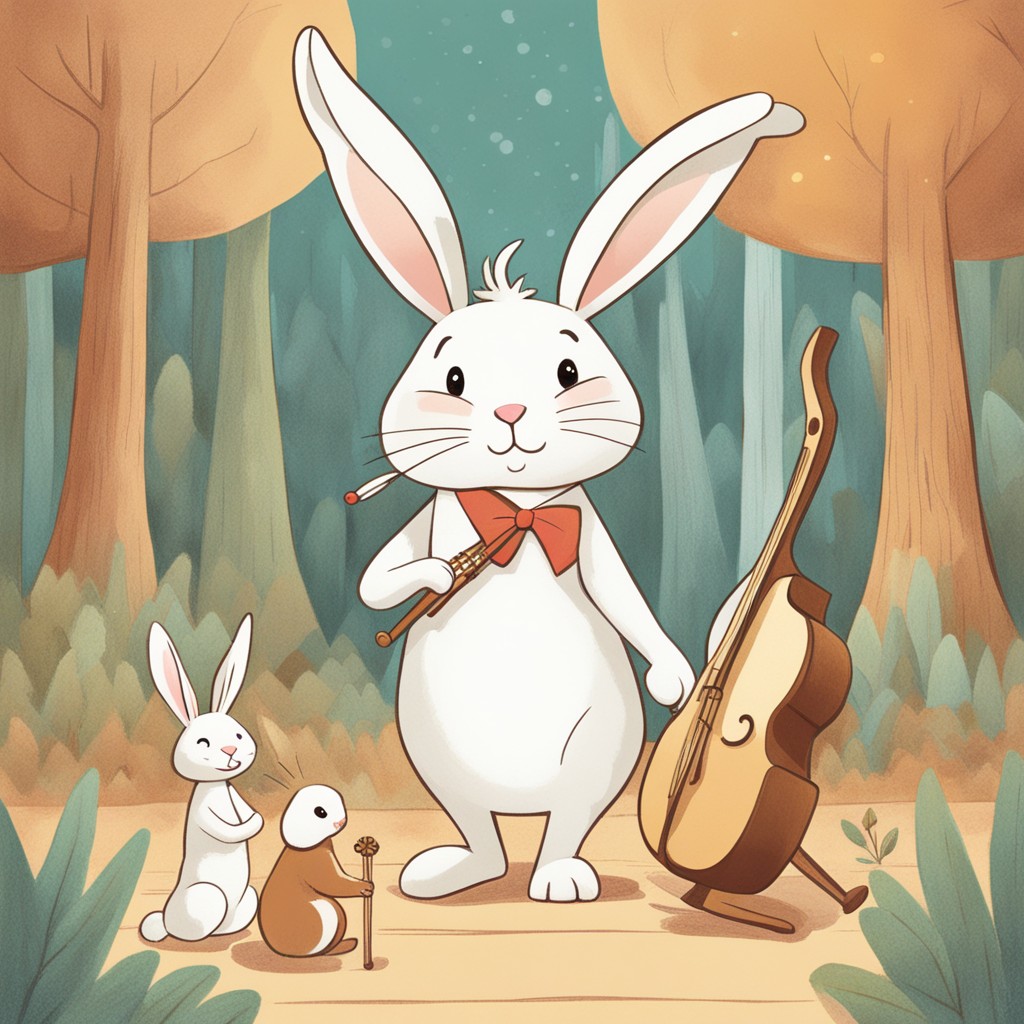
Her siblings tried to help. Her brother Remy, who played the acorn drum, offered to accompany her. Her sister Rosie, who had a lovely though not exceptional voice, suggested they sing a duet. Her youngest brother Rufus, who was learning to play the whistle made from a hollow reed, asked if he could join her performance.
But Ruby refused them all.
"This is my moment," she told them. "I need to do this alone. I can't have anyone distracting from my voice."
"But we always sing together," Rosie said, hurt. "Our harmonies—"
"Your harmonies are nice," Ruby interrupted, "but they're not exceptional. Not like my voice. I need to show the town what I can really do. I need to prove I'm the best."
Rosie's ears drooped. Remy's drumming fell silent. Rufus put his reed whistle away, his eyes downcast.
"Ruby," her father said quietly, "your family has always supported you. We've always sung together. That's what makes our music special."
"I appreciate that," Ruby said, though her tone suggested otherwise. "But this is different. This is the talent show. I need to be perfect. And perfect means doing it my way."
She turned back to her practice, leaving her family in hurt silence. She didn't notice their disappointment. She didn't see the pain in their eyes. She was too busy imagining the golden trophy, the cheering crowds, the moment when everyone in Meadowbrook would know her name.
Word of Ruby's talent spread through the town like wildfire.
"Have you heard the rabbit sing?" the baker asked his customers. "Like an angel, she is. She's going to win the talent show, mark my words."
"I heard her in the square yesterday," the tailor told his wife. "Goosebumps, I had. Real goosebumps. That rabbit is destined for greatness."
"My daughter says Ruby is already famous," the schoolteacher told her class. "She says Ruby's voice will be remembered for generations."
The praise fed Ruby's growing pride. She began to hold her head a little higher, to walk with a little more swagger, to look at her neighbors with a sense of superiority she had never felt before. She was special. She was chosen. She was better than everyone else, and soon they would all know it.
She stopped singing with her family entirely. She was too busy, she told them. Too focused. Too important to waste time on simple burrow concerts.
She stopped helping with chores. "I need to protect my voice," she explained. "I can't strain myself with manual labor."
She stopped talking to her old friends. "They don't understand what it's like to have real talent," she told herself. "They're just ordinary. I'm extraordinary."
And slowly, quietly, Ruby changed. The humble rabbit who had sung for the joy of it became someone else—someone who sang for applause, who measured her worth in admiration, who believed that her gift made her more important than everyone around her.
Her mother watched this transformation with a heavy heart. "Pride comes before a fall," she whispered to her husband one night. "I fear our Ruby is climbing too high, too fast."
"She's young," her father replied. "She'll learn."
"I hope so," her mother said. "Before it's too late."
The day of the talent show arrived with a sky so blue it looked painted and a sun so warm it felt like a blessing.
The Great Meadow had been transformed. Colorful banners fluttered between poles. A wooden stage stood at one end, decorated with wildflowers and ribbons. Rows of benches faced the stage, already filling with excited townsfolk. The smell of popcorn and honey cakes wafted through the air, and children's laughter rang out like bells.
Ruby arrived early, wearing a dress her mother had spent weeks sewing from the finest clover silk. It was green as spring grass and shimmered in the sunlight. Around her neck, she wore a necklace of tiny flowers that her sisters had gathered for her—though she had barely thanked them when they presented it.
She took her place backstage, pacing nervously but confidently. She had chosen the most difficult song she knew, a soaring ballad with high notes that made other singers gasp and low notes that resonated like thunder. It was a song that showcased her range, her power, her absolute mastery of her gift.
"You're going to be amazing," a young hedgehog told her. The hedgehog was performing a juggling act and had been practicing for months.
"I know," Ruby said, without a trace of modesty.
The hedgehog blinked, surprised by her certainty, but said nothing.
One by one, the performers took the stage. The badger family's comedy act had everyone roaring with laughter. The fox twins' dance was graceful and elegant. The owl's poetry recitation was thoughtful and moving. Each performer gave their best, and each received warm applause and genuine appreciation.
Ruby watched from the wings, her nose twitching with impatience. These performances were fine, she thought, but they were nothing compared to what she was about to do. She was the star. Everyone else was just... filler.
Finally, her name was called.
"And now," the announcer, a cheerful raccoon, proclaimed, "the moment you've all been waiting for! The rabbit with the voice of an angel, the songstress who will surely steal your hearts—Ruby!"
The crowd erupted in cheers. Ruby stepped onto the stage, her head held high, her heart pounding with excitement and pride.
She opened her mouth to sing.
And nothing came out.
Ruby's throat felt tight, as if invisible hands were squeezing it. She tried again, forcing air through her vocal cords, but the sound that emerged was thin and reedy, nothing like her usual golden tones.
The crowd fell silent, confused.
Ruby's heart hammered against her ribs. This couldn't be happening. She was the best. She was perfect. She was destined for greatness. Why couldn't she sing?
She tried again, pushing harder, straining her voice. A note emerged, sharp and cracked, like a broken bell. The sound was so wrong, so unexpected, that a few children in the audience giggled.
Tears stung Ruby's eyes. Panic flooded her chest. She looked out at the crowd—hundreds of eyes watching her, expecting miracles, seeing failure.
"I... I can't..." she whispered, though no one could hear her.
She stood frozen, humiliated, her perfect moment crumbling around her like a sandcastle in the tide.
And then, from the audience, a voice rose.
It was soft at first, hesitant, but unmistakably beautiful. A harmony, gentle and supportive, wrapping around Ruby's broken notes like a warm blanket.
Ruby turned. In the front row, her sister Rosie was singing. Her voice was not as powerful as Ruby's, not as technically perfect, but it was pure and sweet and full of love.
Then another voice joined—Remy, thumping his acorn drum in steady rhythm, adding a heartbeat to the music. Then Rufus, his reed whistle piping a simple but lovely melody. Then her mother, her father, her other siblings, all singing together, the way they had always sung in their cozy burrow.
The family harmony swelled, filling the meadow, transforming Ruby's broken solo into something else entirely. Not a star performance. Not a display of individual greatness. But something better.
A song of family. Of love. Of support.
Ruby's throat loosened. The invisible hands released their grip. And slowly, tentatively, she joined her voice with her family's. Not as the star, but as one part of a greater whole.
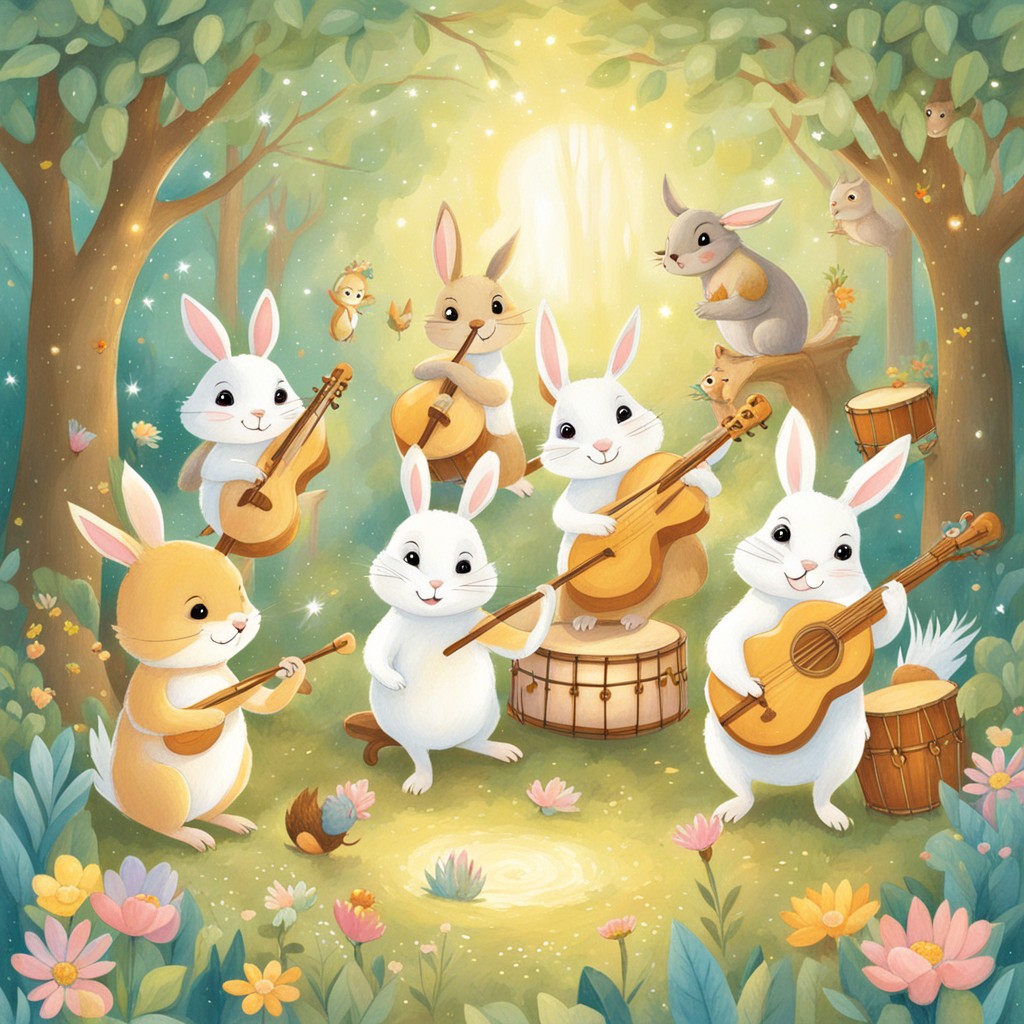
The song they sang was not the difficult ballad Ruby had chosen. It was an old melody, one their grandmother had taught them, about a rabbit who wandered far from home and found her way back through the love of those who waited for her.
Ruby sang the melody. Rosie added harmony. Remy's drum kept time. Rufus's whistle danced above it all. And together, they created something more beautiful than Ruby had ever achieved alone.
When the song ended, the meadow was silent for a moment. Then the applause began—not the polite clapping Ruby had expected for her solo, but a thunderous roar of appreciation that shook the wildflowers and sent birds flying from the trees.
The raccoon announcer wiped a tear from his eye. "That," he said, his voice thick with emotion, "was the most beautiful performance I have ever seen."
Ruby didn't win the golden trophy.
The badger family's comedy act took first place, and they celebrated with such joy and laughter that no one could begrudge them their victory. The fox twins won second place, and the owl's poetry took third.
Ruby and her family received a special recognition—a silver medal for "Most Heartwarming Performance"—but it was not the star-shaped trophy Ruby had dreamed of.
And strangely, she found she didn't mind.
As the sun set over the Great Meadow, painting the sky in shades of amber and rose, Ruby sat with her family on a blanket, sharing honey cakes and watching the fireflies emerge.
"I'm sorry," she said quietly. "For how I acted. For thinking I was better than everyone else. For pushing you away."
Her mother put an arm around her. "We know, dear. We always knew."
"But why?" Ruby asked. "Why did you help me, after how I treated you?"
"Because we're family," her father said simply. "And family doesn't keep score."
"But I was so proud," Ruby admitted, her ears drooping. "I really thought I was the best. That I deserved to win. That my gift made me special."
"Your gift does make you special," Rosie said. "But not because it's better than anyone else's. It's special because it's yours. And it's most special when you share it."
Ruby thought about this. She thought about the weeks of practice, the endless rehearsals, the way she had shut out everyone who loved her in pursuit of a trophy. She thought about the moment on stage when her voice failed, and the way her family had risen to support her, asking for nothing in return.
"I understand now," she said. "Being the best isn't about being better than everyone else. It's about being your best self. And my best self isn't a star standing alone. It's a daughter, a sister, a friend. It's someone who sings with love, not for applause."
Her mother kissed her forehead. "That's our Ruby."
In the days that followed, Ruby changed.
She still sang—how could she not? It was as much a part of her as her soft fur or her twitching nose. But now she sang differently.
She sang with her family, harmonizing with her siblings, learning to blend her voice with theirs instead of overpowering them. She discovered that a well-placed harmony could make a melody soar higher than any solo. She learned that listening was as important as singing, that silence between notes was as meaningful as the notes themselves.
She performed at the town square again, but now she invited other musicians to join her. The hedgehog juggler turned out to have a lovely singing voice. The fox twins could play the violin. Even the badger family, winners of the talent show, had a member who could keep rhythm on a washboard.
Together, they created music that was richer, more complex, more joyful than anything Ruby had achieved alone.
And when people praised her, Ruby learned to say something she had never said before.
"Thank you," she would reply. "But it's not just me. It's all of us. Together, we make the magic."
She still received admiration. She still had fans. But now, when children asked for her autograph, she would invite them to sing with her. When neighbors complimented her voice, she would introduce them to her siblings and their talents. When the town newspaper wanted to interview her, she insisted on including the whole ensemble.
"I'm just one voice," she told the reporter. "There are so many wonderful voices in Meadowbrook. I'm lucky to sing among them."
The reporter was surprised. "Most stars want the spotlight for themselves."
"I'm not a star," Ruby said, and she meant it. "I'm a rabbit who loves to sing. And the best singing happens when voices come together."
Months later, Ruby received an invitation that would have thrilled her old self.
The King and Queen of the neighboring kingdom had heard of her talent and requested a private performance at their palace. It was the kind of opportunity Ruby had once dreamed of—the chance to perform for royalty, to be recognized as the greatest singer in the land, to bask in the admiration of the most important people in the world.
But Ruby did something unexpected.
She asked if her family could come too.
"Of course," the royal messenger replied, surprised. "But the invitation is for you alone. Your family would be guests, not performers."
"Then I must decline," Ruby said.
The messenger stared at her. "You would refuse the King and Queen?"
"Not refuse," Ruby explained gently. "But I don't sing alone anymore. My music is made with my family, and if they cannot perform with me, then I cannot perform at all."
The messenger returned to the palace with Ruby's message, and the royal couple was so intrigued by her humility that they invited the entire family to perform.
The concert was magical. Ruby and her siblings sang their grandmother's old songs, their harmonies weaving together like threads in a tapestry. Remy's drumming echoed through the grand hall. Rufus's whistle danced like a bird in flight. And Ruby's voice, no longer straining to prove its greatness, flowed with a warmth and joy that brought tears to the royal eyes.
When they finished, the Queen approached Ruby, her own eyes shining.
"That was the most beautiful music I have ever heard," she said. "You could have been a great soloist. Why do you choose to share the stage?"
"Because," Ruby said, looking at her family with love, "the stage is brighter when we stand on it together. And the music is sweeter when it's made with people you love."
The Queen smiled. "You are wise beyond your years, little rabbit."
"Not wise," Ruby said, her pink nose twitching. "Just grateful. Grateful for the gift I was given, and for the people who helped me learn how to use it."
Years passed, and Ruby became known throughout the land—not as the greatest singer, though her voice was still beautiful, but as the humblest star anyone had ever met.
She performed in grand halls and simple meadows, always sharing the spotlight with her fellow musicians. She taught young rabbits to sing, not by boasting of her own talent, but by listening to theirs and helping them find their unique voices. She raised her own children with the lessons she had learned—that gifts were meant to be shared, that pride was a lonely prison, and that true greatness lay in lifting others up rather than standing above them.
And every summer, when the Meadowbrook Talent Show arrived, Ruby would take the stage with her family and sing their grandmother's old song. Not to win. Not to impress. But to remind everyone—and herself—that the most beautiful music was made not by stars standing alone, but by voices raised together in love.
THE END
Moral of the Story: Humility is the quality of being modest and respectful, of recognizing that your talents and achievements do not make you better than others. True humility is not about hiding your gifts or pretending you have none—it is about understanding that your gifts are meant to be shared, not hoarded. It is about giving credit to those who helped you, listening to voices other than your own, and finding joy in collaboration rather than competition. Ruby's journey teaches us that pride can blind us to the love and support of those around us. When we believe we are superior, we isolate ourselves, pushing away the very people who care about us most. But when we embrace humility, we discover that our gifts are magnified by connection, not diminished by it. A voice singing alone can be beautiful, but voices singing together create something far more powerful—a harmony that resonates with love, community, and shared joy. The most talented people are often not the ones who boast the loudest, but the ones who lift others up, who share their spotlight, who recognize that every person has something valuable to offer. Humility allows us to learn from others, to grow beyond our limitations, and to find fulfillment not in being better than everyone else, but in being our best selves alongside everyone else. In the end, Ruby discovered that the greatest performance was not the one that won the trophy, but the one that brought her family together, that turned a moment of failure into an opportunity for love, and that taught her the most important lesson of all: we are all stars, but the sky is brightest when we shine together.