The Penguin Who Never Gave Up: A Story About Perseverance
The Penguin Who Never Gave Up: A Story About Perseverance
In the frozen lands of Antarctica, where the ice stretched like a white desert to the edge of the world, there lived a small emperor penguin named Pip. He was smaller than his brothers and sisters, with a round belly that wobbled when he walked and flippers that seemed too short for his body.
Pip lived in a colony of thousands, nestled against the ice shelf where the wind howled like wolves and the snow fell sideways in stinging sheets. His father, Admiral, was the colony's strongest swimmer. His mother, Aurora, was the fastest sledder on the ice. His siblings were strong and graceful, sliding across the snow with ease, diving into the frigid waters with confidence.
But Pip was different. He was clumsy. When he tried to slide on his belly, he veered left and crashed into a snowbank. When he tried to dive into the water, he belly-flopped and surfaced sputtering. When he tried to catch fish, they darted away from his slow, awkward snaps.
"You will never be a proper penguin," his brother Nimbus teased, slicking back his perfect feathers. "You are too slow. Too clumsy. Too small."
Pip's heart ached. He practiced every day. He woke before dawn and slid across the ice until his belly was raw. He dove into the water until his flippers burned. He practiced catching fish in shallow pools until his beak was sore.
But he did not improve. Not really. He was still the worst in the colony.
One day, the Elders announced the Great Journey. Every young penguin who wished to become an adult had to make the trek across the ice to the Crystal Caves, a place where the northern lights danced in colors no penguin had ever named. The journey was treacherous. It took seven days. And many who tried never returned.
"I will go," Pip said, though his voice shook.
Nimbus laughed. "You? You cannot even slide straight. You will die out there."
"Perhaps," Pip said. "But I will try."
His parents were worried. "Pip," Aurora said, pressing her beak to his cheek. "You do not have to do this. Not every penguin makes the journey. You can stay here, safe with us."
"But I want to," Pip said. "Not because I think I will succeed. But because if I do not try, I will always wonder."

The morning of the journey, twenty young penguins gathered at the colony's edge. They were strong and swift and confident. And then there was Pip, small and clumsy, waddling at the back.
The first day was easy. The ice was flat, the wind was calm, and the sun painted the snow in shades of gold and pink. The young penguins slid and chattered and raced each other. Pip struggled to keep up, his short flippers pushing him forward inch by inch.
By sunset, the others were miles ahead. Pip was alone. Exhausted. His flippers throbbed. His belly was scraped raw. He collapsed against a small ice ridge, tears freezing on his cheeks.
"I cannot do this," he whispered. "I am too weak. Too slow."
He looked at the stars. They were bright and cold and indifferent. But somewhere in their light, Pip thought he saw a flash of green. The northern lights, dancing at the edge of the world.
"I want to see that," he said. "I want to see the Crystal Caves."
He stood up. And he kept walking.
The second day, a storm hit. The wind screamed like a living thing, driving snow into Pip's eyes, making it impossible to see. He could no longer follow the tracks of the other penguins. He was lost.
"Keep moving," he told himself. "One flipper in front of the other."
He walked for hours in the whiteout. He fell into crevasses and clawed his way out. He was buffeted by winds that tried to push him back. But he kept moving forward, one small step at a time.
By the third day, the storm had passed. Pip was alone on a vast plain of ice, with no landmarks, no tracks, no sign of the others. He was hungry. His blubber reserves were low. He needed fish, but the water was far and he was too tired to dive.
He found a small pool, barely deeper than a puddle, and practiced his fishing. He missed. Again and again. His beak snapped on empty water. But he kept trying. And finally, after fifty attempts, he caught a tiny silver fish.
It was the smallest fish he had ever eaten. But it was his. And it gave him strength.
The fourth day, he reached the Ice Bridge, a narrow span of frozen stone that crossed a chasm deeper than any penguin had ever measured. The bridge was slick and thin and trembled in the wind.
Pip stood at the edge, looking down into the blue-black void. One wrong step and he would fall forever.
"I cannot," he whispered. "I am too clumsy. I will slip."
He thought about turning back. About returning to the colony, tail between his flippers, admitting defeat.
But then he thought about the Crystal Caves. About the lights. About proving to himself that he could do something hard.
"One step," he said. "Just one step."
He placed one flipper on the ice. It held. He placed the other. It held. Inch by inch, slide by slide, he crossed the bridge. His heart hammered. His flippers shook. But he did not look down. He looked forward.
When he reached the other side, he collapsed, sobbing with relief. He had done it. He had crossed the Ice Bridge.
The fifth day, he found the others.

They were huddled in a valley, trapped by a wall of ice that had shifted in the night, blocking their path. Nimbus was trying to climb it, but his flippers slipped on the slick surface. The others were pacing, panicking, unsure what to do.
"We are stuck," Nimbus said, his voice cracking. "We cannot go back. We cannot go forward. We will die here."
Pip looked at the ice wall. It was tall and smooth and unforgiving. But he noticed something the others had missed. A crack. A thin line running up the side, barely visible, but deep enough for a flipper to grip.
"I can climb it," Pip said.
Nimbus laughed, but there was no humor in it. "You? You cannot even slide straight."
"Maybe not," Pip said. "But I have fallen more times than any of you. And I have gotten up every time. I know how to find holds. I know how to grip. Let me try."
He approached the wall. He placed his flipper in the crack. He pulled himself up. He slipped. He fell. He got up. He tried again.
Again and again. Slip. Fall. Rise. Try.
The other penguins watched in silence. They had never seen such determination. Such refusal to quit.
After two hours, Pip reached the top. He pulled himself over the edge and lay on the ice, panting, his flippers bleeding, his body bruised. But he had done it.
"There is a path," he called down. "Follow my tracks."
One by one, the other penguins climbed the wall, using the holds Pip had found. Nimbus was last. When he reached the top, he looked at Pip with new eyes.
"I was wrong," Nimbus said. "You are not the worst penguin. You are the strongest."
"No," Pip said, smiling. "I am just the one who never gave up."
The sixth day, they reached the Crystal Caves.
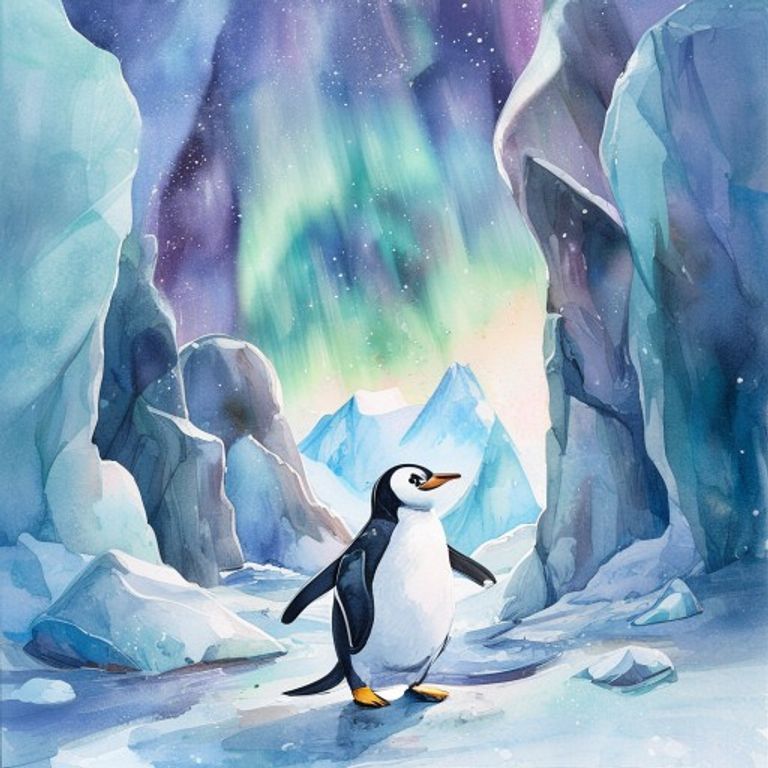
They were more beautiful than any penguin had described. The ice walls were clear as glass, refracting the light into a thousand colors. The northern lights danced above, green and purple and gold, painting the snow in shades that had no names.
Pip stood at the entrance, his heart full. He had made it. Not because he was the fastest or the strongest or the best. But because he had kept going. Through storms. Through hunger. Through fear. Through failure.
The Elders were waiting inside. They were ancient penguins, their feathers white with age, their eyes wise and kind.
"Pip," the oldest Elder said. "You have completed the Great Journey. But more importantly, you have proven something greater. You have proven that perseverance is not about being the best. It is about refusing to stop."
She placed a small crystal around his neck. It was clear and pure, catching the light of the northern lights and holding it like a captured star.
"This is the Crystal of Perseverance," she said. "It reminds us that every great achievement is built on a thousand small failures. Every master was once a beginner. Every champion was once last."
Pip touched the crystal. It was warm against his chest. And in its light, he saw his reflection. Not the clumsy penguin he had been. But the penguin he had become.
From that day on, Pip was known throughout Antarctica as the Penguin Who Never Gave Up. He taught the young ones to slide, not with grace, but with grit. To dive, not with speed, but with heart. To fish, not with skill, but with patience.
And when a young penguin came to him, tears in their eyes, saying, "I am not good enough," Pip would smile and show them his scarred flippers and say:
"Good enough is not the point. The point is to keep trying. Because every fall teaches you how to stand. Every failure teaches you how to succeed. And every step forward, no matter how small, is a victory."
Moral of the Story: Perseverance means never giving up, even when things are hard. Pip was the smallest, slowest, clumsiest penguin in his colony. Everyone told him he could not make the Great Journey to the Crystal Caves. But he kept trying. Through storms and hunger and fear, he took one small step after another. And in the end, it was his perseverance that saved the others, not his strength. So remember, you do not have to be the best. You do not have to be the fastest. You just have to keep going. Because every great achievement is built on a thousand small failures. And every step forward, no matter how small, is a victory.
Age Range: 4-8 years | Reading Time: ~10 minutes | Core Value: Perseverance