The Bell Ringer’s Hope: A Story About Hope
The Bell Ringer's Hope: A Story About Hope
In the town of Frosthaven, where the winters lasted six months and the snow piled so high against the houses that people tunneled from door to door, there was a bell tower.
It stood at the center of the village square, built of gray stone and dark wood, crowned with a copper dome that had turned green with age. The bell inside was older than anyone could remember, forged from bronze that had been mined from the mountains before the mountains had names. When rung, the bell's voice was deep and warm, like a mother singing to a frightened child. It could be heard for miles, cutting through the howl of wind, through the silence of snowfall, through the despair that crept into every hearth during the long white months.
Sylvie was nine years old, the daughter of the town's clockmaker, a man whose hands could repair any mechanism but could not repair his own lungs, which had grown weak from breathing cold air. She had hair the color of wheat, pale and straight, which she kept braided and tucked beneath a woolen cap. Her eyes were blue, the blue of deep ice, clear and steady. She was small for her age, but she was strong. She had to be. Because when the Great Frost came, Sylvie became the only person left in Frosthaven.
The winter had started normally. The first snow fell in October, soft and gentle, turning the world white and quiet. The villagers prepared as they always did—stocking firewood, preserving food, checking the insulation of their homes. They were used to hard winters. They had survived a hundred of them.
But this winter was different.
By November, the snow was twice as deep as usual. By December, the temperature dropped so low that the river froze solid, and the fish beneath the ice died in their sleep. By January, the food began to run out. The firewood grew scarce. The cold seeped through walls and windows, through thick coats and layered blankets, through skin and muscle, settling in bones like a permanent ache.
The elders made a decision. They would leave. All of them. They would travel south, to the city of Emberwell, where the winters were mild and the markets never closed. They would wait out the frost in warmth and safety, and return in spring.
"Come with us," Sylvie's mother begged, her face pale and drawn. "We cannot leave you here."
But Sylvie's father could not travel. His lungs would not survive the journey. And Sylvie would not leave him.
"I will stay," she said, her voice steady as the bell itself. "I will care for Papa. And I will ring the bell."
"The bell?" her mother asked, confused. "Why the bell?"
"Because," Sylvie said, "as long as the bell rings, the village is not dead. As long as the bell rings, there is hope that someone will hear it. That someone will know we are still here. That spring will come, and the villagers will return, and Frosthaven will live again."
Her mother wept. Her father, pale and coughing in his bed, smiled a smile that was sad and proud. "You have always been the strongest of us," he whispered. "Ring the bell, little one. Ring it for all of us."
The villagers left on a gray morning in late January. Their wagons creaked through the snow, their faces turned south, their breath pluming white in the frozen air. Sylvie stood at the edge of the village, watching them go, her father's hand in hers. She did not cry. She had made her choice. She had chosen hope.
The first week was the hardest.
The silence of an empty village is not like ordinary silence. It is heavy. It presses against your ears, against your chest, against your heart. It whispers that you are alone. That no one is coming back. That the world has forgotten you.
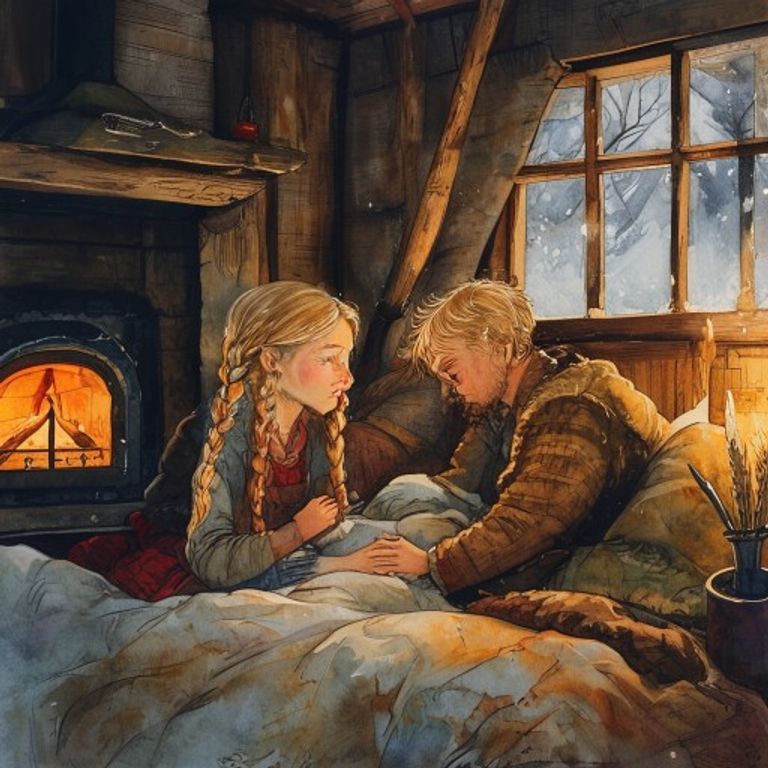
Sylvie fought the silence with work. She tended the small stove in their cottage, feeding it with the last of the firewood, rationing it carefully. She prepared simple meals from the remaining stores—dried beans, pickled vegetables, flour for bread. She cared for her father, changing his bedding, helping him sit up to drink warm broth, reading to him from his favorite books until he fell asleep.
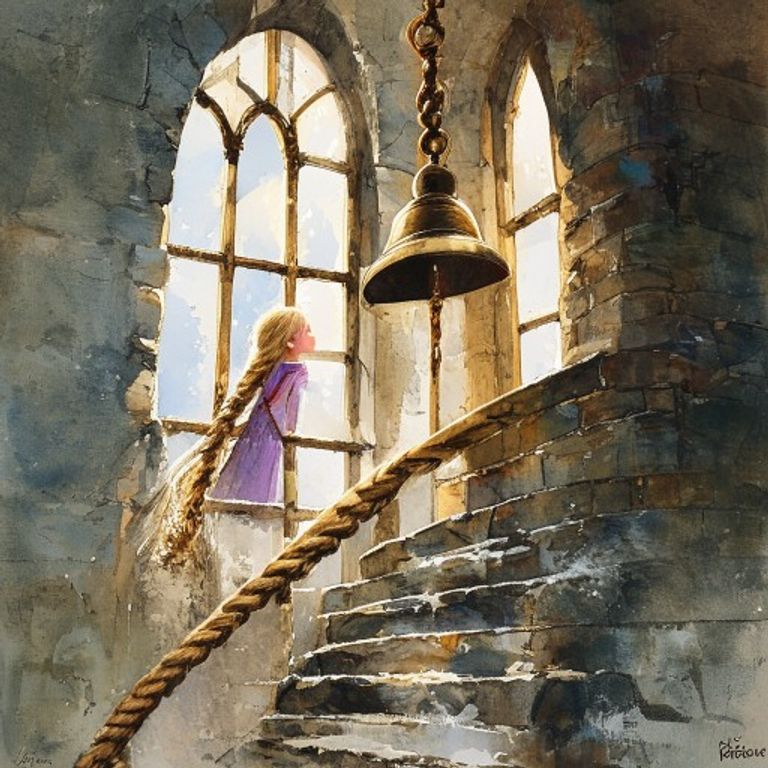
And every morning, at precisely sunrise, she climbed the bell tower.
The climb was seventy-three steps, spiraling upward through cold stone. Her breath came hard and fast, visible in the dim light. Her fingers grew numb on the iron railing. But she climbed. Every morning. Without fail.
At the top, she stood before the great bronze bell, her hands finding the worn rope that hung beside it. She pulled. The bell's voice rang out, deep and warm, rolling across the snow-covered village, across the frozen river, across the empty fields and the silent forest. One ring. Two. Three.
"I am here," the bell said, in Sylvie's voice. "We are here. Frosthaven lives."
Then she would descend, return to the cottage, and continue her work. The work of surviving. The work of hoping.
February came, and with it, the worst storm of the winter.
The wind howled like a living thing, shaking the cottage walls, tearing at the roof, driving snow through every crack and crevice. The temperature dropped so low that the ink in Sylvie's father's inkwell froze solid. The stove could not keep up. They huddled together beneath every blanket they owned, Sylvie's father shivering, his breathing shallow and fast.
"You should have gone," he whispered, his voice barely audible above the wind. "You should have gone with the others."
"No," Sylvie said. "I am exactly where I need to be."
"But if I die—"
"You will not die," Sylvie said, fierce and certain. "You will not die because I will not let you. And you will not die because spring is coming. I know it is."
"How do you know?" her father asked. "The storm... it could last forever."
Sylvie thought about this. She thought about the bell, silent now because she could not climb the tower in this wind. She thought about the empty village, buried in snow. She thought about the southward road, where her mother and neighbors had traveled weeks ago.
"I know," she said slowly, "because hope is not about knowing. It is about choosing. I choose to believe that spring will come. I choose to believe that you will get better. I choose to believe that the villagers will return, and Frosthaven will fill with life again. These things may not happen. But as long as I choose to believe them, I have hope. And as long as I have hope, I have strength. And as long as I have strength, I can keep going."
Her father looked at her, his eyes wet. "Where did you learn this?"
"From the bell," Sylvie said. "It rings even when no one is listening. It rings because that is what bells do. And I hope because that is what Sylvie does."
March arrived, and with it, a change in the air.
The cold was still fierce, the snow still deep, but something was different. The light lasted longer. The sun felt warmer, when it shone. And one morning, Sylvie woke to a sound she had not heard in months—the sound of dripping water.
She ran to the window. The icicles on the eaves were melting, drop by drop, falling to the snow below and carving tiny holes, tiny tunnels, tiny paths to the earth beneath.
"Papa!" she cried, rushing to his bedside. "The thaw! It is starting!"
Her father smiled, the first real smile she had seen in weeks. "You were right," he said. "Spring is coming."
But the thaw brought new dangers. The melting snow turned to water, which ran down the streets and froze again at night, creating sheets of ice that were treacherous to walk. The weight of the snow on the roofs caused some of the older buildings to collapse. The river, frozen for months, began to groan and crack, the ice shifting and breaking in ways that were unpredictable and dangerous.
Sylvie navigated these dangers with care, her small frame moving carefully through the changed landscape. She rang the bell every morning, and now she added an evening ringing as well, as if to hurry the spring along, as if to tell the world that Frosthaven was ready.
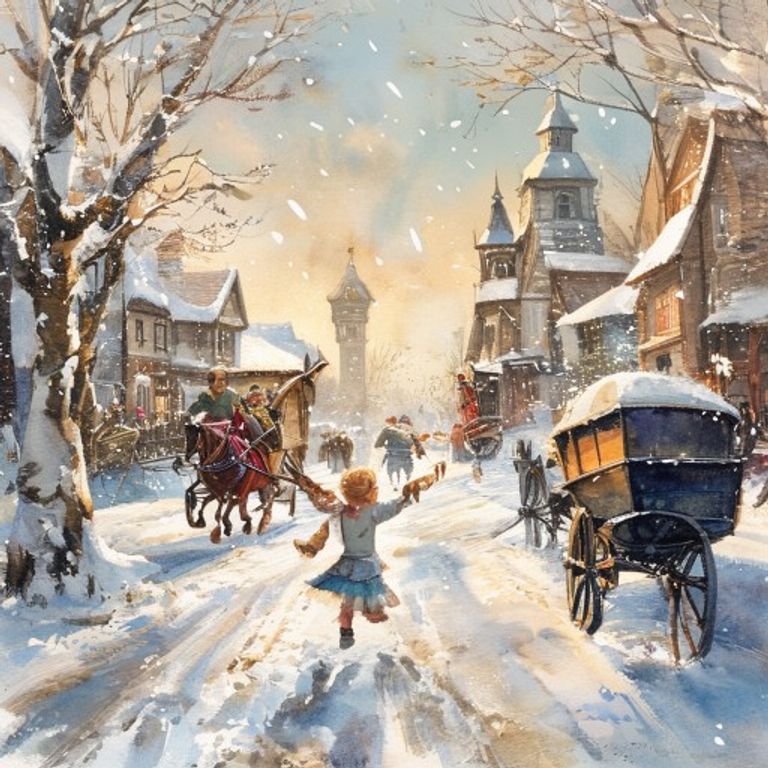
And then, one morning in late March, as she climbed the tower steps, she heard something. A sound beneath the bell's voice. A sound that did not echo. A sound that came from outside.
She stopped, her hand on the rope, listening. The sound came again—a voice, faint but real, calling from the road.
Sylvie ran to the tower window. She looked out, across the snow, across the melting fields, across the road that led south. And she saw them.
A line of figures. Wagons. Horses. People.
The villagers. Returning.
They had heard the bell.
In Emberwell, where they had spent the winter in crowded inns and borrowed rooms, they had heard stories. Travelers passing through, speaking of a sound that carried across the frozen hills—a bell, ringing every morning, without fail, from the direction of Frosthaven.
"It cannot be," the elders had said. "Frosthaven is empty. Everyone left."
"Someone stayed," the travelers had replied. "Someone is ringing that bell. Every day. Without fail."
Sylvie's mother had known. She had stood in the market square of Emberwell, listening to the travelers' stories, and she had known. "Sylvie," she had whispered. "My Sylvie. She stayed. She is ringing the bell."
The villagers had voted. They would return early, before the roads were fully clear, before it was truly safe. They would return for the girl who had kept their home alive.
Now, as Sylvie ran down the tower steps, out into the square, they were already there—her mother leaping from the lead wagon, running through the slush and snow, scooping Sylvie into her arms, weeping, laughing, holding her so tight Sylvie could barely breathe.
"You rang the bell," her mother said, over and over. "You rang the bell. Every day. We heard it. We heard you."
"I told you," Sylvie said, her voice muffled against her mother's shoulder. "I told you I would."
The villagers poured into the square, embracing Sylvie, weeping, laughing, amazed. They went to the cottage, found Sylvie's father, weak but alive, cared for and loved. The doctor was summoned. Warmth was restored. Life returned to Frosthaven, not gradually, but all at once, like a flood after a dam breaks.
That evening, as the sun set on a village that was no longer empty, Sylvie climbed the bell tower one more time. She stood before the great bronze bell, her hands on the worn rope. The villagers gathered in the square below, looking up, waiting.
Sylvie pulled the rope. The bell rang out, deep and warm, rolling across the village, across the melting snow, across the hills that were slowly turning green. One ring. Two. Three.
But this time, she was not alone. Her father, wrapped in blankets, sat in a chair by the window, listening. Her mother stood beside him, her hand in his. The villagers filled the square, their faces turned upward, their hearts full.
And when the bell fell silent, Sylvie spoke. Her voice was small, but in the stillness, everyone heard.
"I rang this bell every morning," she said, "because I believed you would return. I believed spring would come. I believed my father would get better. I did not know these things would happen. But I chose to believe them. That is hope. Hope is not certainty. It is not knowledge. It is choice. It is the choice to keep ringing, even when no one seems to be listening. It is the choice to keep believing, even when the world gives you no reason. It is the choice to keep going, even when the path is buried in snow."
She looked down at the villagers, at her parents, at the town she had kept alive.
"And sometimes," she said, smiling, "someone is listening. Someone always is. You just have to keep ringing until they hear."
The villagers cheered. The sound rose up through the tower window, surrounding Sylvie like a warm embrace. She rang the bell once more, a celebration, a triumph, a song of hope fulfilled.
And far to the south, in the cities and towns where winter was already ending, travelers stopped and listened. They heard the bell, faint but clear, and they smiled, not knowing why, but feeling somehow that the world was a little warmer, a little brighter, a little more full of hope than it had been before.
Because in Frosthaven, a nine-year-old girl had refused to be silent. She had chosen hope. And in choosing hope, she had saved her village, her father, and herself.
Moral of the Story: Hope is not about knowing that things will get better. It is about choosing to believe they will, even when you have no proof. Sylvie did not know that spring would come. She did not know that her father would survive. She did not know that the villagers would hear her bell and return. But she chose to believe these things. She chose to ring the bell every morning, not because she knew someone would hear it, but because she refused to let hope die. And in that refusal, she found strength. She found purpose. She found the will to keep going, even when the winter was darkest, even when the silence was heaviest, even when it seemed that no one was listening. Hope is a choice. It is a daily practice, like ringing a bell. It is the decision to keep your heart open, to keep your spirit alive, to keep believing in the possibility of spring, even in the depths of winter. And sometimes, that choice is heard. Sometimes, it brings people back. Sometimes, it saves lives. But even when it is not heard, even when no one comes, the choice itself matters. Because hope is not about the outcome. It is about who you become when you choose to hope. It is about the strength you find, the love you give, the light you keep burning in the darkness. Sylvie became the bell ringer. She became the voice that refused to be silent. She became hope itself. And in doing so, she taught her village, her family, and everyone who heard her story, that the darkest winters always end. That spring always comes. That as long as someone keeps ringing the bell, hope is never lost.
Age Range: 4-8 years | Reading Time: ~10 minutes | Core Value: Hope