The Garden on the Wall: A Story About Forgiveness
The Garden on the Wall: A Story About Forgiveness
In the village of Riverbend, where the houses were painted in colors that would make a rainbow jealous and the river wound through like a silver ribbon, there lived a girl named Lila who loved to draw.
Not loved in the casual way that children love sweets or sunny days. Lila loved to draw the way birds love the sky, the way fish love water, the way roots love the dark earth. She drew on every surface she could find. She drew on paper, on bark, on stones she found by the river. She drew in the margins of her schoolbooks, in the dust of the road with a stick, in the steam on the kitchen window with her finger.
Her drawings were extraordinary. Not because they were perfect—her horses sometimes had too many legs, her trees sometimes grew upside-down—but because they were alive. When Lila drew a bird, you could almost hear it singing. When she drew a flower, you could almost smell its perfume. When she drew the river, you could almost feel the current tugging at your ankles.
She was nine years old, with ink-stained fingers and clothes that were more paint than fabric. Her mother, a practical woman who baked bread for the village, would shake her head and say, "Lila, the world is not your canvas." And Lila would smile and reply, "But it could be."
The trouble began on the first day of summer.
Lila had discovered a wall. It was not just any wall. It was the eastern wall of Old Man Thornberry's house, and it was the largest, smoothest, most perfect wall in all of Riverbend. It faced the morning sun, which gave it a warm golden glow. It was unblemished by windows or doors. And it was completely, utterly blank.
To Lila, that blankness was a crime. A wall that large, that smooth, that sun-kissed—it was begging for color. It was whispering, "Draw on me." It was singing a siren song that only an artist could hear.
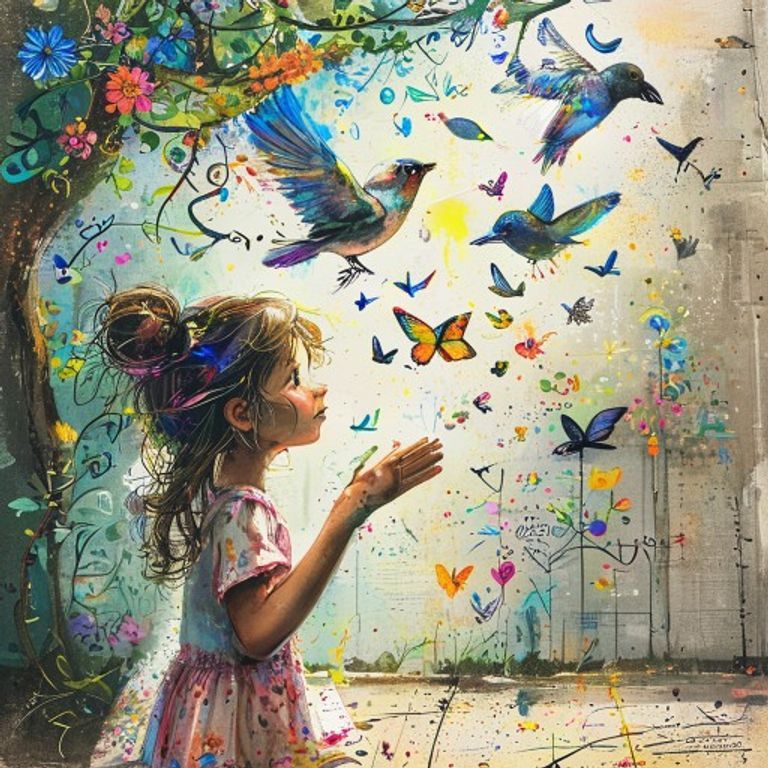
She did not mean to paint the entire wall. She only meant to draw a small bird, just one, in the corner where the morning glories grew. She brought her chalks—soft pastels in every color, a gift from her grandmother who had once been a painter in the city. She drew a robin, fat and cheerful, perched on an invisible branch. It took ten minutes. It was beautiful.
But the robin looked lonely.
So she drew a friend for it, a blue jay with an improbably long tail. And then a wren, and then a sparrow, and then an owl with eyes like two small moons. And then she needed branches for them to sit on, and leaves for the branches, and flowers for the leaves to shelter, and butterflies for the flowers to feed.
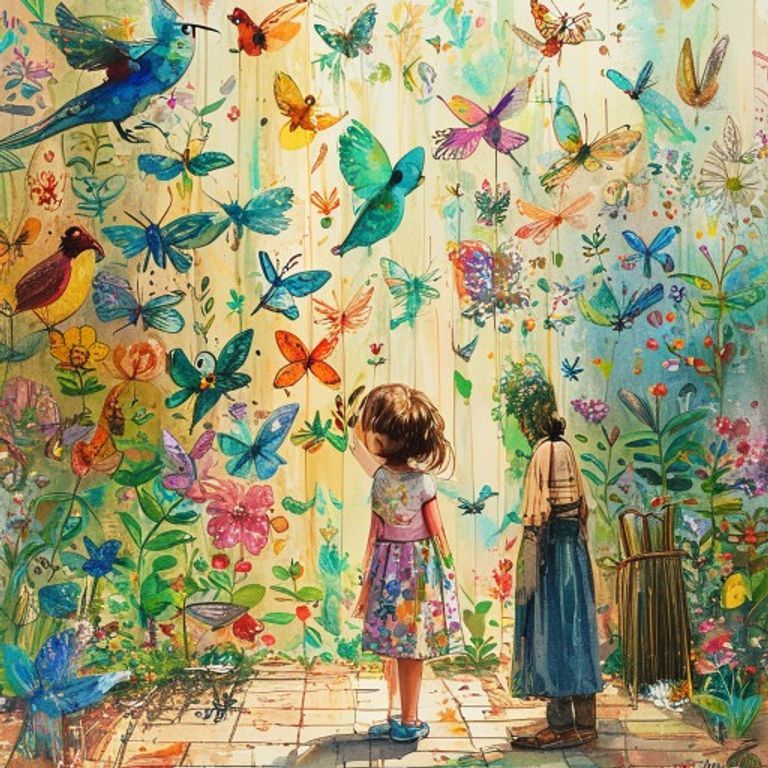
By noon, the entire wall was alive with color. Birds and blossoms, vines and dragonflies, a whole ecosystem of joy painted in chalk pastel that caught the sun and glowed like stained glass. Lila stepped back, her hands covered in rainbow dust, and felt a satisfaction so deep it made her dizzy.
"What," said a voice like grinding stones, "have you done?"
Lila turned. Old Man Thornberry stood behind her, his cane trembling in his hand, his face the color of old ashes. He was seventy years old, a retired sailor who had lost his wife to fever and his son to the sea. He lived alone in the big house, speaking to no one, tending his small garden with the dedication of a man who had nothing else to tend.
And now, Lila realized with a cold drop of horror in her stomach, he was looking at his wall. His wall, which she had painted without permission. His wall, which she had covered in birds and flowers while he was inside, unaware.
"I—" Lila began, but the words died in her throat.
Thornberry walked to the wall. He touched the painted owl with a finger that shook. He traced the vine of morning glories. He stood in silence for so long that Lila thought she might faint from the waiting.
Then he turned to her, and his eyes were wet. But not, she realized with confusion, with anger.
"My wife," he said, his voice softer now, almost breaking, "used to draw. On everything. The tablecloths. The walls of our first home. Our son's bedroom, she painted a whole ocean, with whales and mermaids and ships with purple sails. She said the world was too gray, and it was our job to add the color."
He touched the painted bird again. "When she died, I painted over everything. I couldn't bear to see the colors without her. I made everything white. White walls. White curtains. White plates. I thought if I removed the color, I could remove the pain."
Lila stood frozen, her chalks fallen from her fingers, scattered on the ground like broken rainbows.
"And now," Thornberry said, looking at the wall, at the garden she had created without asking, "you have brought the color back."
He did not smile. He did not say it was alright. He turned and walked into his house, and closed the door, and Lila was left alone with the wall and her terror and her confusion.
She ran home. She told her mother. She cried until her eyes were swollen and her ink-stained fingers were wrung raw.
"I ruined everything," she sobbed. "I ruined his wall. I reminded him of his wife. I made him sad. I didn't ask. I never asked. I just— drew."
Her mother held her, saying nothing for a long time. Then: "What will you do about it?"
"I can't fix it," Lila wailed. "The chalk is already set. It won't wash off. I ruined his wall forever."
"Not the wall," her mother said gently. "The man. The wall is just a wall. But you hurt a man who was already hurting. So what will you do about the man?"
Lila thought all night. She thought about Thornberry's white walls, his white curtains, his white plates. She thought about his wife painting oceans, his son sleeping beneath whales and mermaids. She thought about the color he had buried, and the pain he had tried to paint over, and the garden she had grown on his grief without permission.
In the morning, she made a decision.
She went to Thornberry's house with a bucket of soapy water and a scrubbing brush. She knocked on his door. When he opened it, his face was guarded, closed, a fortress of white.
"I'm sorry," Lila said. "I didn't ask. I should have asked. I got carried away. I always get carried away. But that doesn't make it right. I hurt you, and I'm sorry. I'll wash it off. I'll wash every bit of color off your wall, and I'll never draw on anything that isn't mine again. I promise."
Thornberry looked at her for a long time. Then he looked past her, at the wall, at the birds and flowers glowing in the morning sun.
"No," he said.
Lila blinked. "No?"
"No, you will not wash it off." He stepped past her, out into the garden, toward the wall. He touched the painted owl again. "I have lived in white for ten years. Ten years of nothing, of absence, of trying to erase the past by erasing the color. And in one morning, you have reminded me that color is not the enemy. Color is life. My wife knew that. I forgot."
He turned to Lila, and this time, he almost smiled. A small, rusty thing, like a hinge that hadn't moved in years. "But you did not ask. And that was wrong. Permission matters. Even when your heart is full of beauty, you cannot pour it onto someone else's life without invitation. Do you understand?"
Lila nodded, tears streaming down her face. "I understand. I'm sorry. I'm so sorry."
"I know," Thornberry said. "And I forgive you."
The words hit her like a wave. She had expected anger, punishment, a lecture that would ring in her ears for years. But forgiveness? It was so simple, so gentle, so completely unexpected that she didn't know what to do with it.
"You... forgive me?" she whispered.
"I forgive you," he repeated. "Not because what you did was right. It wasn't. Not because your drawing is beautiful. It is, but that doesn't matter. I forgive you because forgiveness is the only way to stop hurting. I have been angry at the world for ten years, Lila. Angry at death for taking my wife. Angry at the sea for taking my son. Angry at myself for surviving when they did not. Your drawing did not cause my pain. It simply reminded me that I was still carrying it. And forgiving you— forgiving a child who made a mistake out of too much enthusiasm and too little thought— it reminds me that I can forgive myself too. For surviving. For forgetting. For living in white when she would have wanted me to live in color."
He reached out, his weathered hand touching Lila's ink-stained fingers. "So yes. I forgive you. And I thank you. And I have a proposition."
"What?" Lila asked, still reeling.
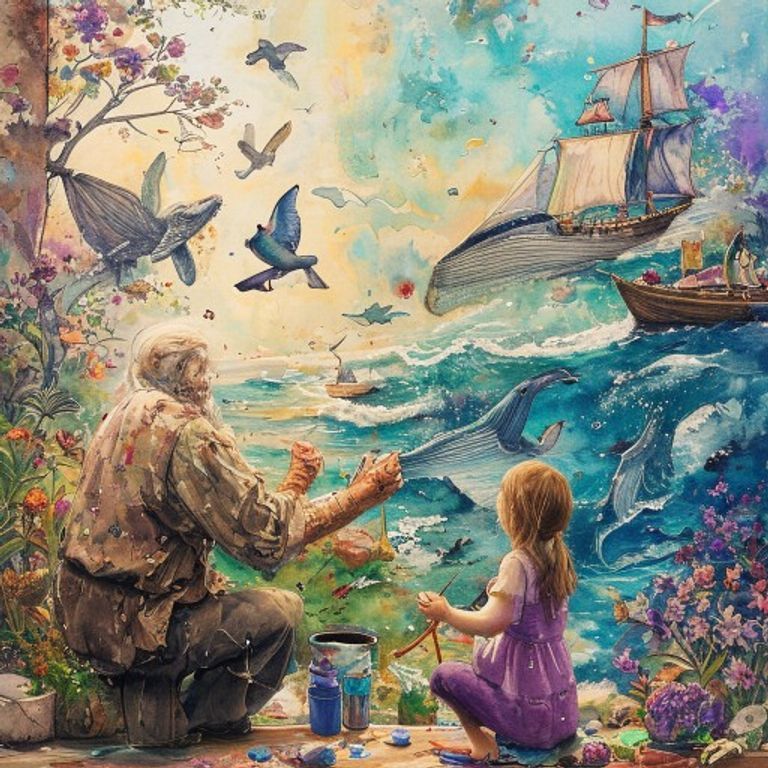
"The wall needs more," Thornberry said. "It needs the ocean. My wife's ocean, with the whales and mermaids and purple-sailed ships. I cannot draw. I have no gift for it. But you do. Will you finish what you started? Not because you are sorry. But because I am asking. Because I am giving you permission. Because I want my wall to be alive again."
Lila worked on the wall for three weeks. She painted in the mornings, before the sun grew too hot. Thornberry brought her lemonade and sandwiches and stories about his wife—her laughter, her terrible cooking, her habit of singing while she painted, her belief that every room needed at least one impossible thing.
"She would have loved you," Thornberry said, watching Lila paint a mermaid with hair the color of sea foam. "You have the same disorder. The same inability to see a blank surface and leave it alone."
The wall became magnificent. The left side was Lila's garden—birds and blossoms, butterflies and dragonflies. The right side was Thornberry's ocean—whales breaching, mermaids combing their hair on rocks, ships with sails in every shade of purple sailing toward a painted sun that never set. In the middle, where the garden met the sea, they painted together—Lila's hand guiding Thornberry's stiff fingers, teaching him to hold a brush, to mix colors, to see the world as something waiting to be made beautiful.
When it was finished, the whole village came to see. They brought food and music and dancing. Someone hung lanterns along the wall, and at night, the painted garden and ocean glowed like a dream, the birds and whales and mermaids alive in the flickering light.
Thornberry stood before his wall, holding Lila's hand, and for the first time in ten years, he wept not from loss but from fullness. The color had returned. The pain had not disappeared—it never does—but it had changed. It was no longer a white void, an erasure. It was a garden and an ocean, a celebration, a life that continued to bloom in memory of those who had planted it.
"Forgiveness," he said to Lila, as the villagers cheered and the lanterns swayed, "is not about saying that what happened was okay. It is about saying that you will not let what happened define you forever. You drew on my wall without asking. That was wrong. But if I had held onto my anger at you, I would still be living in white. Forgiveness is the door that lets the color back in. It is the choice to stop being a victim of your own pain. And it is the hardest, bravest, most beautiful thing a person can do."
Lila understood. She had come to Thornberry's wall as a thief, stealing space that was not hers, and she had left as an artist, invited, welcomed, transformed. But more importantly, she had learned that the most important canvas was not a wall. It was a heart. And the most beautiful thing you could draw on it was not a bird or a flower or even an ocean.
It was forgiveness.
Moral of the Story: Forgiveness is not about saying that what happened was okay. It is about choosing not to let what happened define you forever. Lila drew on Thornberry's wall without asking, and she hurt a man who was already carrying more pain than she could imagine. But when she apologized, truly and deeply, something remarkable happened. Thornberry forgave her—not because her drawing was beautiful, but because he realized that holding onto anger was keeping him trapped in a white, lifeless world. Forgiveness was the door that let the color back in. It did not erase the past. It simply refused to let the past erase the future. And in that refusal, in that brave choice to stop being a victim of his own pain, Thornberry found something he had lost: the courage to live in color again. Forgiveness is the hardest, bravest, most beautiful thing a heart can do. It is not a gift you give to the person who hurt you. It is a gift you give to yourself. It is the choice to open the door, to let the light in, to paint again.
Age Range: 4-8 years | Reading Time: ~10 minutes | Core Value: Forgiveness