The Shepherds Song: A Story About Humility
The Shepherd's Song: A Story About Humility
In the kingdom of Aurelia, where the mountains touched the clouds and the rivers sang as they flowed, there lived a young prince named Aldric who was the best at everything.
At least, that's what everyone told him. And what everyone tells you, especially when you are young and golden-haired and the son of a king, tends to become what you believe.
Aldric was nine years old, small for his age but quick as a fox. He could ride a horse better than the stable master, shoot a bow better than the captain of the guard, recite poetry better than the court bard, and solve mathematics better than the royal accountant. He had never met a puzzle he could not solve, a game he could not win, or a skill he could not master within a week.
The kingdom adored him. The people cheered when he rode through the streets. The servants smiled when he passed. The tutors praised him with glowing words that landed like warm honey in his ears. "A natural talent," they said. "A gift from the heavens." "The finest prince Aurelia has ever known."
Aldric believed them. He began to believe that his excellence was not the result of practice or effort or the sheer luck of birth, but of some inherent superiority that made him special, chosen, destined for greatness. He looked at other children—children who struggled with horses, who fumbled with bows, who stumbled over poems—and felt not compassion but contempt. Why couldn't they be more like him? Why couldn't they simply try harder?
"You are extraordinary," his father, the king, told him one evening, clapping a hand on Aldric's shoulder. "One day, you will rule this kingdom, and they will sing your name for a thousand years."
Aldric smiled, already imagining the songs.
The trouble began when the annual Festival of Talents was announced. It was a tradition in Aurelia, older than the castle itself. Every child in the kingdom, from farmhands to nobles, was invited to demonstrate a skill before the royal court. The winner would receive the Golden Laurel, a crown of woven gold leaves, and more importantly, the title of Champion of Aurelia until the next festival.
Aldric had won the Golden Laurel three years in a row. He expected to win a fourth. He did not prepare. He did not practice. He simply selected his demonstration—a complex sword routine that the captain of the guard had taught him—and waited for the day to arrive, certain that his natural brilliance would carry him to victory as it always had.
The festival began at dawn. The great hall of the castle filled with children and parents, farmers and lords, all gathered to watch the demonstrations. Aldric sat on the royal balcony, his legs dangling over the edge, eating grapes and watching the competitors with a smirk.
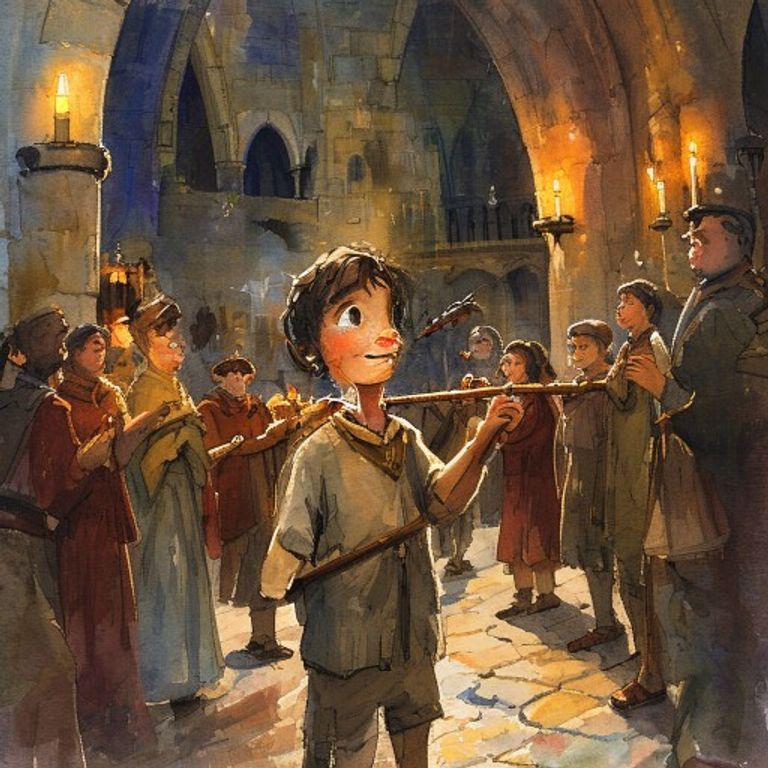
A girl from the northern villages demonstrated weaving. Her fingers moved like spiders spinning silk, creating patterns so intricate that the court seamstress leaned forward in wonder. Aldric yawned.
A boy from the eastern farms demonstrated plowing. He guided a team of oxen through a miniature field with such precision that every furrow was perfectly straight. The royal gardener nodded in approval. Aldric rolled his eyes.
A child from the southern fisherfolk demonstrated net-mending. Their hands moved in a blur, repairing tears in a fishing net so complex that the royal admiral asked to inspect their work. Aldric ate another grape.
And then a boy walked into the hall who Aldric had never seen before.
He was thin as a reed, with dark hair that fell over his eyes and hands that looked too large for his wrists. He wore clothes that were clean but patched, the garments of a farmer's son. He carried no sword, no bow, no tool of any kind. He carried only a wooden flute.
"Who is that?" Aldric asked the captain of the guard.
"Tomas," the captain said. "From the western valley. His family tends sheep."
"A shepherd?" Aldric laughed. "What could a shepherd possibly demonstrate? Counting sheep without falling asleep?"
The captain did not laugh. He looked at Tomas with an expression Aldric could not read. "Wait," he said. "Just wait."
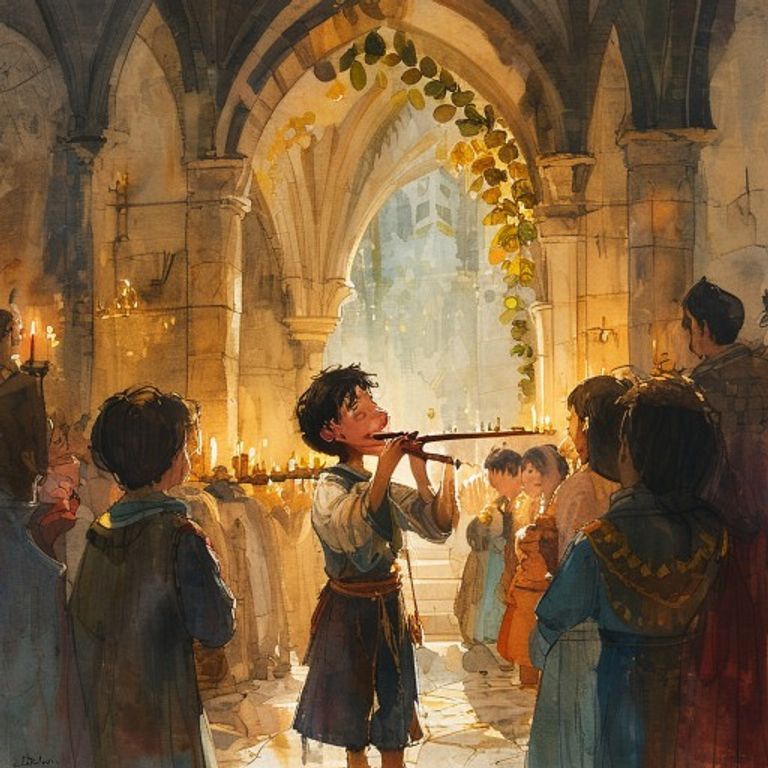
Tomas stepped to the center of the hall. He did not bow to the king. He did not look at the crowd. He simply raised his flute to his lips and began to play.
The sound that emerged was not music as Aldric understood it. It was not the formal compositions of the court bard, structured and predictable, pleasing but forgettable. It was something else entirely. It was the sound of wind through mountain passes. It was the song of rivers over stones. It was the cry of hawks and the whisper of snowfall and the creak of ancient trees.
Tomas played, and the hall fell silent. The chatter stopped. The rustling stopped. Even the dogs lying by the fire stopped panting. The music wrapped around the listeners like a warm blanket, like cool water, like the embrace of something vast and ancient and loving.
Aldric felt tears on his cheeks. He did not know when he had started crying. He looked around and saw that others were crying too—the stern-faced guards, the gossiping ladies, his own father the king, whose eyes were wet with memories Aldric could not know.
Tomas played for ten minutes. When he stopped, the silence held for a long moment, trembling like a held breath. Then the hall erupted. The applause was thunderous. People stood, cheering, weeping, calling for an encore. The king himself descended from his throne to embrace the shepherd boy, something he had never done for any festival winner, not even Aldric.
Aldric sat on the balcony, his grapes forgotten, his smirk vanished. He felt something he had never felt before. It was not jealousy, though jealousy was part of it. It was not anger, though anger flickered in his chest. It was a vast, hollow emptiness, as if he had been living in a beautiful room and only now realized that the room had no windows, and the world outside was enormous.
He had spent his life being the best. He had practiced and trained and honed his skills with dedication that he had mistaken for destiny. But Tomas had not played the flute with skill. He had played it with something else, something Aldric did not have and did not understand.
The Golden Laurel was awarded to Tomas. The shepherd boy accepted it with a bow so humble it seemed almost embarrassed. He did not smile. He did not boast. He simply tucked the laurel under his arm, picked up his flute, and walked out of the hall as quietly as he had entered.
Aldric did not sleep that night. He sat in his room, staring at the swords and trophies and ribbons that covered his walls, and felt for the first time that they meant nothing. He could ride a horse. He could shoot a bow. He could recite poems and solve equations. But he could not do what Tomas had done. He could not touch people's hearts. He could not make them weep with beauty. He could not, in the end, make them feel.
The next morning, Aldric did something he had never done before. He asked his father for permission to leave the castle. He wanted to visit the western valley. He wanted to find Tomas.
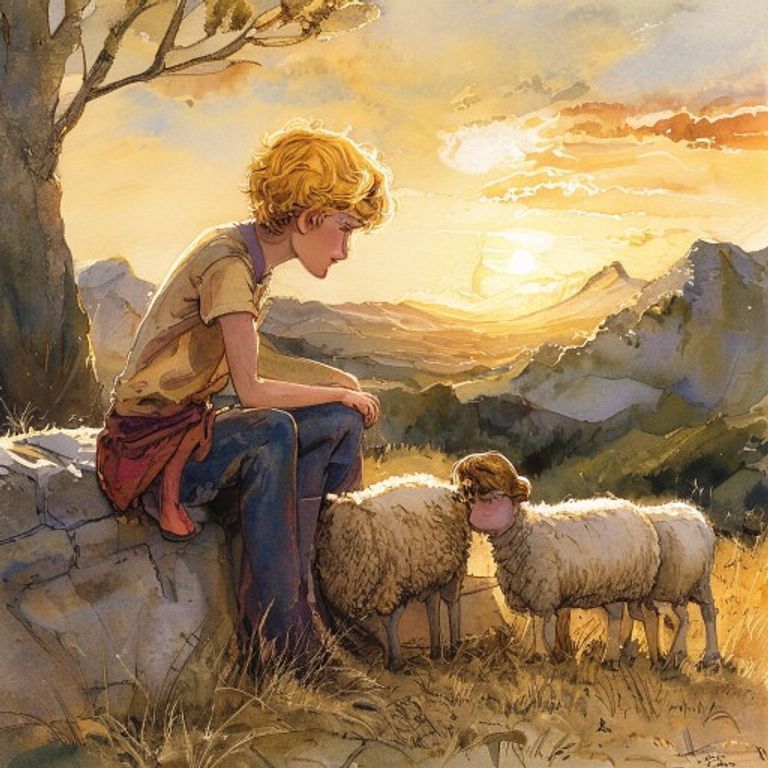
The king, still moved by the music, agreed. Aldric rode west for half a day, through forests and across streams, until he reached a valley where sheep grazed on hillsides like scattered clouds. He found Tomas sitting on a stone wall, playing his flute for the sheep. The animals stood in a semicircle, listening, their ears twitching in time with the melody.
Tomas stopped playing when he saw Aldric. He stood, bowing awkwardly. "Your Highness," he said. "I did not expect—"
"Teach me," Aldric interrupted.
Tomas blinked. "Teach you what?"
"To play. The way you played. Not the notes. I can learn notes. I need to learn..." Aldric struggled for words. "Whatever it is that you know."
Tomas studied the prince for a long moment. Then he smiled, a gentle, sad smile. "I cannot teach you that, Your Highness."
"Why not?" Aldric demanded, his old arrogance flaring. "I am the best student in Aurelia. I can learn anything."
"That," Tomas said softly, "is why I cannot teach you."
Aldric felt the words like a slap. "What do you mean?"
Tomas sat back down on the wall, his flute resting in his lap. "I play the way I play because I know that I am small. I know that the mountains were here before me and will be here after. I know that my music is not mine—it belongs to the wind, to the rivers, to the sheep, to everything that ever was. I am just a vessel. A hollow reed that the world blows through."
He looked at Aldric with eyes that held no judgment, only truth. "You play—if you played—like you are the source. Like the music comes from your greatness. But greatness is not a well that we draw from. It is a river that flows through us. The moment we think we own it, the moment we think we are special, the river dries up."
Aldric sat on the wall beside Tomas, his royal cloak dragging in the dust. "So you are saying I cannot be great because I think I am great?"
"I am saying," Tomas replied, "that you cannot be great because you think greatness is about being better than others. True greatness is about being honest. About knowing how small you are, and letting the world be large through you."
Aldric sat in silence, watching the sheep graze. He thought of all his trophies, all his victories, all his effortless superiority. He had been a golden vessel, sealed and perfect, containing nothing but his own reflection. Tomas was a cracked cup, humble and broken, but through his cracks, the whole world poured.
"How do I learn this?" Aldric asked, his voice small.
"You already have," Tomas said. "The moment you asked to learn, you began. Humility is not a skill you master. It is a door you open. You have cracked yours. Now walk through."
Aldric stayed in the valley for three days. He did not learn to play the flute. He learned to listen. He learned to sit with the sheep and feel the wind and hear the rivers. He learned that the world was not a stage for his greatness, but a symphony in which he was one small note.
When he returned to the castle, he was changed. He still rode horses and shot bows and recited poems, but he practiced now with gratitude rather than arrogance. He thanked his tutors. He complimented his rivals. He visited the villages and listened to the farmers and the weavers and the fisherfolk, learning that their knowledge was as deep and valuable as any in the royal library.
He never won the Golden Laurel again. But he became, in time, the finest king Aurelia had ever known. Not because he was the best at everything, but because he had learned that the best thing he could be was humble.
Moral of the Story: Humility is not about thinking you are less than others. It is about knowing that greatness is not a well you draw from, but a river that flows through you. Aldric spent his life believing that his excellence made him special, that his victories were proof of his superiority. But when he heard Tomas play, he realized that true greatness comes not from being better than others, but from being honest about how small you are, and letting the world be large through you. The moment we think we own our gifts, the moment we believe we are the source of our own brilliance, the river dries up. Humility is the cracked cup through which the whole world pours. So when you are praised, remember the wind that carried you. When you succeed, thank the teachers who shaped you. When you are told you are extraordinary, remember that you are one note in a symphony older than mountains. True greatness is not about being the best. It is about being grateful for the chance to play at all.
Age Range: 4-8 years | Reading Time: ~10 minutes | Core Value: Humility