The Berry Thiefs Truth: A Story About Justice
In the heart of the Verdant Valley, where wildflowers painted the hills in strokes of purple and gold, there lived a community of animals who had always managed to live together in harmony. The valley was home to creatures of all shapes and sizes: rabbits, foxes, deer, birds, and even the occasional wandering bear. They shared the meadow's bounty, respected each other's territories, and celebrated the changing seasons together.
But one autumn, when the harvest moon hung low and heavy in the sky, something strange began to happen.
The wild berries—the ones that grew along the eastern ridge, which every animal in the valley depended upon for winter sustenance—began to disappear.
Not all at once. Not in a single night. But slowly, steadily, as if some invisible thief were creeping through the bushes under cover of darkness, taking more than their share.
At first, the animals didn't notice. A rabbit might find a bush slightly less full than she remembered. A deer might notice fewer clusters hanging from the lower branches. A fox might sniff the air and catch the scent of berries that had been there yesterday but were gone today.
But as the days passed, the disappearances became impossible to ignore.
By the time the first frost painted the meadow silver, the eastern ridge was nearly bare. Bushes that should have been heavy with fruit stood empty, their branches rattling in the cold wind like skeleton fingers.
The animals gathered at the Old Oak, the ancient tree that stood at the center of the valley and had served as their meeting place for generations.
"Someone is stealing our berries," said Hazel, a red squirrel whose winter stores were already dangerously low. "I've watched the bushes for three nights. Each morning, more are gone."
"It must be the deer," muttered Thorn, a bristly hedgehog. "They're the only ones tall enough to reach the highest branches."
"How dare you!" snapped a young buck named Rowan. "We deer eat grass and leaves, not berries. Why would we take what doesn't belong to us?"
"Maybe it's the rabbits," suggested a crow named Obsidian. "There are so many of them, and they breed like—well, like rabbits. They're probably gathering everything they can carry."
The rabbits, led by a gray doe named Clover, bristled with indignation. "We would never!" Clover cried. "We eat clover and dandelions, not berries. Besides, we have our own winter stores. We don't need to steal from anyone."
The accusations flew back and forth like arrows. The foxes blamed the badgers. The badgers blamed the mice. The mice blamed the birds. The birds blamed everyone.
Tensions rose. Fences appeared—thorny barriers of bramble and thistle that divided the meadow into territories. Animals who had been friends for years stopped speaking to each other. The valley, once a place of harmony and cooperation, became a landscape of suspicion and fear.
And still, the berries disappeared.
One evening, as the sun painted the western hills in shades of amber and rose, a young rabbit named Pip sat alone by the stream that ran through the center of the valley. Pip was small for his age, with ears that were slightly too long and a habit of twitching his nose when he was nervous.
Pip had been thinking. Thinking hard.
He knew the rabbits weren't stealing the berries. He knew because he had been watching. Not watching to catch a thief, but watching because he was curious. Pip had always been curious—too curious, his mother often said, for his own good.
And what Pip had seen didn't make sense.
He had seen tracks in the soft earth near the berry bushes. Not rabbit tracks. Not deer tracks. Not fox tracks or badger tracks or any tracks he recognized.
He had seen broken twigs and scattered leaves, as if something large had pushed through the undergrowth.
And once, just once, he had caught a glimpse of something in the moonlight: a shadow, tall and broad, moving silently between the bushes.
But Pip hadn't told anyone. Who would believe a small rabbit with too-long ears and a nervous twitch?
As Pip sat by the stream, watching the water ripple over smooth stones, he heard a voice behind him.
"You look troubled, little one."
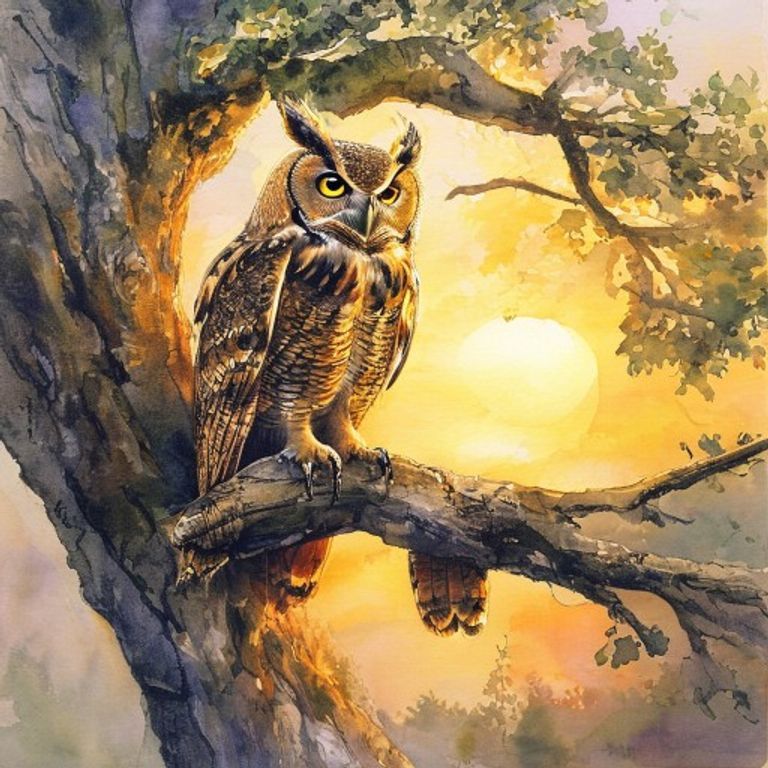
Pip turned. Standing on the bank was an owl. Not just any owl, but the oldest, wisest owl in the valley. Her name was Solstice, and she had lived in the Great Oak for as long as any animal could remember. Her feathers were the color of autumn leaves—gold and brown and russet—and her eyes were the deep amber of honey.
"I... I'm thinking about the berries," Pip said.
"As are we all," Solstice replied, settling onto a low branch. "The valley has never known such discord. Friends have become strangers. Neighbors have become enemies. All because of a few missing berries."
"But that's just it," Pip said, his nose twitching furiously. "I don't think it's a few. And I don't think it's us."
Solstice tilted her head. "What do you mean?"
Pip told her everything. The tracks. The broken twigs. The shadow in the moonlight. "Something else is taking the berries," he finished. "Something that doesn't belong in the valley. But no one will listen. They're too busy blaming each other."
Solstice was silent for a long moment. Then she spread her wings and rose into the air. "Come, Pip. We have work to do."
The next morning, Solstice called a gathering at the Old Oak. The animals came, though many came with reluctance, their eyes narrowed with suspicion.
"I have called you here," Solstice began, her voice carrying across the meadow, "because I believe we have been blaming the wrong creatures for our troubles."
A murmur rippled through the crowd.
"What do you mean?" Hazel demanded. "Are you saying the thief isn't among us?"
"I am saying," Solstice replied, "that we have been so eager to find a culprit that we have forgotten to look for the truth. We have accused our neighbors, our friends, our families—without evidence, without proof, without justice."
She turned her amber eyes on the crowd. "Justice is not about punishment. Justice is about truth. And the truth is that something else is taking our berries. Something that comes in the night. Something that leaves tracks unlike any in our valley."
Pip stepped forward. "I've seen the tracks," he said, his voice small but steady. "Near the eastern ridge. They're big. Bigger than any of us. And they lead toward the northern hills."
The animals exchanged glances. The northern hills were wild country, home to creatures that rarely ventured into the valley: wolves, bears, and other animals that the valley dwellers feared.
"Tonight," Solstice said, "we will not accuse. We will not blame. We will watch. And we will learn."
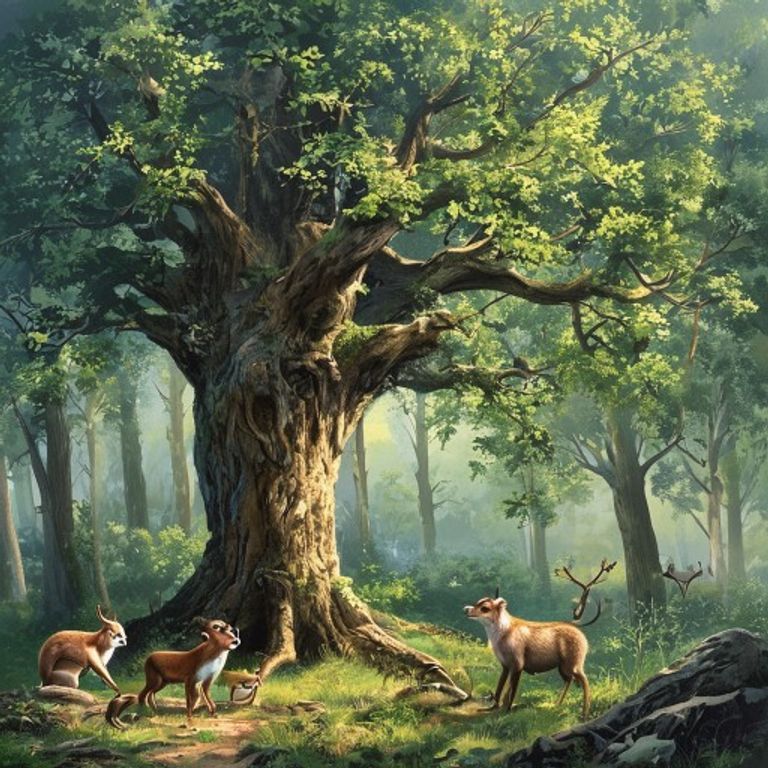
That night, under a silver moon, a group of animals gathered near the eastern ridge. Solstice had chosen them carefully: Pip the rabbit, Rowan the deer, Thorn the hedgehog, Clover the doe, and Obsidian the crow. They represented the species that had been most at odds, the ones who had built fences and thrown accusations.
They waited in silence.
Hours passed. The moon climbed higher. The stars wheeled overhead. The animals shivered in the cold, their breath misting in the air.
And then, just as the moon began to set, they heard it: a rustling in the bushes. A snapping of twigs. The soft thud of heavy footsteps.
A shape emerged from the darkness.
It was a bear. A young bear, barely more than a cub, with fur the color of midnight and eyes that gleamed like wet stones in the moonlight.
The bear moved slowly, carefully, plucking berries from the bushes with surprising gentleness. He filled a small sack—a sack made of woven grass, clearly crafted by careful paws—and then turned toward the northern hills.
"Wait," Solstice called, gliding down from her perch.
The bear froze. His eyes widened. He dropped the sack and prepared to run.
"We will not hurt you," Solstice said softly. "We only wish to understand."
The bear hesitated. Then, slowly, he turned back. "I... I'm sorry," he said, his voice a low rumble. "I didn't mean to cause trouble."
"Why are you taking our berries?" Thorn demanded, his spines bristling.
The bear looked down at his paws. "My mother is sick. She cannot hunt. She cannot forage. The northern hills are bare this year—the frost came early, and the berries withered. I came to the valley because I heard there was food here. I didn't know... I didn't know I was stealing. I thought the berries belonged to no one."
Silence fell over the meadow.
Pip stepped forward. "You didn't know," he said. "But now you do. The berries belong to all of us. We need them to survive the winter, just as your mother does."
The bear nodded, his eyes glistening. "I understand. I will go. I will find another way."
"Wait," Solstice said. She turned to the gathered animals. "This young bear took our berries because he was desperate. Because his mother was sick. Because he had nowhere else to turn. He did not act out of malice. He acted out of love."
She looked at each animal in turn. "We have spent weeks accusing each other. We have built fences and fostered hatred. All because we assumed the worst of our neighbors. But the truth was not what we expected. The truth was that a stranger, a creature from the wild, was acting out of desperation."
"What should we do?" Clover asked.
Solstice spread her wings. "We should do what is just. We should not punish this bear for trying to save his mother. But we also cannot let him take what we need to survive."
She turned to the bear. "You will stop taking the berries. But we will help you. We will share what we can spare. And we will teach you how to find food in the valley without taking from others."
The bear's eyes widened. "You would do that? Even though I stole from you?"
"Justice is not about punishment," Solstice said. "Justice is about making things right. You made a mistake, but you did so out of love. We can understand that. And we can help you find a better way."
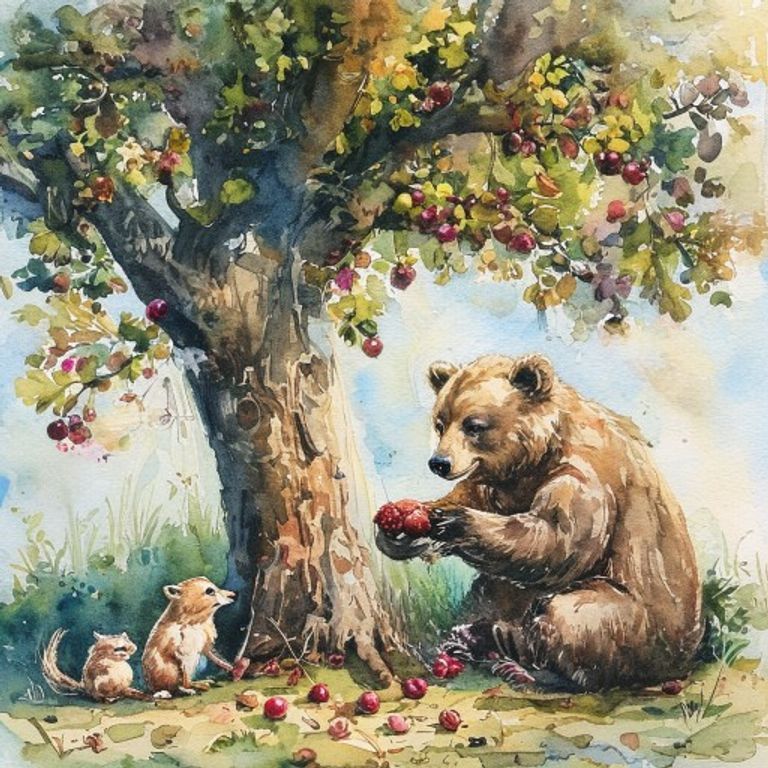
In the days that followed, the valley changed.
The fences came down. The animals began to talk again, to share again, to trust again. They gathered extra berries—more than they needed—and gave them to the bear for his mother. They taught him which plants were safe to eat, where to find fish in the stream, how to gather nuts and roots.
The bear, whose name was Ash, became a friend to the valley. He helped the beavers move logs. He protected the smaller animals from predators. He became a guardian, a helper, a neighbor.
And his mother? She recovered, thanks to the nourishment the valley provided and the care of a young deer named Rowan, who knew which herbs could heal a sick bear.
On the night of the first snowfall, the animals gathered at the Old Oak for a celebration. The berry bushes were bare now, but the stores were full. The valley was at peace. And a young bear stood among them, accepted and loved.
Solstice looked out over the gathering, her amber eyes warm. "You see?" she said. "Justice is not about being right. Justice is about making things right. We could have punished Ash. We could have driven him away. But instead, we chose understanding. We chose compassion. We chose to make things right—for him, for his mother, and for ourselves."
Pip sat at the base of the Old Oak, his long ears twitching with happiness. He had been right to be curious. He had been right to watch. And most of all, he had been right to speak up.
"Justice," Solstice said, her voice carrying across the snow-covered meadow, "is the courage to seek the truth, even when the truth is not what we expect. It is the wisdom to understand, even when understanding is hard. And it is the heart to forgive, even when forgiveness seems impossible."
The animals cheered, their voices rising into the winter sky like song.
And in the valley of Verdant, where wildflowers would bloom again in spring, justice had been served—not with punishment, but with love.
Justice, little ones. Justice.
The End