The Patchwork Rescue: A Story About Diversity
In the heart of Willowbrook Valley, where wildflowers painted the hills in strokes of purple and gold, there lay a meadow known to all the animals as Thornberry. It was not the largest meadow, nor the greenest, nor the most famous. But it was the most unusual.
For in Thornberry Meadow, every creature was different.
Not just different in the way that all creatures are different—different in ways that made them stand out, that made other animals pause and stare, that made them wonder if they belonged.
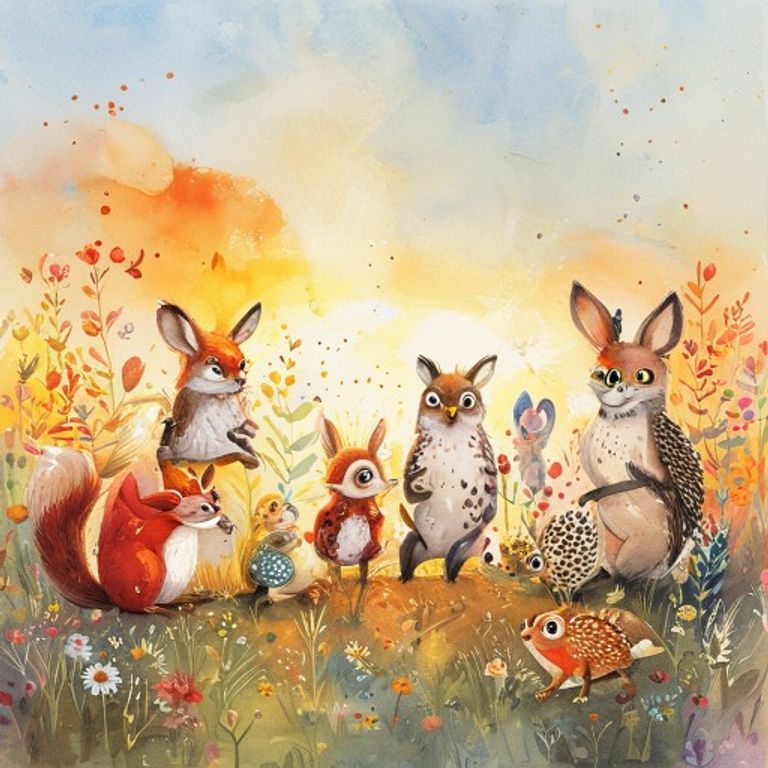
There was Kip, a red squirrel who collected shiny things. Not acorns, like other squirrels. Not seeds, not nuts. Shiny things. Bottle caps lost by hikers. Polished pebbles from the stream. Bits of broken mirror that caught the sunlight and scattered it like stars. Other squirrels thought Kip was strange. "Why collect trash?" they would whisper. But Kip couldn't help it. He saw beauty in what others overlooked.
There was Wren, a small brown bird whose left wing had healed crooked after a hawk attack. She couldn't fly as fast as the other birds, couldn't soar as high, couldn't migrate south when winter came. She stayed in Thornberry while the others left, hopping along branches, flapping in short bursts, finding her own way through the world.
There was Mottle, a frog whose spots were not the usual green-on-green of other frogs, but patches of gold and blue and orange, like someone had spilled a painter's palette across his back. The other frogs at the pond called him "Rainbow," which wasn't unkind, but wasn't exactly friendly either. Mottle spent most of his time alone, sitting on his lily pad, watching the dragonflies.
There was Thistle, a young hedgehog whose quills were softer than they should be. Instead of the sharp, protective spines that kept other hedgehogs safe from foxes and badgers, Thistle's quills were like hairbrush bristles—firm, but not dangerous. Thistle couldn't curl into a spiky ball like his brothers and sisters. He had to run faster, hide better, think smarter.
There was Dash, a rabbit who hopped sideways. No one knew why. From birth, Dash's back legs had worked differently from other rabbits, sending him in arcs and curves instead of straight lines. He bumped into trees. He missed his burrow entrance. He was the last to reach safety when predators came. The other rabbits sighed and shook their heads.
There was Bramble, a young fox with a tail so bushy it dragged on the ground behind him. Other foxes had sleek, elegant tails that helped them balance when they ran. Bramble's tail was a burden, catching on brambles, tripping him when he chased mice, making him the slowest fox in the valley.
And watching over all of them was Sage, an old owl with one golden eye and one silver eye, who lived in the hollow of an ancient oak at the meadow's edge.
Sage was different too, of course. But Sage was old, and old creatures are allowed to be different. It is the young who are expected to fit in.
For years, the animals of Thornberry Meadow had lived their separate lives. Kip collected his shiny things in a hollow tree. Wren hopped from branch to branch. Mottle sat on his lily pad. Thistle hid in the undergrowth. Dash zigzagged across the grass. Bramble dragged his tail through the dust. They were neighbors, but not friends. They were aware of each other, but not connected.
Until the Drought came.
It started with the stream.
The stream that ran through Thornberry Meadow had flowed for as long as any animal could remember. It was not a large stream, but it was reliable. It provided water for drinking, for bathing, for the fish that swam in its deeper pools. It fed the wildflowers and the berry bushes and the grass that sustained the meadow's many creatures.
But one summer, the rains did not come.
At first, the stream merely slowed. Then it shrank. Then it became a trickle, a thread of water barely wide enough for a frog to swim in.
And then, one morning in late August, the stream stopped flowing altogether.
The animals gathered at its dry bed, staring at the cracked mud where water had once danced.
"What do we do?" Kip asked, clutching a shiny pebble so tightly his paws shook.
"We dig," said Thistle, who had been digging his whole life. "There must be water underground. If we dig deep enough—"
"I've already tried," said Mottle, his rainbow spots looking dull in the harsh sunlight. "The mud at the bottom of the pond is as dry as dust. I dug until my paws were sore. Nothing."
"The other animals are leaving," Wren said, hopping onto a dry rock. "The sparrows flew north to the big lake. The deer have gone to the river valley. Even the ants are marching away."
"We can't leave," Dash said, his sideways hop carrying him in a circle. "This is our home. I know every bump and tree and hiding spot in this meadow. If I leave, I'll just be... a sideways-hopping rabbit in a world of straight-hopping rabbits."
"And I'll be a soft-quilled hedgehog in a world of sharp-quilled ones," Thistle added. "Where will we hide? How will we survive?"
The animals fell silent, each thinking their own thoughts of fear and loneliness.
It was Bramble who spoke next. "Sage," he said, his bushy tail sweeping the dust. "Sage will know what to do. Sage knows everything."
They found the old owl in his hollow, his mismatched eyes gleaming in the darkness.
"The stream is gone," Kip said.
"I know," Sage replied.
"The other animals are leaving," Wren added.
"I know."
"We can't leave," Dash said. "We wouldn't survive out there. We're too... different."
Sage turned his head, his golden eye catching the sunlight, his silver eye reflecting the shadows. "Different," he said slowly. "Yes. You are all different. And for years, you have thought this was a weakness. A flaw. Something to hide or apologize for."
He hopped down from his perch, his old wings spreading wide, and landed before them with a soft thump.
"But I have watched you," he continued. "I have watched Kip collect things that others throw away. I have watched Wren find paths through the trees that no flying bird would notice. I have watched Mottle sit so still that dragonflies land on his nose. I have watched Thistle squeeze through gaps that would trap a spikier hedgehog. I have watched Dash zigzag through brambles that would catch a straight-hopping rabbit. I have watched Bramble use that magnificent tail to sweep away leaves and uncover hidden food."
Sage looked at each of them in turn, his mismatched eyes seeing things they could not see in themselves.
"You are not flawed," he said. "You are specialized. You are unique. And right now, the meadow needs exactly what you are."
"What do you mean?" Mottle asked, his rainbow spots catching a shaft of sunlight.
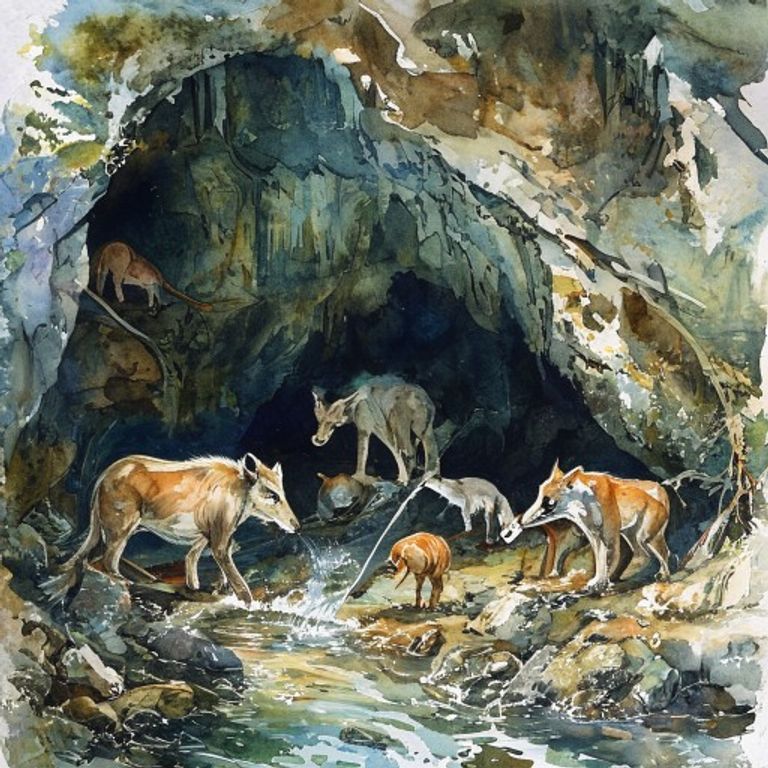
"I mean," Sage said, "that the water is not gone. It has merely gone... elsewhere. Deep underground, where the sun cannot reach it. Hidden in pockets beneath the roots of ancient trees. Trapped in limestone caves that run beneath the valley. The water is there. But finding it will require skills that ordinary animals do not possess."
He spread his wings, one golden, one silver, in the dappled light.
"It will require," he said, "a squirrel who notices what others overlook. A bird who knows every branch and hollow. A frog who can sense moisture through the mud. A hedgehog who can squeeze into narrow places. A rabbit who can navigate where others cannot. And a fox whose tail can clear the way."
The animals looked at each other. For the first time, they did not see their differences as flaws. They saw them as... possibilities.
"What do we do first?" Kip asked, his eyes bright.
Sage smiled. "First, you work together."
They started at dawn.
Kip led the way, his sharp eyes scanning the ground for signs that others missed. A patch of slightly greener grass. A stone with damp moss on one side. A beetle walking in an unusual direction.
"Water leaves traces," Sage had told him. "Even when it is hidden, it changes the world around it. And you, Kip, are the best in the meadow at noticing small changes."
Kip found the first clue: a cluster of ferns growing greener than the rest, their fronds curling in a pattern that suggested moisture below. He marked the spot with one of his shiny pebbles, a blue one that caught the light.
"Here," he said. "There's water here. I can feel it."
Thistle stepped forward. His soft quills, which had always been a source of shame, now became an advantage. He could squeeze into gaps between rocks, tunnel through narrow passages, explore spaces that a spikier hedgehog could never enter.
He dug. And dug. And dug.
His paws were sore. His nose was dusty. But he dug.
And at two feet down, he found wet mud.
"It's here!" he called, his voice muffled by the earth. "There's water here!"
But it was deep. Too deep for Thistle to reach. And the passage was narrow, too narrow for the larger animals.
"I can help," Wren said.
She couldn't fly well, but she could hop. And she could hop into spaces that flying birds would never think to enter. She hopped down into the hole Thistle had dug, her crooked wing folding tight against her body, and explored the tunnel beyond.
"It opens up," she called back. "There's a cave down here! But it's dark. I can't see the water."
"I can help," Mottle said.
He squeezed into the hole, his colorful spots disappearing into the darkness. Frogs can sense moisture through their skin, feeling the humidity in the air like a compass feels north. Mottle closed his eyes and let his skin guide him.
"This way," he said, his voice echoing in the cave. "The water is this way."
But the cave was blocked. A fall of rocks, centuries old, sealed the passage to the underground pool.
"I can help," said Dash.
His sideways hop, which had always made him the clumsiest rabbit in the meadow, turned out to be perfect for navigating the uneven floor of the cave. He could hop around rocks, angle past stalagmites, reach places that a straight-hopping rabbit would crash into.
He reached the rockfall. But the stones were too heavy for him to move.
"I can help," said Bramble.
His bushy tail, which had always tripped him up, became a tool. He swept it across the ground, clearing smaller stones. He wedged it into gaps, using it as a lever. He wrapped it around rocks, pulling them away.
But some stones were too large even for Bramble.
"I can help," said a voice from above.
Sage, the old owl, spread his wings and descended into the cave. His golden eye gleamed in the darkness. His silver eye caught the faint moisture in the air.
"Together," he said. "Bramble, clear the small stones. Dash, navigate the gaps. Mottle, sense the water's direction. Wren, guide us with your voice. Thistle, squeeze into spaces and push from within. Kip, watch for signs and mark our progress."
The animals moved as one.
Bramble swept. Dash hopped. Mottle sensed. Wren called directions. Thistle pushed. Kip watched and placed his shiny pebbles like breadcrumbs, marking the path to water.
And Sage? Sage held the darkness at bay, his mismatched eyes seeing what others could not, his ancient wisdom guiding every move.
Hours passed.
The sun climbed high, then began to descend.
The animals were exhausted. Their paws were sore. Their wings were tired. Their hearts were pounding.
But they did not stop.
Because they were not seven different animals working alone.
They were one team, moving as one creature, each part essential, each part unique.
And then—
"I feel it!" Mottle cried. "Water! It's right here!"
Thistle pushed one final stone. It rolled away, revealing a crack in the cave floor.
And from that crack, water began to seep.
A trickle at first. Then a flow. Then a small stream, bubbling up from the depths, filling the cave with the sweetest sound any of them had ever heard.
The water found the path Kip had marked with his pebbles. It followed the tunnel Thistle had dug. It reached the surface, bursting into the sunlight, flowing across the dry streambed, filling the pond, feeding the meadow.
The animals of Thornberry Meadow cheered.
Cheered until their voices were hoarse. Cheered until the other meadows heard them and wondered what had happened. Cheered until the sun set and the stars came out and the new stream sang them to sleep.
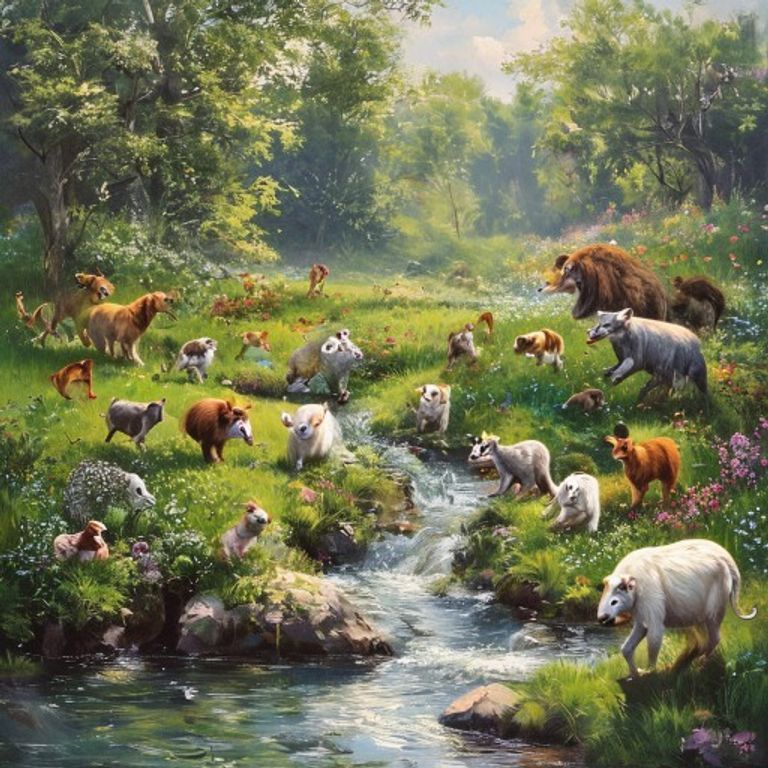
In the weeks that followed, Thornberry Meadow changed.
Not the meadow itself—the grass was still green, the flowers still colorful, the trees still ancient. But the animals changed.
Kip didn't hide his shiny collection anymore. He displayed it proudly in his hollow tree, and other animals came to marvel at the beauty he had found in forgotten things.
Wren didn't apologize for her crooked wing anymore. She taught other birds the paths she had discovered, the shortcuts through branches, the safe routes that only a hopping bird could navigate.
Mottle didn't hide his rainbow spots anymore. He sat in the center of the pond, a splash of color among the lily pads, and the other frogs admitted that he was the most beautiful creature they had ever seen.
Thistle didn't avoid other hedgehogs anymore. He showed them the narrow passages he could squeeze through, the hidden places he could reach, the advantages of being soft in a world that expected hardness.
Dash didn't try to hop straight anymore. He embraced his sideways arcs, his zigzag patterns, his unique way of moving through the world. And he discovered that he could navigate mazes that trapped straight-hopping rabbits.
Bramble didn't drag his tail in shame anymore. He used it proudly, sweeping paths through snow, clearing leaves from dens, helping others find what was hidden.
And Sage? Sage watched them all, his mismatched eyes gleaming with pride.
"You see?" he said one evening, as the animals gathered by the restored stream. "The meadow did not need seven ordinary animals. It needed seven unique ones. It needed Kip's eye for the overlooked. Wren's knowledge of hidden paths. Mottle's sensitivity to change. Thistle's ability to squeeze through the impossible. Dash's zigzag navigation. Bramble's sweeping strength."
He looked at each of them, his golden eye warm, his silver eye wise.
"Diversity is not a flaw to be fixed. It is a strength to be celebrated. When we are all the same, we can only do what one of us can do. But when we are different—truly different, each with our own gifts and perspectives and abilities—we can do what no one of us could ever do alone."
He spread his wings, one catching the sunset, one holding the shadows.
"The stream was saved not because you were all the same. The stream was saved because you were all different. And together, your differences became your greatest power."
The animals looked at each other—really looked—for the first time.
They saw not flaws, but features. Not weaknesses, but wonders. Not mistakes, but magic.
And as the stars came out, they sat together by the stream, seven different creatures, one united family, in a meadow that was unlike any other.
Because in Thornberry Meadow, being different was not just accepted.
It was celebrated.
Diversity, little ones. Diversity.
The End