The Garden of Wonders: A Story About Creativity
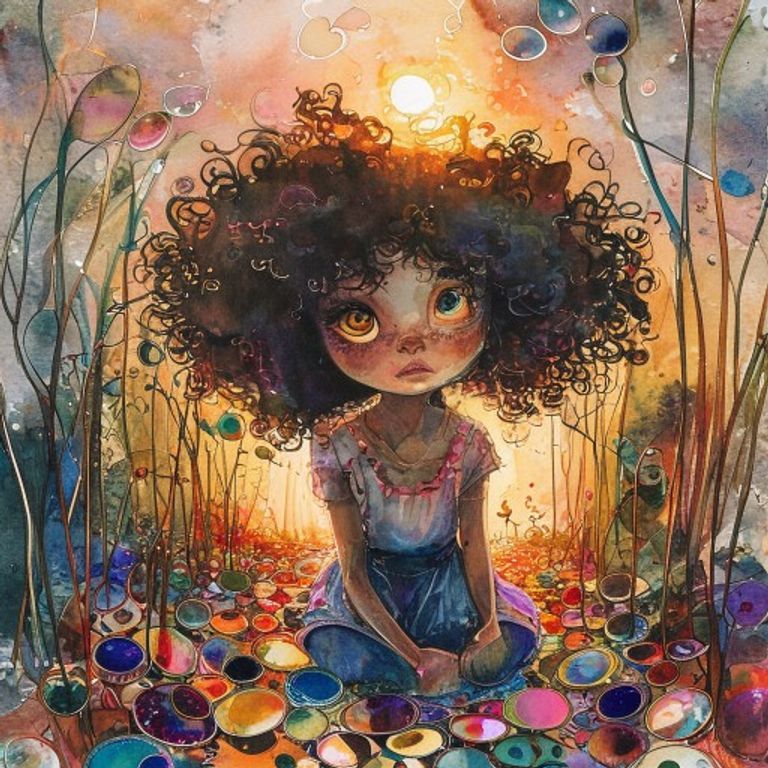
In the sleepy village of Hollyhollow, where the cottages were the color of butter and cream, and every garden grew roses that smelled like cinnamon and rain, there lived a young girl named Elara who saw what others could not.
Not ghosts. Not spirits. Not anything frightening.
She saw possibilities.
Where others saw a broken wheel, Elara saw a crown for a flower fairy. Where others saw a cracked teacup, Elara saw a home for a family of snails. Where others saw a tangled mess of yarn, Elara saw the beginning of a net to catch falling stars.
Her mother sighed when Elara brought home "treasures" from the village dump—a rusted hinge, a chipped mirror, a collection of smooth blue glass from old medicine bottles.
"Elara, darling," her mother would say, "these are not treasures. These are trash."
"Trash is just treasure that hasn't met the right dreamer yet," Elara would reply, her eyes bright as dew.
Her father, a practical carpenter who measured twice and cut once, would shake his head. "Imagination is fine for play, Elara. But the real world runs on rules. Wood must be straight. Nails must be hammered true. A door that doesn't close is just a hole in the wall."
Elara loved her parents. She truly did. But she also loved the mess inside her head—the swirling colors, the impossible shapes, the quiet whisper that said, "What if you tried it THIS way?"
And so, while other children in Hollyhollow played with proper toys—dolls with real silk dresses, wooden soldiers with painted faces, miniature tea sets from the china shop—Elara played with garbage.
Beautiful, wonderful, endless garbage.
One autumn morning, when the leaves were turning the color of apricots and burnt sugar, the Mayor of Hollyhollow posted a notice in the village square.
THE GREAT GARDEN CONTEST
All citizens are invited to create the most beautiful garden display in the town square. The winner will receive the Golden Trowel and have their design featured in the Royal Gardens of the capital.
Elara read the notice with trembling hands. A contest! For gardens! For beauty! For creativity!
She ran home and burst through the kitchen door. "Mother! Father! I am going to enter the Great Garden Contest!"
Her father looked up from his blueprint. "That's wonderful, Elara. What will you plant?"
"Plant?" Elara blinked. "Oh, I won't plant anything. At least, not just flowers. I'm going to create a Garden of Wonders!"
Her mother's eyebrows rose. "A Garden of Wonders? What's that, exactly?"
"I don't know yet," Elara admitted. "But I will figure it out. That's the wonderful part."
The other contestants began their preparations immediately.
Mrs. Bramble, the baker, planted rows of marigolds the color of her famous lemon tarts. She arranged them in neat spirals, measured with string and stakes, perfect as a pie crust.
Mr. Finch, the blacksmith, forged an iron trellis in the shape of a dragon and trained moonflower vines to climb its scales. It was impressive, strong, precise.
The Thornwood twins, who were rich and competitive, ordered rare seeds from across the sea—orchids that glowed in moonlight, roses that changed color with the temperature, tulips that chimed like bells when the wind blew.
And Elara?
Elara went to the village dump.
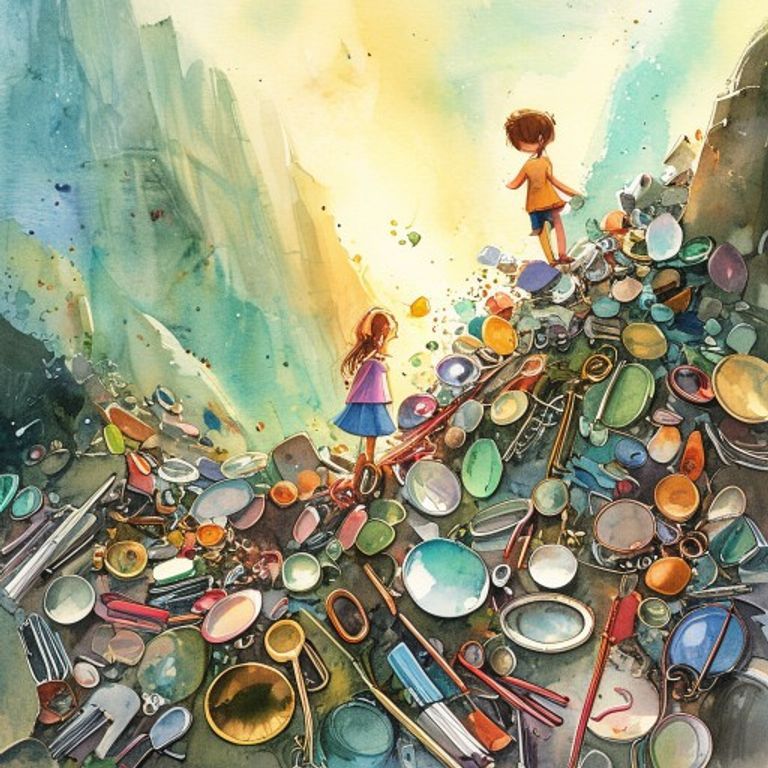
The dump was a mountain of forgotten things.
Broken pottery. Rusted tools. Torn curtains. Bent silverware. A doll with one eye. A clock with no hands. A birdcage with a door that wouldn't close.
Elara climbed the heap like a mountain goat, her skirts hiked up, her hair wild in the wind.
"What are you doing, Elara?" called Old Tom, the dump keeper, who sat on his stump drinking cider from a wooden cup.
"I'm gardening," she said, holding up a piece of colored glass from a broken window. "This will be the sky in my garden."
"That?" Old Tom laughed. "That's a piece of junk from the old stained-glass chapel. Been sitting here since the roof fell in."
"Not junk," Elara said. "A sky."
She gathered.
She gathered broken plates with blue willow patterns that looked like rivers. She gathered copper wire that had once held fences together. She gathered smooth stones that had been polished by years of rain. She gathered old keys, rusted but still beautiful in their shapes. She gathered shards of mirror that caught the light like captured stars.
She filled her wagon, trip after trip, until her garden plot in the square looked less like a garden and more like a dragon's hoard.
The other contestants stared.
"What is she doing?" Mrs. Bramble whispered to Mr. Finch.
"Making a mess, by the looks of it," Mr. Finch muttered.
The Thornwood twins snickered behind their lace handkerchiefs. "She's going to lose so badly," one whispered. "Our orchids are from the Island of Eternal Moonlight. Her garden is from a trash heap."
But Elara didn't hear them. Or if she heard, she didn't care.
She was too busy seeing.
The first day, she arranged the broken plates.
She laid them flat in the soil, their blue willow patterns facing up, creating a stream that wound through her plot like a river of porcelain. She placed smooth stones along its edges, making banks, making bends, making the illusion of water that flowed without moving.
The second day, she worked with the copper wire.
She twisted it into arches and loops and spirals. She wove it through old keys, hanging them like wind chimes that never rang but caught the light and scattered it into golden spots on the ground. She made a fence of wire that looked like music frozen mid-melody.
The third day, she added the mirrors.
She buried them at angles in the earth, catching the sky and turning it downward, so that when you stood in her garden, you saw clouds beneath your feet and birds swimming like fish through the ground. She placed the colored glass—red, amber, emerald, sapphire—in patterns that made sunlight fall in rainbow patches, warm as kisses, cool as spring water.
By the fourth day, something magical happened.
The real garden began to interact with her made-up one.
A vine, wandering from Mrs. Bramble's plot, curled through Elara's copper arch and bloomed with orange flowers that looked like lanterns in her "river." A bird, nesting in the eaves of the town hall, began collecting the colored glass in its beak, thinking it was bright stone, and dropped a feather in exchange. A spider, ambitious and artistic, wove its web between two of Elara's wire spirals, turning her sculpture into something alive and trembling.
Elara didn't plant a single seed. But her garden grew anyway.
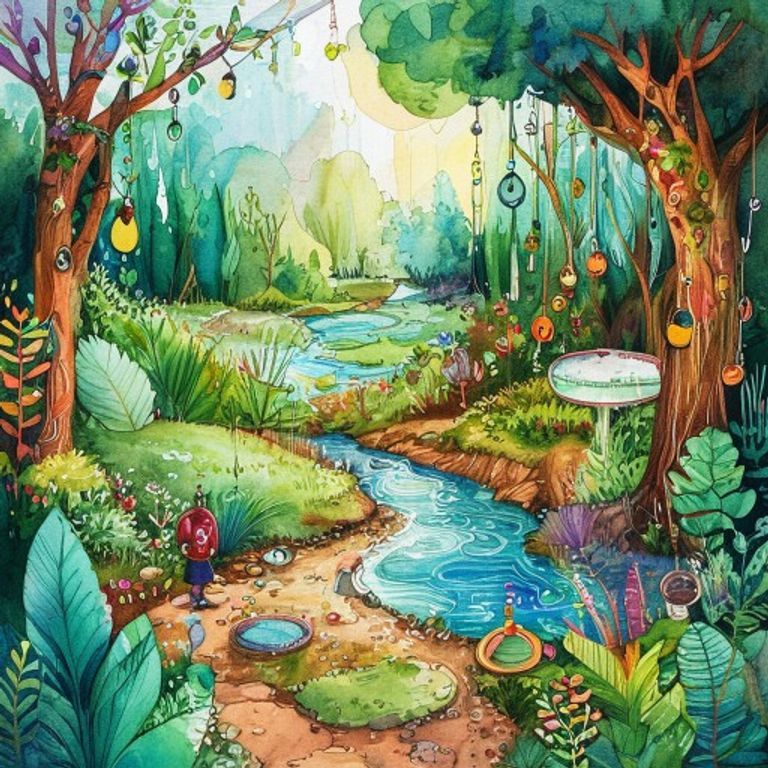
The day of judging arrived.
The Mayor, a round man with kind eyes and a mustache that twitched when he was impressed, walked through the square with his clipboard and his panel of advisors.
Mrs. Bramble's marigolds were perfect. Neat. Symmetrical. They smelled like sunshine and sugar. "Very professional," the Mayor nodded. "Very... expected."
Mr. Finch's iron dragon was magnificent. The moonflowers were just beginning to open, their white faces turning toward the evening. "Impressive engineering," the Mayor said. "Very... solid."
The Thornwood twins' rare orchids glowed faintly in the twilight. Their roses changed from pink to violet as the temperature dropped. Their tulips chimed in the breeze, a delicate music. "Exotic," the Mayor breathed. "Very... expensive."
And then he reached Elara's plot.
He stopped.
He stared.
The garden was not a garden. It was a world.
The porcelain river gleamed in the setting sun, its blue willow patterns telling stories of ancient bridges and sailing ships. The copper wire sang in the wind, its hanging keys turning and flashing like fireflies made of gold. The mirrors caught the clouds and held them, so the Mayor felt he was floating, standing on air, walking through the sky.
And the light.
The colored glass made the whole garden glow in patches of ruby and amber and emerald, so that the Mayor felt he was standing not in Hollyhollow, but inside a stained-glass window, inside a dream, inside a story.
"What... what is this?" he whispered.
"It's a Garden of Wonders," Elara said, appearing from behind a copper spiral. She had dirt on her nose and a cut on her finger and a smile brighter than all the mirrors combined. "It's a place where broken things remember they were once beautiful. Where trash remembers it was treasure. Where the world is made not of what things are, but what they could be."
The Mayor walked through slowly. He stepped on the mirrors and saw himself from below, a man standing on clouds. He touched the hanging keys and felt their music in his palm, silent but warm. He knelt by the porcelain river and saw his own face reflected in the blue willow pattern, a man younger than he remembered, a man who had once dreamed too.
"I don't understand," he said softly. "You didn't plant anything."
"I planted ideas," Elara said. "Ideas grow faster than roses. And they bloom longer."
The Mayor stood up. He looked at his advisors. He looked at the other contestants. He looked at Elara, small and dirty and glowing with something that was not pride, exactly, but joy.
"The Golden Trowel," he announced, his voice carrying across the square, "goes to the garden that reminded me why we build, why we grow, why we create. Not for perfection. Not for rarity. Not for expense. But for wonder."
He turned to Elara.
"To Elara, and her Garden of Wonders."
The square erupted. Mrs. Bramble clapped, her eyes wet. Mr. Finch nodded, his jaw set with reluctant admiration. The Thornwood twins... the Thornwood twins said nothing, but their eyes were wide, and later, one of them would ask Elara to teach her how to see treasures in trash.
But Elara wasn't looking at the crowd. She was looking at her garden. At the vine that had wandered in from next door. At the bird feather left as payment. At the spider web trembling in the copper spiral.
"You grew," she whispered to her garden. "You actually grew."
Her mother came and hugged her, smelling of flour and love. "I was wrong," she said. "Trash is treasure. When it meets the right dreamer."
Her father came and ruffled her hair, his carpenter's hands rough and warm. "A door that doesn't close," he said, "is just a door waiting to become a window. I was wrong too, Elara. Rules are good. But dreams... dreams are better."
The Garden of Wonders stayed in the square.
Not just for the contest. Forever.
The village voted to keep it, to add to it, to let it grow. Other children brought their own "treasures"—buttons and beads and broken toys—and Elara helped them see what each could become. The porcelain river grew longer. The copper spirals multiplied. The mirrors caught more sky.
And children came from other villages, other towns, other kingdoms, to walk through the garden and learn what Elara had discovered.
That creativity is not about having the best materials.
It is about having the best eyes.
Eyes that see a broken plate and think, "river." Eyes that see a rusted key and think, "sunlight." Eyes that see a tangled wire and think, "music." Eyes that see the world not as it is, but as it could be.
Elara grew up, as all children do. She became a teacher, then a builder, then an artist whose works hung in galleries across the land. But she never forgot the garden. And she never forgot the lesson.
Whenever young people came to her, anxious and unsure, holding their own strange ideas like fragile eggs, Elara would take them to the square. She would walk them through the garden, now ancient and sprawling and more beautiful than ever, and she would say:
"Creativity is not a gift that some people have and others don't. It is not a talent, or a magic, or a blessing from the gods. Creativity is a choice. The choice to look at the world and ask, 'What if?' The choice to pick up something broken and say, 'I can make this whole.' The choice to see not what is, but what could be."
She would kneel by the porcelain river, now smooth with age, and run her finger along its blue willow patterns.
"You don't need rare orchids from the Island of Eternal Moonlight. You don't need an iron dragon forged by a master blacksmith. You don't need the most expensive seeds or the perfect soil or the best tools. You need only one thing."
She would smile, her eyes still bright as dew, even in the face of a woman grown.
"You need to believe that your way of seeing is valuable. That your strange ideas matter. That your broken treasures are worth sharing. Because the world doesn't need more of the same. The world needs your wonder. Your Garden of Wonders. Your way of making the ordinary extraordinary."
She would stand and spread her arms, and the colored glass would catch the light, and the garden would glow.
"So go. Find your trash. Find your treasures. And build something that only you can build. Something that makes people stop. Something that makes them remember. Something that makes them wonder."
Creativity, little one. Creativity.
The End