The Library Under the Oak: A Story About Curiosity
In the village of Wrenwick, where cobblestone streets wound like ribbons and every chimney puffed smoke the color of cinnamon, there lived a young rabbit named Remy who could not stop asking questions.
Not silly questions. Not annoying questions. The kind of questions that made grown-ups pause mid-sip and look at him with eyes suddenly remembering their own childhood wonder.
"Why do oak trees live longer than dandelions?" Remy would ask his mother, who was kneading bread dough by the kitchen window.
"Why does the moon follow us when we walk?" he would ask his father, who was mending a garden gate at twilight.
"Why do books smell like storms?" he would ask the village librarian, a sleepy badger who would smile and say, "Because stories are weather, little one. Some are sunshine. Some are rain."
Remy's questions were endless. They bubbled up in him like a spring that could not be capped. His brothers and sisters would roll their eyes. "Remy and his whys," they'd sigh. "Can't he just play like a normal rabbit?"
But Remy couldn't. Not because he was strange. Because he was awake.
While other rabbits saw the world as a finished painting, Remy saw it as an unfinished sketch, full of blank spaces waiting to be filled in.
One misty autumn morning, when the world felt wrapped in grey silk and spiderwebs hung between branches like silver lace, Remy hopped beyond the garden fence.
He wasn't supposed to. The old oak at the edge of the meadow was "out of bounds," his mother always said. "Too many roots. Too many shadows. Nothing but trouble out there."
But Remy had noticed something. For three mornings, he had seen a light flicker in the oak's hollow trunk—a light that was not sunlight, not moonlight, but something softer. Something the color of warm honey and old parchment.
So he went.
The meadow was damp with dew, and every blade of grass held a tiny world in its curl. Remy hopped slowly, his nose twitching, his ears swiveling like satellite dishes tuned to the universe.
When he reached the oak, he saw what he had hoped to see.
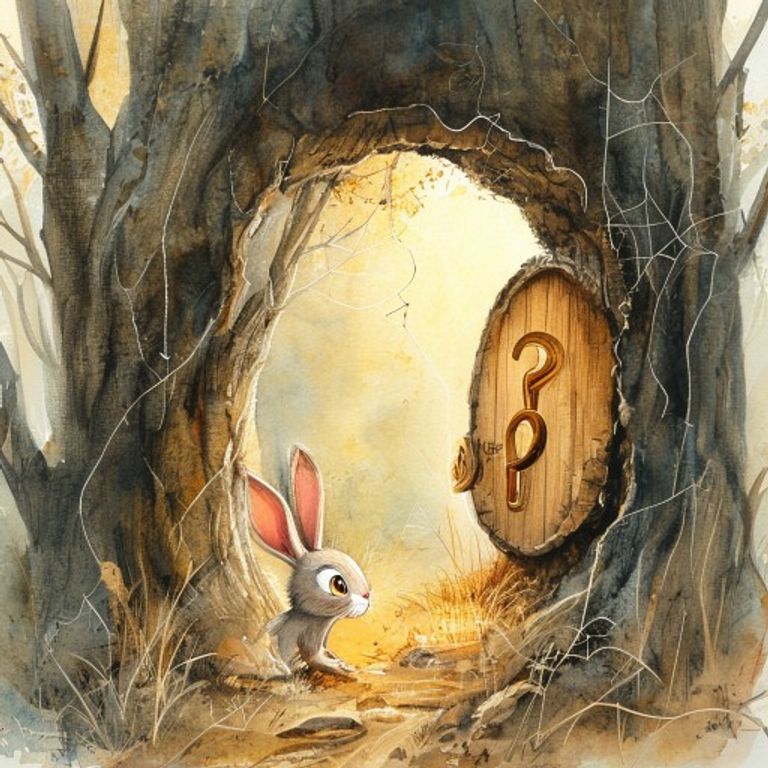
The hollow trunk was not hollow at all.
It was a door.
A round door, wood as dark as molasses, with a brass handle shaped like a question mark. And from beneath the door, light seeped—warm, golden, inviting.
Remy's heart hammered against his ribs like a woodpecker against bark.
Should he go in?
His mother's warning echoed: "Nothing but trouble."
But his curiosity whispered: "What if it's wonderful?"
Remy reached out. His paw touched the brass question mark. It was warm, as if someone had been holding it just moments before.
He turned the handle.
The door swung open with a sound like a sigh.
Remy stepped inside and forgot to breathe.
He was standing in a library.
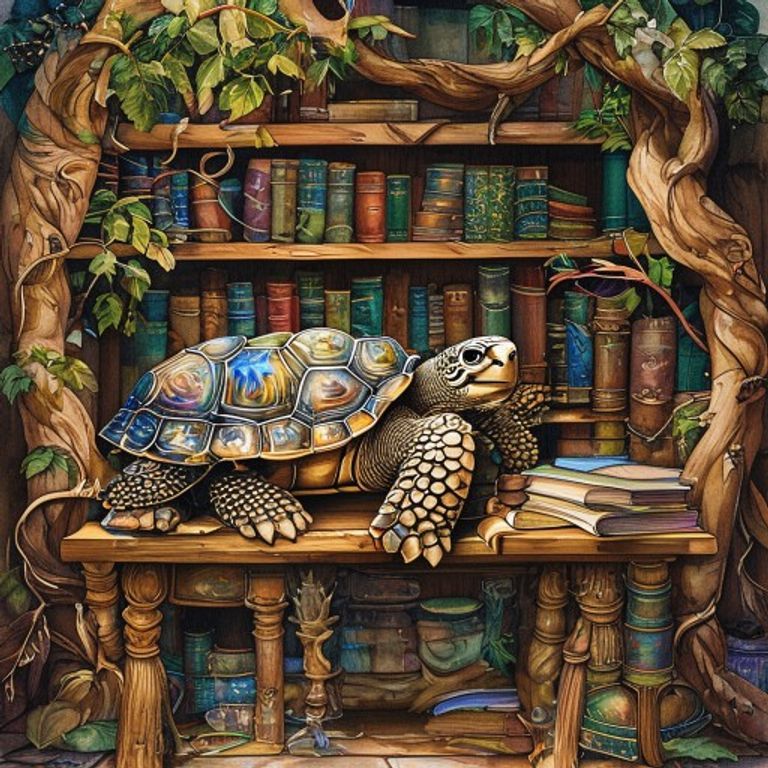
But not the village library, with its neat shelves and dusty corners and badger librarian snoring behind the desk. This was a library that seemed to breathe. The shelves were not made of wood but of roots—twisted, gnarled oak roots that had grown into shapes perfect for holding books. The books themselves were not all paper. Some were leaves, their pages thin as breath, inscribed with ink that shimmered. Some were stones, heavy and warm, their words carved in languages Remy almost recognized. Some were feathers, soft and drifting, carrying stories in the patterns of their barbs.
And the light.
The light came from everywhere and nowhere. It pulsed gently, like a heartbeat, warm as a hearth fire on the coldest night.
"You found the door," said a voice.
Remy jumped, his fur standing on end.
Sitting at a desk made of polished acorn caps was a tortoise. Not just any tortoise. This one was ancient. His shell was mapped with patterns that looked like constellations. His eyes were deep and dark and kind, holding the patience of centuries.
"I... I saw the light," Remy stammered. "From my garden. Three mornings. I just... I wanted to know what it was."
"Of course you did," the tortoise said, and his voice was like honey poured over stones. "That is why the door opened for you. The Library Under the Oak only opens for those who need it. And you, young rabbit, need it very much."
"Need what?" Remy asked.
"Answers," the tortoise said. "But more importantly, better questions."
The tortoise's name was Archimedes.
He had been the librarian for three hundred years, he said. Maybe four. Time moved differently in the Library Under the Oak. A day outside might be an hour inside. Or a year. It depended on what you were learning.
"Every book in this library," Archimedes explained, gesturing with a claw that moved like a branch in slow wind, "is a question that someone, somewhere, asked. And every question, when asked truly, becomes a door to a hundred more."
He picked up a stone book, heavy as a heart.
"This one was asked by a mole, three centuries ago. 'Why does the earth shake?' She felt a tremor while digging and needed to understand. The book led her to discover the roots of mountains, the rivers of fire beneath the world, the slow dance of continents. She became the greatest earth-scholar of her age."
He placed the stone down and lifted a feather, which drifted in his claw like a thought.
"This one was asked by a sparrow. 'Why do we sing?' He wanted to know why his throat opened in spring and poured music into the air. The book led him to discover that song is how the world remembers itself. He became a composer whose melodies are still sung by every dawn chorus."
Remy's eyes were wide. "But... but I'm just a rabbit. I ask silly questions. My family says I ask too many."
Archimedes laughed, a sound like pebbles rolling in a stream. "Too many? Young one, there is no such thing. Questions are the seeds of civilization. Every road, every bridge, every warm home, every full belly—they all began with someone asking 'What if?' or 'Why?' or 'How?'"
He leaned closer, his ancient eyes twinkling.
"But there is a secret to asking well. A secret most never learn."
Remy leaned in too, his ears flat with attention.
"The secret," Archimedes whispered, "is that the best questions are not the ones with answers. They are the ones that lead to more questions. A question with an answer is a full stop. A question that opens doors is a beginning. And beginnings, young Remy, are where the magic lives."
Archimedes gave Remy a tour.
The library had no end. Corridors of roots stretched in every direction, each one lined with books that hummed with their own particular questions. Some corridors were warm, smelling of cinnamon and sun. Others were cool, smelling of moss and midnight. Some were loud, the books chattering like birds. Others were silent, the books waiting like seeds in winter.
"How do I find my question?" Remy asked.
"You don't find it," Archimedes said. "It finds you. Walk. Listen. When a book calls to you, you'll know."
Remy walked.
He passed books of stone and leaf and feather and crystal. He passed questions asked by mice and whales and beetles and eagles. He walked until his paws were tired and his mind was spinning with wonder.
And then he heard it.
A whisper. Soft as dandelion seeds on the wind.
"Why do some flowers bloom at night?"
Remy stopped. He turned. There, on a shelf of twisted root, sat a book made of petals. Moonflower petals, white and luminous, bound with spider silk.
He reached for it. The moment his paw touched the cover, the petals opened.
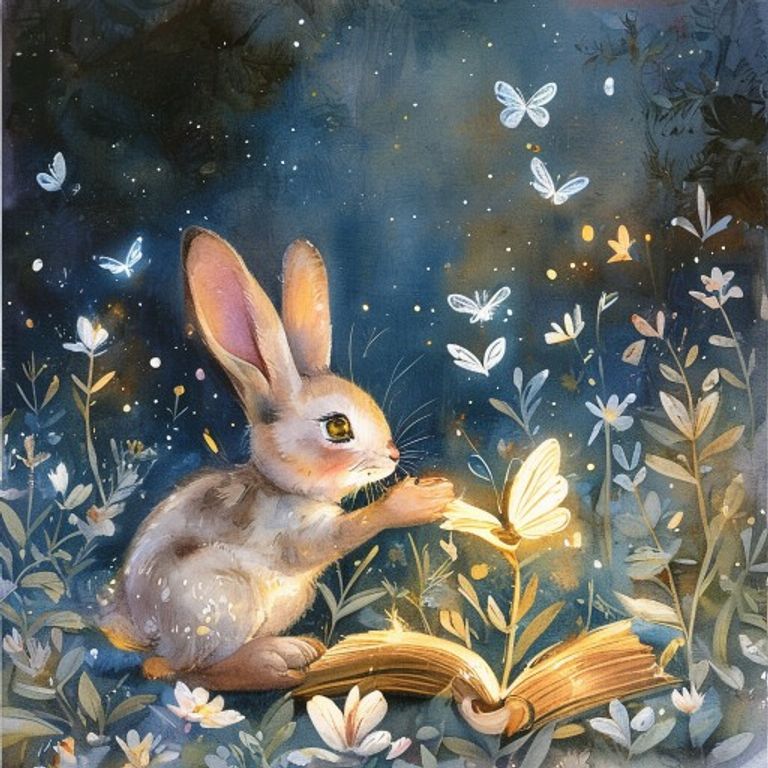
Inside, there were no words. Only pictures.
Pictures that moved.
Remy saw a garden at night. He saw flowers that had closed their faces to the sun, waiting. Waiting for darkness. Waiting for the moon. And when the moon rose, they opened—slowly, shyly, beautifully—revealing petals that glowed like captured starlight.
He saw bees that worked by moonlight, their bodies silver with pollen. He saw moths with wings like stained glass, dancing from bloom to bloom. He saw a whole world that lived in darkness, that thrived in shadows, that was just as alive and busy and wonderful as the daytime world he knew.
And he understood.
Some things bloom in darkness. Some creatures live in shadow. Some beauty only reveals itself when the sun goes down. The night was not empty. It was full. Full of life, full of work, full of wonder.
Remy closed the petal book, his heart full.
"I understand now," he said to Archimedes, who had appeared beside him silently, as ancient librarians do. "The world is bigger than I thought. There are whole worlds I never knew existed. Whole questions I never knew to ask."
"And now?" Archimedes asked, his eyes gentle.
"Now I have more questions than ever," Remy laughed. "But they don't feel heavy anymore. They feel like... like doors. Like invitations. Like adventures waiting to begin."
Archimedes nodded, satisfied. "Then you have learned what the Library Under the Oak teaches. Not answers. The hunger for better questions."
Remy returned home.
The sun was setting when he hopped back through the garden gate, his paws dusty, his mind alight. His mother was calling for him, worried.
"Remy! Where have you been? I was so frightened!"
"I found a library, Mother," Remy said, his eyes shining. "Under the old oak. A library of questions. And I learned that my questions are not silly. They are doors."
His mother looked at him, her worry melting into wonder. "A library? Under the oak?"
"Yes. And there are books made of petals and stones and feathers. And an ancient tortoise named Archimedes who has been the librarian for three hundred years. And I learned that the best questions are the ones that lead to more questions, and that the world is full of worlds I never knew existed, and that—"
His mother laughed and pulled him into a hug. "Slow down, little question-asker. Tell me everything. Over dinner. While I try to believe that my son found a magic library in an afternoon."
His father listened too, his gate-mending forgotten. His brothers and sisters, who had rolled their eyes at "Remy and his whys," now leaned in, wide-eyed, as Remy described the petal book, the moonflower garden, the night bees, the silver moths.
"Can we go too?" his youngest sister asked.
"Only if you need it," Remy said, repeating Archimedes' words. "Only if you have questions that won't let you sleep."
Remy never stopped asking questions.
But they changed. They became deeper. Richer. More wonderful.
He didn't just ask "Why is the sky blue?" He asked "What would the world look like if we could see all the colors, not just the ones our eyes catch?"
He didn't just ask "Why do birds sing?" He asked "What songs do the trees sing, in frequencies too low for our ears?"
He didn't just ask "Why do leaves fall?" He asked "What would autumn be like if gravity worked sideways, and leaves flew up instead of down?"
His questions made people think. Made them wonder. Made them remember their own childhood curiosity, buried under years of "because I said so" and "that's just how it is."
The village changed. Slowly. Like seasons change.
The badger librarian woke up from his naps and started ordering new books—strange books, wonderful books, books that answered questions no one had thought to ask yet. The baker started making bread in the shape of question marks. The blacksmith forged garden gates with curious spirals. The schoolteacher stopped saying "It just is" and started saying "That's a wonderful question. Let's find out together."
And every full moon, Remy would hop to the old oak, turn the brass question-mark handle, and spend an hour in the Library Under the Oak, learning new questions to bring back to the world.
Archimedes would smile his ancient smile. "You are becoming a Keeper of Questions yourself, young Remy."
"I don't want to be a Keeper," Remy said. "I want to be a Sharer. I want to give my questions away. To everyone."
"That," Archimedes said, his eyes glowing with three hundred years of pride, "is exactly what the world needs."
Years later, when Remy was grown and his own young rabbits were bouncing around the garden, asking their own endless questions, he would take them to the meadow's edge.
"See that oak?" he would say. "There is a door in its trunk. A door that only opens for those who need it. A door that leads to a library of questions. But more importantly, it leads to a way of seeing the world."
His children would stare at the oak, their noses twitching.
"What kind of way?" they would ask.
And Remy would smile, his eyes still bright with wonder, even in the face of a rabbit grown.
"A way where every leaf is a mystery. Where every shadow holds a secret. Where every moment is an invitation to ask, to wonder, to explore. The world is not finished, little ones. It is not a painting already complete. It is a sketch waiting for your questions to fill in the blank spaces."
He would kneel and look each of them in the eyes.
"So ask. Ask everything. Ask why and how and what if. Ask the questions that make people pause. Ask the questions that have no answers, only more questions. Ask until the world opens up like a flower and shows you its hidden beauty."
He would stand and gesture to the oak, to the sky, to the infinite horizon.
"Curiosity is not a habit. It is not a phase. It is a way of being alive. The most alive people are the ones who never stop wondering. Who never stop asking. Who never stop looking at the world and saying, 'I want to know more.'"
His children would hop closer to the oak, their own questions bubbling up like springs.
"Is the door really there?"
"Can we see it?"
"What books are inside?"
Remy would laugh, his heart full.
"Go find out," he would say. "That's the whole point."
Curiosity, little ones. Curiosity.
The End