The Purse Under the Fountain: A Story About Honesty
In the village of Luminfield, where cobblestone streets wound between cottages painted in butter-yellow and sky-blue, there lived a young boy named Oliver. He was ten years old, with hair the color of autumn wheat and eyes the shade of forest moss. Oliver lived with his grandmother, Nana Pearl, in a cottage at the edge of the village, where her garden grew wild with sunflowers and climbing roses.
Oliver was a quiet boy. He spent his days reading in the garden, helping Nana Pearl bake honey-cakes, and wandering the meadows beyond the village with his sketchbook. He was not the fastest runner, nor the loudest speaker, nor the bravest adventurer. But Oliver had something rare—he noticed things.
He noticed how the baker, Mr. Finch, always set aside the crustiest loaf for old Mrs. Bramble, who had no teeth but loved to gnaw the edges. He noticed how the blacksmith's daughter, Clara, secretly left wildflowers on the windowsill of the widowed cobbler. He noticed how the village cat, Marmalade, only ever sat in doorways where someone needed cheering.
And one Tuesday afternoon, Oliver noticed something he wished he had not.
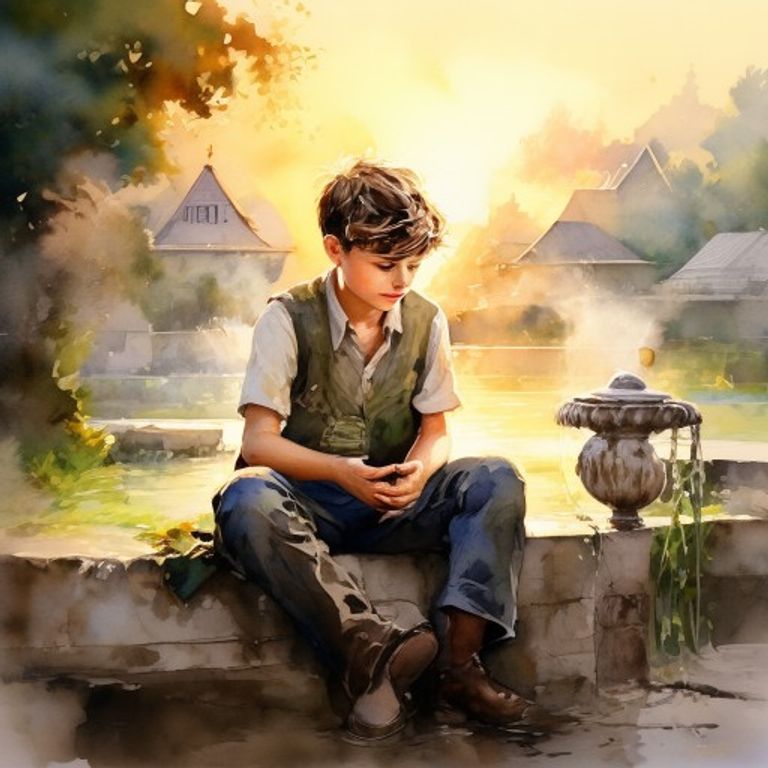
He was walking through the village square, carrying a basket of Nana Pearl's apricots for the market, when he saw something glinting under the fountain's edge. It was a purse—a small, embroidered thing of midnight-blue velvet, with silver thread tracing the shape of a crescent moon. And it was stuffed with gold coins.
Oliver's heart thumped like a rabbit's foot. He looked around. The square was nearly empty. Only the fountain's stone mermaids watched him, their blind eyes eternally gazing at the sky.
He could keep it. The thought bloomed in his mind like a dark flower. Nana Pearl's roof leaked. Her shoes had holes. The gold could fix everything. No one would know. The fountain was old, rarely visited. Whoever had dropped the purse might never return.
Oliver reached out. His fingers brushed the velvet. It was soft as a whisper. He picked it up. It was heavier than he expected, the coins clinking softly, seductively.
"Finders keepers," he whispered to himself. But the words tasted wrong, like honey mixed with vinegar.
He tucked the purse into his pocket and walked home, his legs stiff, his chest tight. Nana Pearl was in the kitchen, humming as she kneaded dough.
"Oliver!" she called, flour dusting her cheek like snow. "Did you sell the apricots?"
"Yes, Nana," he said, though his voice came out thin.
She turned, sensing something. Nana Pearl had raised Oliver since he was four, since the fever had taken his parents. She knew his moods the way a gardener knows her plants.
"What's wrong, my boy?"
Oliver hesitated. The purse felt like a stone in his pocket, dragging him down. He thought of the leaking roof. He thought of her holey shoes. He thought of how she worked her fingers raw mending other people's clothes to keep them fed.
"Nothing," he said. And felt the lie settle in his stomach like cold porridge.
That night, Oliver could not sleep. He lay in his small room under the eaves, staring at the moon through his window. The purse sat on his desk, a dark blot against the pale wood. He kept opening it, counting the coins, closing it. Forty-seven gold pieces. Enough to fix the roof. Enough for new shoes. Enough for a winter's worth of firewood.
But every time he imagined spending the money, he saw something else. He saw Mrs. Dewdrop, the seamstress, who always paid Nana Pearl with fresh eggs and kind words. What if this was her sewing money? He saw Mr. Halloway, the traveling musician, who had played at the village fair and lost his earnings. What if this was his livelihood? He saw Widow Ash, who sold herbs at the market, her hands twisted with arthritis, her eyes clouded with cataracts. What if this was her medicine money?
And worst of all, he saw Nana Pearl's face—not smiling, but disappointed. Not angry, but sad. The way she had looked when he was six and had lied about breaking her favorite teapot.
"Oliver," she had said then, kneeling to his level. "I do not care about the teapot. I care about your truth. A person who lies is like a house with a cracked foundation. It might stand for a while, but eventually, it will fall."
He had cried. She had held him. And he had promised never to lie again.
Now, in the moonlight, Oliver made a decision.

He got out of bed, dressed quietly, and tucked the purse into his coat. He slipped out the door, past Marmalade the cat, who watched him with knowing golden eyes, and into the night.
The village square was silent, silvered by moonlight. The fountain murmured its eternal song. Oliver sat on the fountain's edge, the purse in his lap, and waited.
He waited through the darkest hour, when the moon sank low and the stars seemed to hold their breath. He waited as the sky turned from black to indigo to violet. He waited as the first birds began to stir and the baker's chimney began to smoke.
And then, just as the sun cracked the horizon in a blaze of rose and gold, a figure appeared at the edge of the square.
It was a girl, perhaps Oliver's age, perhaps a little older. She wore a patched cloak of forest green, and her hair was the color of copper wire, pulled back in a practical braid. Her face was streaked with dirt and tears, and she moved with the frantic energy of someone searching for something precious.
She was looking under benches. Peering behind planters. Running her hands along the fountain's rim. And when she reached the spot where Oliver had found the purse, she sank to her knees and began to cry.
Oliver stood. His legs were stiff from sitting. His heart hammered against his ribs. He walked toward her, the purse held out like an offering.
"Excuse me," he said. His voice cracked. He cleared his throat. "Is this yours?"
The girl looked up. Her eyes were the color of storm clouds, red-rimmed and wet. She stared at the purse. Then at Oliver. Then at the purse again.
"You found it," she whispered. "You found it."
"Under the fountain," Oliver said. "Yesterday. I... I took it home. I'm sorry. I should have brought it back sooner. I should have—"
But the girl wasn't listening. She snatched the purse and clutched it to her chest, sobbing with relief. "Thank you," she gasped. "Thank you, thank you, thank you. You don't understand. This is everything."
Oliver swallowed. "I'm sorry I kept it overnight. I was wrong."
The girl stared at him. Then, slowly, a smile bloomed on her face—a smile that started in her eyes and spread outward, lighting her entire face like sunrise breaking through clouds.
"My name is Rowan," she said. "And I owe you more than I can ever repay. But I can tell you what this money is for."
She opened the purse and pulled out a folded paper. It was a letter, sealed with blue wax. "My mother is sick. Very sick. The village healer says she needs medicine from the city—special herbs that don't grow here. This gold was going to buy her cure. I was carrying it to the healer yesterday when the strap broke. I didn't notice until I reached her cottage. I searched all night. I searched this morning. And then... then you appeared."
Oliver felt something warm spread through his chest—a warmth that drove out the cold porridge feeling, the tightness, the shadow that had lived in him since he picked up the purse.
"I'm glad I found it," he said. And meant it.
Rowan stood, brushing dirt from her knees. She looked at Oliver with something like wonder. "What's your name?"
"Oliver."
"Oliver," she repeated. "You chose honesty when no one was watching. That makes you the richest person in Luminfield, even without a single gold piece."
She reached into the purse, withdrew three coins, and pressed them into Oliver's palm. "For your honesty. For your courage. For bringing this back when you could have walked away."
Oliver shook his head. "I can't take this. You need it for your mother."
"And I will use it for her," Rowan said firmly. "But these three coins are for you. Not as payment. As... a promise. A promise that honesty is never wasted. That doing the right thing—even when it's hard, even when no one sees—always comes back to you."
She folded his fingers over the coins. Her hands were rough, her nails bitten, but her grip was strong and warm.
"Come to the healer's cottage tomorrow," she said. "Come meet my mother. She would want to thank the boy who saved her life."
Oliver nodded, his throat tight.
Rowan turned and hurried away, the purse clutched close, her patched cloak billowing behind her. Oliver watched until she disappeared around the corner of the baker's shop.
Then he looked at the three gold coins in his hand. They were warm from Rowan's palm. They caught the morning light and threw it back in bright, honest sparks.
He walked home, his steps light, his chest open. Marmalade the cat met him at the door, winding between his ankles, purring loud as a thunderstorm.
Nana Pearl was in the kitchen, setting out breakfast. She looked up as Oliver entered, and her eyes—the same moss-green as his—went soft with understanding.
"You did the right thing," she said. It was not a question.
"How did you know?"
She smiled, the lines around her eyes crinkling like paper. "Because you came home with light in your step and truth in your face. That's what honesty looks like, my dear. It looks like peace."
Oliver placed the three gold coins on the table. "A girl named Rowan gave me these. For her sick mother. I found her purse. I almost kept it. But I didn't."
Nana Pearl picked up a coin, turning it so the light danced across its surface. "Almost doesn't matter, Oliver. What matters is what we choose. And you chose truth."
She set the coin down and took his hands in hers—her fingers rough with work, but gentle as petals. "Do you know what I think? I think honesty is like the sun. It doesn't just light up the room you're in. It reaches through windows, under doors, into the darkest corners. Your honesty today didn't just save a woman. It showed a girl named Rowan that goodness exists. It showed yourself that you are strong enough to choose right over easy. And it showed me—" her voice caught "—that the boy I raised is becoming the man I always knew he could be."
Oliver hugged her then, burying his face in her flour-dusted shoulder. She smelled of honey and lavender and home.
The next day, Oliver visited the healer's cottage. Rowan's mother was thin and pale, but her smile was warm, and she held Oliver's hand for a long time, thanking him with words that made his eyes sting. Rowan showed him her mother's garden, where herbs grew in neat rows, and told him about her dream of becoming a healer herself.
They became friends—Oliver and Rowan. They met in the village square, by the fountain where their story had begun. She taught him the names of herbs; he drew pictures of them in his sketchbook. She told him about the city; he shared Nana Pearl's honey-cakes.
And sometimes, when the sun was setting and the fountain's mermaids glowed golden in the light, Rowan would touch the purse—now mended with a new strap—and say, "I thought honesty was extinct. I thought everyone only looked out for themselves. You proved me wrong."
And Oliver would smile and say, "My Nana says honesty is like a seed. You plant it in darkness, not knowing if it will grow. But if you tend it, if you water it with courage... it becomes a tree that gives shade to everyone."
One evening, as autumn painted the village in russet and gold, Oliver sat with Nana Pearl by the fire. The roof had been fixed—not with stolen gold, but with the three honest coins and Nana Pearl's savings, earned stitch by stitch. Her new shoes sat by the door, sturdy and warm.
"Nana," Oliver said, watching the flames dance. "Do you think Rowan's mother will get better?"
"I think," Nana Pearl said, her eyes reflecting the firelight, "that you gave her the best medicine there is. You gave her hope. And hope, my dear, heals more than any herb."
She reached into her apron and pulled out something small and shining. It was a pendant, shaped like a sun, on a silver chain.
"I made this for you," she said. "From the honest gold. I wanted you to have something to remind you, always, of who you are."
Oliver took it, the metal warm from her hand. He fastened it around his neck, and the sun-pendant settled against his chest, over his heart.
"When you wear this," Nana Pearl said, her voice soft as a lullaby, "remember: honesty is not just about telling the truth. It is about being true. To others. To the world. And most of all... to yourself."
Oliver touched the pendant. It was not as valuable as forty-seven gold pieces. It would not fix a roof or buy medicine. But it was honest. It was true. And in that moment, Oliver understood that some treasures cannot be counted in coins.
The greatest treasure of all is a heart that chooses right, even when no one is watching.
The End