The Song That Never Ends: A Story About Love
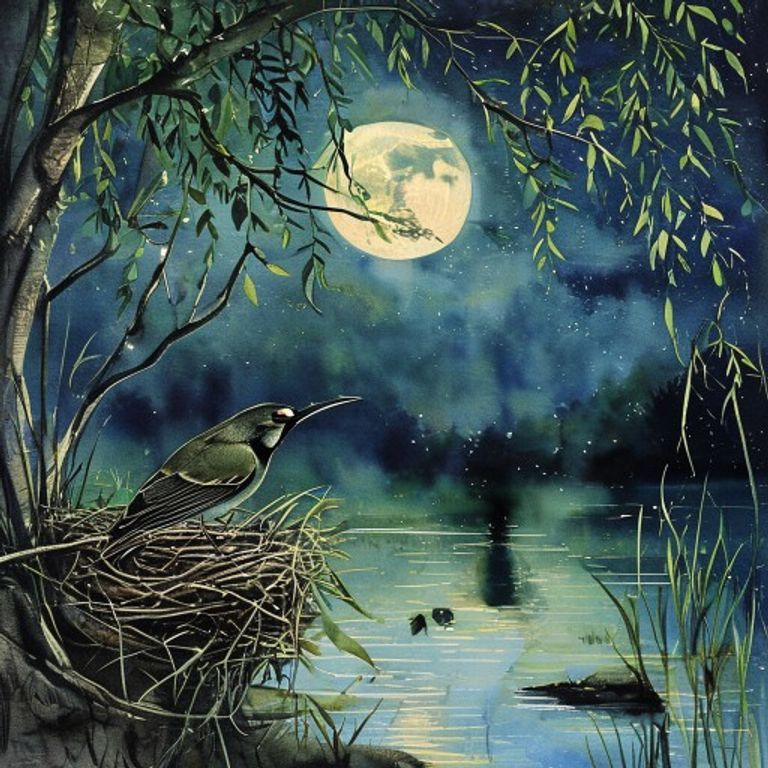
In the land where Silvermist Lake shimmered like a mirror under the moon, there grew an ancient willow tree. Its branches dipped low, trailing silver-green leaves into the water, creating a curtain of whispering silk. And in the heart of this willow, in a nest woven from moonflower vines and dried grasses, lived Papa Nightingale and his daughter, Melody.
Papa Nightingale was old. His feathers, once the deep blue-black of a midnight sky, had softened to a gentle charcoal, edged with silver. His voice, which had once been the most beautiful in all the valley—clear and strong and full of joy—had grown quiet. Not silent, but... softer. Like a song heard from very far away.
But every evening, as the sun painted the lake in strokes of amber and rose, Papa would settle beside Melody on their nest and sing.
"Love," he would sing, his voice trembling but true, "is the first note of the morning."
And Melody, who was still young, with feathers the color of honey and sunrise, would listen. She would close her eyes and let her father's song wrap around her like a warm breeze.
"Tell me again, Papa," she would whisper. "Tell me about the Song of Love."
And Papa would smile, his dark eyes crinkling at the corners, and he would begin.
"Long ago," he said, "before you were born, before your mother's eggs were laid, before even I was a hatchling, the Great Bird taught the first nightingale that love is not a single note. It is a song with many verses."
Melody nestled closer. "How many verses, Papa?"
"Infinite," Papa whispered. "As many as there are stars above Silvermist Lake. But I will teach you the ones I know."
He cleared his throat—a soft, rustling sound—and began.
"The first verse is the Love of Family."
Papa told Melody about the spring when she had been nothing but a tiny, featherless thing, smaller than his wingtip. He told her how he had sat on her mother's eggs for thirty nights and days, never leaving, never resting, keeping them warm while storms raged and winds howled.
"I was so tired, little one. My bones ached. My eyes burned. But every time I thought about leaving, about stretching my wings and flying away, I would feel you move inside your egg—a tiny flutter, like a heartbeat—and I knew. I knew that love means staying, even when staying is hard."
Melody's eyes grew wide. "You never left?"
"Not once," Papa said. "Not when the rain soaked through my feathers. Not when my stomach ached with hunger. Not when I was so weary I could barely keep my eyes open. Because love, my dear, is choosing to be there. Again and again. Even when it's difficult. Especially when it's difficult."
He sang a few notes then—a lullaby so soft that the willow branches seemed to lean closer to listen. The notes drifted across Silvermist Lake, and somewhere in the reeds, a frog sighed with contentment.
"The second verse," Papa continued, "is the Love of Friends."
He told Melody about Old Cedar, the crow who lived in the pine tree across the lake. Cedar and Papa had been friends for more years than Melody had been alive. They had flown together, explored together, shared berries and insects and stories.
"But one autumn," Papa said, his voice growing softer, "Cedar found a shiny thing. A ring, lost by a human, lying in the mud by the shore. It glittered like a captured star. Cedar became obsessed with it. He stopped visiting. Stopped flying. He sat in his pine tree, staring at that ring, day and night."
"What happened?" Melody asked.
"I visited him," Papa said simply. "Every day. Even when he snapped at me. Even when he told me to go away. Even when he said he didn't need friends, only his shiny treasure. I brought him berries. I sang outside his tree. I sat with him in silence when he wouldn't speak."
Papa paused, his eyes distant. "And one morning, Cedar woke up and realized the ring was just metal. Cold, hard metal. It couldn't sing to him. It couldn't fly beside him. It couldn't keep him warm on a winter night. He left the ring on a rock and flew to our willow tree. And when he arrived, I was there. Waiting. As I had been every day."
Melody felt tears prick her eyes. "Because love means not giving up on someone."
"Exactly," Papa whispered. "Love means believing in someone, even when they've forgotten how to believe in themselves."
He sang another verse then, a melody of friendship and forgiveness, and across the lake, Old Cedar—who was listening, as he always did—cawed softly in reply.
"The third verse," Papa said, his voice growing tired, "is the Love of the World."
He told Melody about the morning he had found an injured sparrow by the roadside, its wing broken, its eyes dull with pain. He told her how he had stayed with the sparrow for three days, bringing water, bringing food, singing soft songs of comfort, even though the sparrow was a stranger, even though they had never met.
"Why?" Melody asked. "Why help someone you don't know?"
Papa smiled. "Because love is not a limited thing, my dear. It is not a berry that grows smaller when shared. Love is like Silvermist Lake—the more streams flow into it, the larger it becomes. When we love the world, when we care for creatures we have never met, we make the lake bigger. We make love stronger. For everyone."
Melody looked out at the lake, at the moon rising over the water, casting a path of silver light across the ripples. She thought about all the creatures in the world—all the birds, all the animals, all the people she would never meet. And she felt her heart grow, just a little, to make room for them all.
"The fourth verse," Papa said, his voice now barely a whisper, "is the Love of Self."
He turned to Melody, his dark eyes serious. "This is the hardest verse to learn, little one. Because we are taught that love is only for others. We are taught to give and give and give, until we have nothing left for ourselves. But that is not love. That is... emptiness."
He reached out with his wingtip and gently touched Melody's beak. "You must love yourself, my dear. You must be gentle with yourself when you make mistakes. You must forgive yourself when you fall. You must celebrate yourself when you fly. Because you cannot pour from an empty cup. You cannot give love to others if you have no love for yourself."
Melody nodded slowly. "How do I love myself, Papa?"
"By speaking kindly to yourself. By resting when you are tired. By asking for help when you need it. By knowing that you are worthy of love—not because of what you do, but because of who you are."
Papa's voice faltered. He closed his eyes for a moment, breathing deeply. When he opened them again, they were wet with tears.
"And the final verse," he whispered, "the verse that holds all the others together... is the Love That Never Ends."
He looked at Melody, his gaze filled with a depth of feeling that words could not capture. "One day, little one, my song will end. My wings will grow still. My eyes will close. And I will become part of the wind, part of the lake, part of the stars above."
Melody's heart ached. "No, Papa. Don't say that."
"But listen," Papa said, his voice tender. "Love does not end when the body grows still. Love is not contained in feathers or beaks or bones. Love is a song. And songs... songs never truly end. They echo. They repeat. They transform into new melodies, sung by new voices."
He took Melody's wing in his. "When I am gone, my love will live in you. In the way you sing to your own children. In the way you stay when staying is hard. In the way you visit a friend who has forgotten how to be a friend. In the way you care for strangers. In the way you love yourself."
A tear slipped down Melody's cheek. "But I don't want you to go, Papa."
"I know," Papa whispered. "And that is love too. The love that hurts. The love that misses. The love that longs. It is all part of the song, my dear. The sad notes make the joyful ones sweeter. The quiet moments make the loud ones more beautiful."
He sang one final verse then—a song so pure, so full of love, that the stars themselves seemed to lean closer to listen. The willow branches swayed in time. The lake grew still, as if holding its breath. And in the reeds, every frog, every cricket, every creature of the night fell silent, honoring the beauty of the moment.
"Remember," Papa said, his voice barely audible now, "love is not a feeling. It is a choice. A practice. A song that you sing, again and again, until it becomes part of who you are. And even when you think you have sung your last note... the song continues. In the wind. In the water. In the hearts of those you have loved."
He closed his eyes, his breathing slow and peaceful. "Sing with me, Melody. One more time."
And so they sang together—father and daughter, old voice and young voice, weaving their love into a melody that drifted across Silvermist Lake, into the stars, into the endless night.
Love, little ones. Love.
The End