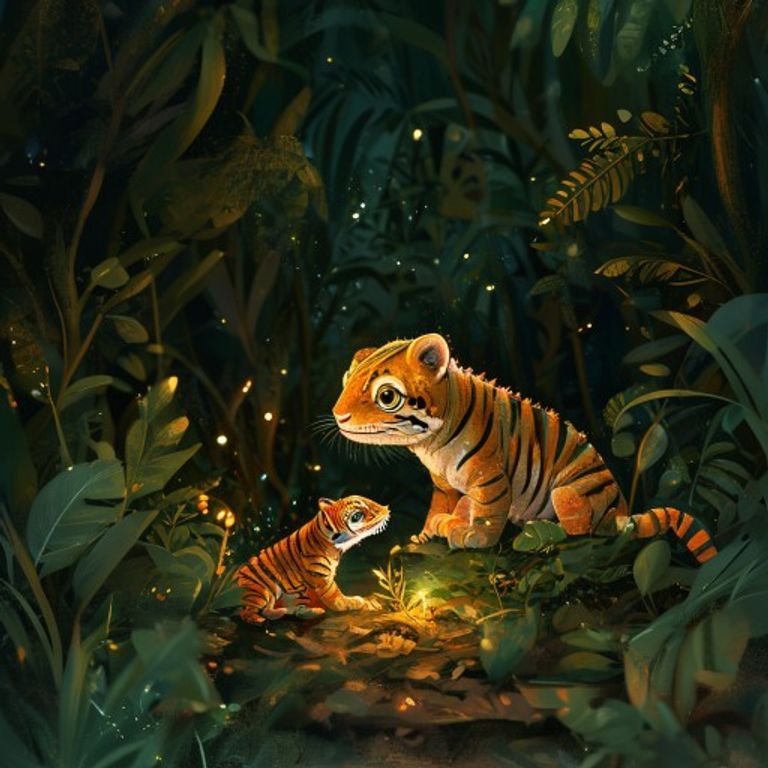
The Chameleon Who Glowed Too Slowly: A Story About Self-Confidence
In the heart of the Rainbow Jungle, where flowers bloomed in colors that had no names and butterflies wore wings like stained glass windows, there lived a young chameleon named Kira. She was a gentle creature, no bigger than a human's thumb, with soft emerald skin and eyes like tiny golden moons. But Kira had a secret—a secret she believed was a flaw, a mistake, a reason to hide.
She could not change colors quickly.
Now, for most creatures, this would not matter. A frog does not worry about climbing trees. A fish does not dream of flying. But chameleons—they are the artists of the jungle. Their color-changing is their language, their art, their identity. A chameleon who cannot flash and flicker and shift in the blink of an eye is like a bird who cannot sing, a flower that will not open.
At least, that is what Kira believed.
Her brother Zazu could shift from leaf-green to sunset-orange in half a second. Her sister Lila could ripple through every color of the rainbow while hanging upside down from a vine. Their mother could become the exact pattern of bark, moss, and shadow on any tree in the jungle, vanishing so completely that even the sharpest-eyed hawk could not find her.
And Kira? When Kira tried to change color, it took her minutes. Long, slow minutes. Her emerald would gradually soften to jade. Her jade would lazily deepen to forest green. Her forest green would reluctantly shift to olive. It was beautiful, yes—like watching a sunset paint the sky—but it was slow. Painfully slow. Torturously slow. The other chameleons did not say she was bad. They said she was different. But Kira heard what they did not say. She saw the pity in their swivel eyes. She felt the silence when she entered the Great Banyan clearing where the young chameleons practiced their color-shifting games.
So Kira hid.
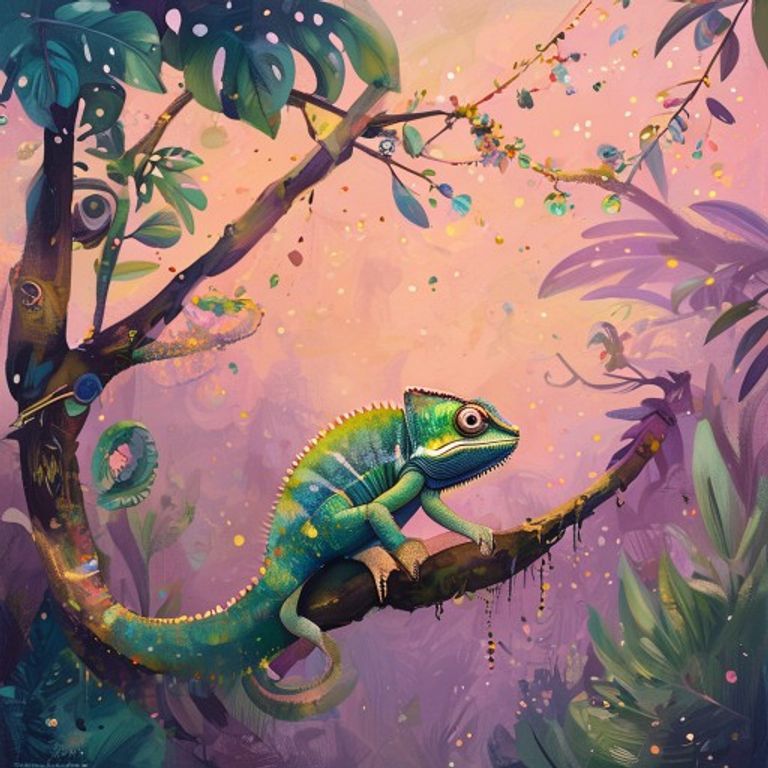
She found a quiet branch on the edge of the jungle, far from the color games and the laughter, and she made it her home. She wrapped her tiny tail around the branch and stayed very still. She did not try to change color. She did not try to be fast. She simply existed, small and green and invisible in her own way—not because she could blend in, but because no one looked for her there.
The Night of a Thousand Colors
Once a year, when the moon was full and the jungle hummed with life, the Rainbow Jungle held its grandest celebration: the Festival of a Thousand Colors. On this night, every chameleon in the jungle gathered at the Great Banyan tree and painted the clearing with their most spectacular color-shifting displays. They created living murals—forests of light, rivers of shadow, gardens of impossible blooms. Fireflies danced around them, adding their golden sparks. Glow-worms beneath the roots pulsed in rhythm. The jungle itself seemed to hold its breath, watching the chameleons paint the night.
Kira never went.
She had been invited, of course. Her mother had begged her. Her siblings had promised to help her. But Kira could not bear the thought of standing in that clearing, changing so slowly while the others painted masterpieces around her. She could not bear the thought of being the one chameleon who could not keep up. So she stayed on her quiet branch, watching the distant glow of the festival through the leaves, telling herself she did not mind.
But she minded.
She minded very much.
The Lost Cub
On the night of the festival, when the moon was a silver coin in the sky and the Great Banyan blazed with color, something happened that had never happened before.
A young tiger cub named Raja wandered away from his mother's den.
Raja was not supposed to be out. He was barely old enough to open his eyes all the way, and the jungle at night was full of shadows that moved and sounds that whispered. But Raja was curious—terribly, wonderfully, dangerously curious. He had heard the music of the festival drifting through the trees, and he had followed it, one wobbly paw-step at a time, until he found himself in a part of the jungle he did not know.
He was lost.
And he was terrified.
The jungle that had seemed so exciting in daylight had become a place of monsters. Every shadow was a predator. Every rustle was a threat. Raja mewed softly, his tiny stripes bristling, his heart hammering against his ribs like a trapped bird. He did not know which way was home. He did not know that his mother was already searching, her orange coat flashing through the undergrowth like a living flame. He only knew that he was small, and alone, and afraid.
He stumbled through the dark, past the festival clearing where the chameleons danced in their thousand colors, past the river where crocodiles slept with one eye open, past the ancient temple where monkeys chattered warnings. He wandered deeper and deeper into the part of the jungle where even the moonlight could not reach, where the trees grew so thick their branches wove a roof of darkness overhead.
And there, on her quiet branch at the very edge of that darkness, Kira heard him.
She heard the soft, broken mewing. She heard the rustle of small paws on dry leaves. She heard the quick, frightened breathing. And she turned her golden eyes toward the sound and saw Raja—small, striped, trembling—standing in a patch of moonlight no bigger than a leaf.
Kira's first instinct was to hide. Tigers ate chameleons. Everyone knew that. Even a cub could snap her up in one bite. She pressed herself against her branch and willed herself to change color, to blend in, to vanish.
But she could not change quickly. Her emerald skin stayed emerald. Her golden eyes stayed golden. She was as visible as a leaf in winter.
Raja saw her. Their eyes met. The cub's golden eyes, so like her own, locked onto her. And Raja did not roar. He did not pounce. He simply stared, trembling, and mewed again—softly, pitifully, the sound of a child who needs help.
Kira felt something shift inside her. It was not courage, exactly. It was something quieter. Something deeper. It was the understanding that being afraid and helping anyway are not opposites. They are companions.
"Hello," she whispered, her voice no louder than a leaf falling. "I am Kira. I know you are lost. I will help you."
The Slow Light
Kira did not know where Raja's den was. She had never been to that part of the jungle. But she knew something the other chameleons did not know—something she had discovered during all those lonely hours on her quiet branch.
She knew that her slow color changes, while useless for blending in, created something else. Something the quick-flickering chameleons could never make.
A glow.
When Kira changed color slowly, her skin did not simply shift from one hue to another. It glowed. Each transition released a soft, steady light—a bioluminescence that built gradually, like a lantern being turned up. Where Zazu's quick shifts were like sparks, Kira's slow changes were like embers. Where Lila's rippling rainbow was like fireworks, Kira's gradual glow was like a candle. It was not bright. It was not flashy. But it was steady. It was warm. And in the deepest darkness, it was enough.
"Follow me," Kira said to Raja. And she began to change.
She let her emerald skin soften to jade. The jade deepened to forest green. The forest green shifted to olive. And as she changed, she glowed—a soft, pulsing light that cut through the darkness like a tiny green star.
Raja stared, his fear momentarily forgotten. "You are glowing," he whispered.
"Yes," Kira said. "I am slow. But I am steady. And steady light is better than bright light when you are lost in the dark."
She moved forward, one careful step at a time, her body glowing like a living lantern. Raja followed, his small paws padding in her light, his fear slowly melting into wonder. They walked through the thickest part of the jungle, where the moon could not reach, where even the fireflies did not venture. But Kira's glow was enough. It was small, yes. It was gentle, yes. But it was constant. It did not flicker. It did not fade. It simply stayed, a promise in the dark.
They walked for what felt like hours. Kira's glow never wavered, though her legs ached and her heart pounded and her fear of tigers never fully left her. She thought of her quiet branch. She thought of the festival, blazing with color somewhere behind her. She thought of Zazu and Lila and all the chameleons who could shift faster than thought, who would never understand why she was doing this, why she was risking her life for a tiger cub.
And then she thought: they do not need to understand. I understand. This is my gift. This slow, steady glow. It is not what they have. It is what I have. And right now, it is exactly what is needed.
It was the first time Kira had ever thought of her slowness as a gift.
The Finding
They found Raja's mother at the edge of the Deep Thorn Thicket. She was frantic, her orange coat streaked with mud and thorns, her golden eyes wild with worry. When she saw Raja trotting out of the darkness behind a small, glowing chameleon, she did not roar. She did not attack. She simply stopped, stared, and then—incredibly, beautifully—lay down and nuzzled her cub with a tenderness that made Kira's heart ache.
"You found him," Raja's mother said, her voice a rumbling purr. "I searched everywhere. The festival lights were too bright. The fireflies were too scattered. I could not see him in the dark. But you..." She looked at Kira's soft, steady glow. "You were a light that did not go out."
Kira bowed her tiny head. "I am slow," she said. "But I am here."
Raja's mother licked her cub clean, then turned to Kira with golden eyes full of something the little chameleon had never seen before. Not pity. Not amusement. Respect.
"Slow is not less," the tiger said. "Slow is its own kind of strength. The river that flows slowly digs the deepest canyon. The star that burns slowly shines the longest. And the chameleon who glows slowly..." She paused, nuzzling Raja. "...guides the lost home."
Kira did not know what to say. She had spent her whole life believing her slowness was a flaw. Now a tiger—a creature who could have eaten her in one bite—was telling her it was a strength.
She glowed a little brighter then. Not because she tried to. But because she finally believed she could.
The Festival Revisited
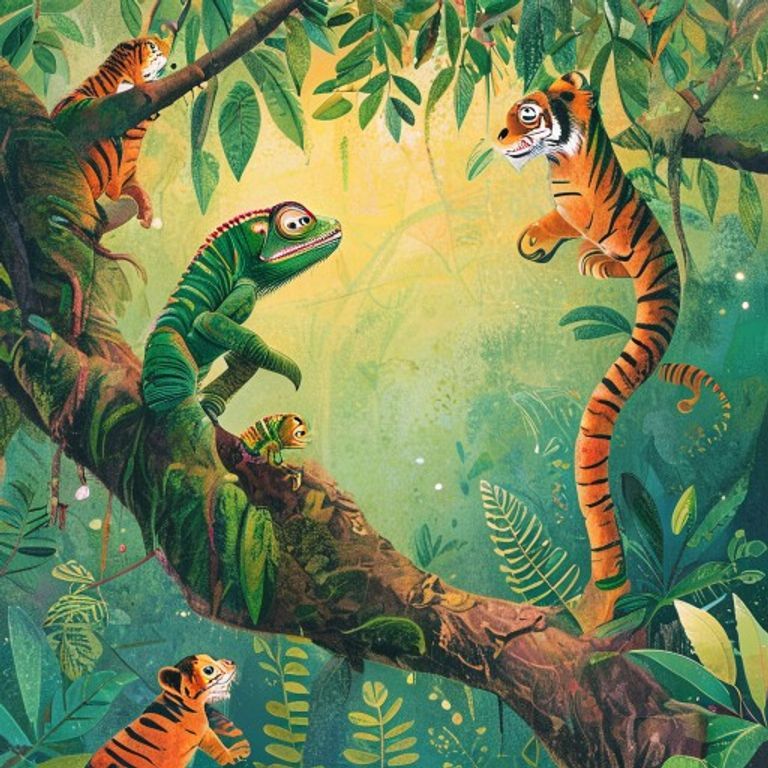
Kira returned to the Great Banyan clearing just as the Festival of a Thousand Colors was ending. The chameleons were dispersing, their colors fading to nighttime greens and browns, their energy spent. Zazu and Lila were resting on a branch, talking about their displays—how Zazu had created a lightning storm with his quick shifts, how Lila had painted a galaxy with her rippling rainbow.
They did not notice Kira at first. She was too small. Too quiet. Too slow.
But then Raja appeared behind her, his mother walking proudly at his side. The chameleons froze. Tigers did not come to the festival. Tigers were not part of their world. And yet here was a tiger mother, nudging her cub forward, and the cub was pointing with one small paw at Kira.
"That chameleon saved my life," Raja announced, his voice piping and brave. "She glowed in the dark. She was slow, but she never stopped. She brought me home."
The clearing fell silent. Every eye—swivel eyes, golden eyes, tiger eyes—turned to Kira. She wanted to hide. She wanted to vanish. But she could not change quickly, and she was tired of trying to be what she was not.
So she simply glowed.
Her emerald skin softened to jade. Her jade deepened to forest green. Her forest green shifted to olive. And as she changed, she glowed—soft, steady, warm. It was not a lightning storm. It was not a galaxy. It was a candle in the dark. And every creature in the clearing understood, suddenly and completely, that a candle in the dark is sometimes more precious than all the stars in the sky.
Zazu was the first to speak. "Kira," he said, his voice hushed. "I never knew you could do that."
"I didn't either," Kira admitted. "Not until I needed to."
Lila climbed down from her branch, her colors soft with wonder. "Your glow... it is different from ours. We flash and spark and vanish. But you... you stay. You hold the light. That is..." She searched for the word. "That is beautiful."
Kira felt her heart swell. Not with pride. Not with arrogance. With something quieter. Something truer. She felt, for the first time in her life, that she was enough. Not because she was the fastest. Not because she was the brightest. But because she was Kira. And Kira, it turned out, had exactly what someone needed.
The Morning After
The next morning, Kira woke on her quiet branch at the edge of the jungle. The sun was rising, painting the sky in colors that rivaled any chameleon display. She stretched her tiny legs and felt the branch beneath her and thought: I am still slow. I still cannot change color quickly. I still will never win a color-shifting race.
But she also thought: I glow. I guide. I help. And that is enough.
She climbed down from her branch and walked toward the Great Banyan clearing. She did not hide. She did not hurry. She moved at her own pace, her skin shifting slowly through shades of morning—dew-green, leaf-gold, sun-amber. And as she walked, she glowed. Not brightly. Not dramatically. Just enough.
The other chameleons saw her coming. They did not laugh. They did not look away. They simply made room for her in the clearing, and when she arrived, Zazu asked if she would teach them how to glow.
"I cannot teach you to be slow," Kira said. "You are fast. That is your gift. But I can teach you that being different is not being less. And that the thing you think is your flaw might be the thing someone else needs most."
So Kira became the Glow-Teacher of the Rainbow Jungle. She taught young chameleons that there are many ways to be beautiful. She taught them that speed is not the only measure of worth. She taught them that the chameleon who takes her time might light the way for someone who is lost.
And every year, at the Festival of a Thousand Colors, after the quick-flickering displays had ended and the fireflies had gone to sleep, Kira would climb to the highest branch of the Great Banyan tree and glow. Slowly. Steadily. Beautifully.
And in the darkness below, any creature who was lost, any creature who was afraid, any creature who needed to believe that they were enough—would see her light, and follow it home.
The Moral of the Story: Self-confidence is not about being the best at everything. It is not about being the fastest, the brightest, or the most talented. It is about understanding that your differences are not flaws—they are gifts waiting to be discovered. Kira spent her whole life believing that being slow meant being less. But her slowness turned out to be exactly what made her glow. Your so-called weaknesses might be your greatest strengths in disguise. The world does not need a hundred copies of the same person. It needs you—exactly as you are, with your unique gifts, your unique pace, your unique light. When you stop trying to be someone else and start being fully yourself, you do not just find confidence. You find your purpose. And sometimes, the very thing you have been hiding is the very thing that will guide someone else home.