The Garden of Many Hands: A Story About Cooperation
In the old Meadow of Morning Dew, where buttercups nodded their golden heads and clover spread like a green carpet stitched with purple, there lived a young rabbit named Petal. She was a soft brown creature with ears the color of autumn leaves and a habit of thumping her left hind foot when she was excited. And today, she was very excited indeed.
Petal had discovered something wonderful. Behind the old stone wall at the meadow's edge, where blackberry vines tangled and no creature had wandered in years, there was a patch of earth that caught the morning sun perfectly. It was sheltered from the wind. It had good soil. And Petal could see it in her mind's eye: a garden. Not just any garden, but the most beautiful wildflower garden the Meadow had ever seen. Purple lupines. Scarlet poppies. Golden sunflowers. Bluebells ringing in the breeze. A place where every creature could come to rest, to feast on nectar, to find shade on hot afternoons.
There was only one problem.
Petal could not build it alone.
She was, after all, just one small rabbit. She could dig, yes, but the soil behind the stone wall was hard and clay-heavy, packed tight by years of neglect. She could gather seeds, certainly, but the best wildflower seeds grew in the distant hills, farther than her small legs could travel in a day. She could water the garden with dew from the grass, but the patch was large—too large for one rabbit to keep moist through the dry summer months.
Petal sat by the stone wall, her whiskers drooping, her thumping foot still. The garden in her mind was so clear, so perfect, so full of color and life. But the garden in the world was just a patch of hard dirt.
"You look like someone who has lost something precious," a voice said.
Petal turned. A fat earthworm named Tilly was poking her pink head out of the ground, her segmented body glistening in the morning light. Tilly was known throughout the Meadow as the best digger—she could turn hard soil into soft, crumbly earth in a single afternoon.
"I haven't lost anything," Petal said, her ears drooping. "I just... I found something. A place for a garden. But I can't make it alone. The soil is too hard. The seeds are too far. The work is too much."
Tilly considered this, her tiny mouth pursing in thought. "Well," she said slowly, "I can help with the soil. Hard dirt is my specialty. But I can't carry seeds. I have no arms. And I can't water plants—I would drown. But if you find others who can do those things, and I can do the digging... well, that would be cooperation, wouldn't it?"
Petal's ears perked up. "Cooperation?"
"Working together," Tilly explained. "Each of us doing what we do best, so that together we can do what none of us can do alone."
Petal thumped her foot. Hope bloomed in her chest like the first flower of spring.
The First Helpers
Petal did not know where to find the others she needed. But she knew what she needed. And she knew that in the Meadow of Morning Dew, every creature had a gift. You just had to ask the right questions.
She found Buzz first. Buzz was a honeybee who lived in a hollow oak at the meadow's center. He was a scout bee, which meant he spent his days flying farther than any other bee, searching for new flowers, new fields, new sources of sweet nectar.
"Buzz," Petal said, thumping her foot nervously. "I want to build a flower garden behind the old stone wall. But the best seeds are in the distant hills, and I cannot fly. Could you... would you help me find seeds?"
Buzz circled her twice, his wings humming like a tiny violin. "A garden, you say? Full of flowers?"
"The most beautiful flowers," Petal promised. "Poppies and lupines and sunflowers taller than my ears."
Buzz landed on a clover blossom, his antennae twitching with delight. "I know those hills. I know exactly where the wild lupines grow, where the poppies paint the slopes red, where the sunflowers turn their faces to the sky. I will bring you seeds. But I cannot plant them. I am too small, and my legs are made for landing, not digging."
"Tilly will dig," Petal said. "And I will help plant."
Buzz buzzed with approval. "Then we have a garden to build."
The next helper came by accident. Petal was searching for someone who could bring water to the garden when a rain frog named Drop hopped out from beneath a fern, nearly landing on her nose. Drop was a nervous creature, always predicting storms, always feeling the weather in his green skin.
"A storm is coming," Drop said, his throat pulsing. "I can feel it in my bones. Three days, maybe four."
"A storm?" Petal's ears shot straight up. "But the garden—if we plant seeds, a storm might wash them away!"
Drop blinked his golden eyes. "Garden? What garden?"
Petal explained her dream. Drop listened, his throat pulsing faster with each detail. "I can help," he said when she finished. "I know every puddle in the Meadow. I know where the rainwater pools, where the underground springs bubble up, where the soil stays moist even in drought. I will guide the water to your garden. Not too much. Not too little. Just enough."
"But the storm," Petal said. "The seeds—"
"I will dig drainage channels," Drop said proudly. "I am a frog. Water is my language. I will speak to the storm and tell it where to go. The seeds will be safe. The garden will drink what it needs and send the rest away. Trust me. I have been listening to water since I was a tadpole."
Petal trusted him. She did not know why, but she did.
The Seed Hunt
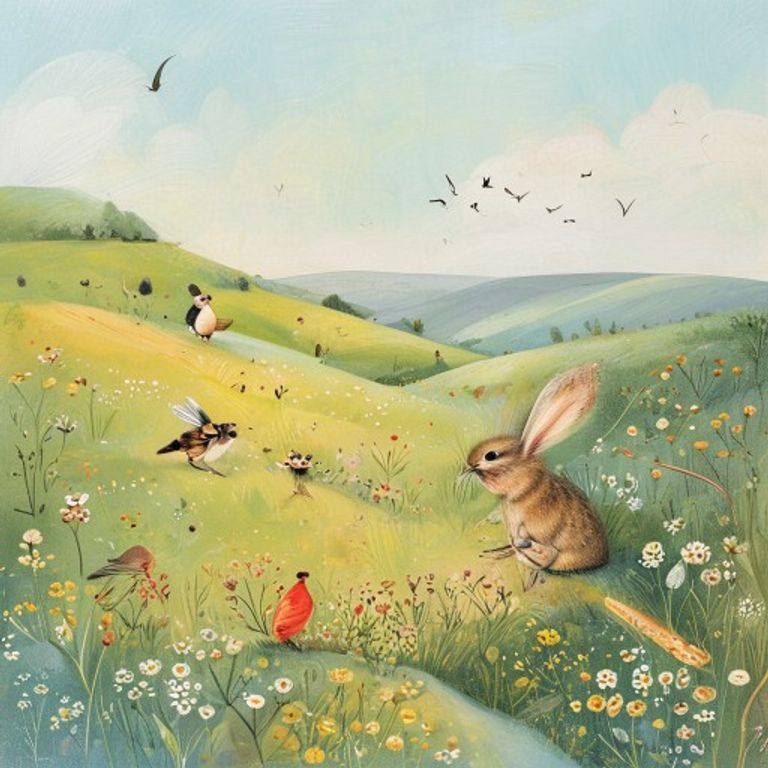
Buzz returned three days later with news that made Petal's heart race. "I found them," he announced, his wings dusty from travel. "The lupines on Windy Hill. The poppies on Red Ridge. The sunflowers in the Valley of Gold. The seeds are ripe. But there is a problem."
"What problem?" Petal asked.
"The seeds are heavy. I can carry one at a time, maybe two. But the garden you described needs hundreds. Thousands. It would take me all summer to bring enough."
Petal's ears drooped. Then a voice called from above. "I can help with that."
A finch named Feather landed on the stone wall, her feathers the color of ripe wheat. She was a seed-eater, which meant her beak was shaped for cracking shells and her crop was designed to carry them. "I travel to the hills every morning for breakfast," Feather said. "I can carry seeds in my crop. Not as many as a squirrel, but more than a bee. And I know shortcuts through the air that no ground creature can find."
"And I know where the blackberries hide their best canes," said a voice from the brambles. A harvest mouse named Twist emerged, her tiny paws clutching a ripe berry. "I can weave supports for the tall flowers so they do not fall in the wind. And I can gather the small seeds that fall between stones, the ones the big creatures miss."
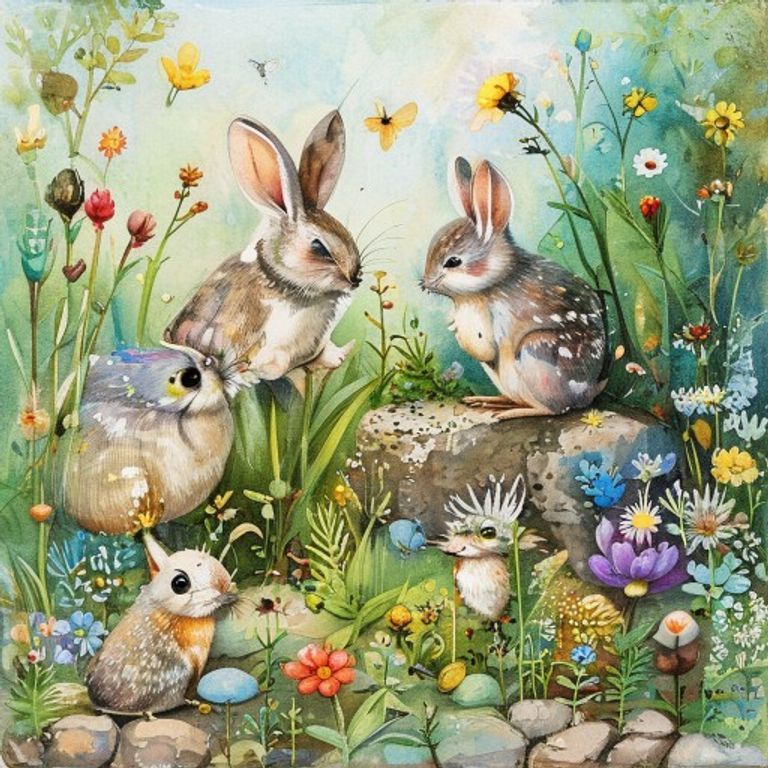
Petal looked around at her growing team. Tilly the worm, who would soften the soil. Buzz the bee, who would find the best seeds. Feather the finch, who would carry them from the hills. Drop the frog, who would guide the water. Twist the mouse, who would weave supports and gather what others missed. And Petal herself, who would plant, tend, and dream.
"But we still need protection," Petal said. "The garden will be new and tender. What if creatures trample it? What if hungry mouths eat the sprouts before they bloom?"
A deep, rumbling laugh came from the hedge. "Protection is my specialty."
A hedgehog named Bramble emerged, his spines bristling with authority. He was old, grumpy, and had defended the eastern corner of the Meadow from weasels, foxes, and overly enthusiastic deer for as long as anyone could remember. "I will patrol the garden at night," he declared. "Any creature who tries to nibble a sprout will find my spines instead of petals. And during the day, I will roll through the soil around the garden's edge, creating a natural wall of packed earth that says: 'This place is protected. Tread carefully.'"
"But why?" Petal asked, genuinely curious. "You are old. You have your own corner. Why help with my garden?"
Bramble snuffled. "Because I am tired of defending alone. Because a garden that belongs to everyone is a garden that everyone will defend. Because cooperation, young rabbit, means that even a grumpy old hedgehog can be part of something beautiful."
The Building
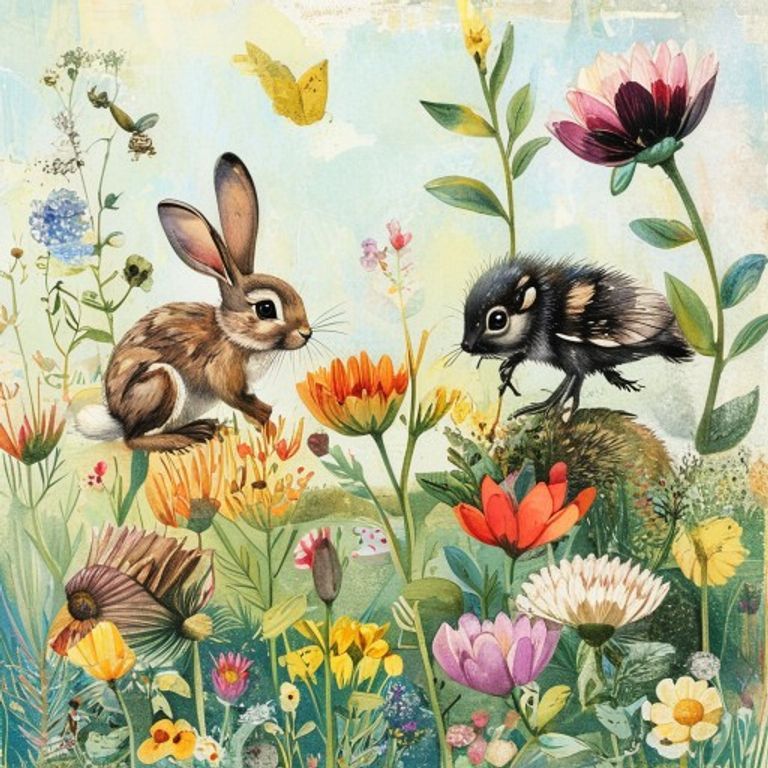
The work began at dawn.
Tilly worked the soil first, her segmented body moving through the clay like a needle through soft cloth. Where she passed, hard earth became crumbly, rich, ready to receive life. Petal followed, her strong hind legs kicking the loosened soil into gentle mounds and furrows.
Drop dug his channels, snaking paths of pebbles and gravel that would carry excess water away from the seeds while directing just enough moisture to their roots. He worked with the precision of a musician, feeling the slope of the land, listening to the soil's song.
Buzz and Feather made trip after trip to the hills, returning with seeds of every color and shape. Lupine seeds like tiny black pearls. Poppy seeds smaller than grains of sand, carried by Feather in batches of a hundred. Sunflower seeds, heavy and striped, brought by both bees and birds working in relay. Twist gathered the seeds that fell, the ones that rolled into cracks, the precious leftovers that no one else thought to save.
Petal planted each seed with care, tucking them into the soft earth at just the right depth, spacing them so they would have room to grow but not so much room that weeds would take over. She worked from sunrise to sunset, her paws muddy, her fur flecked with soil, her eyes bright with purpose.
Bramble rolled around the garden's edge, his spines leaving a protective barrier of packed earth. He patrolled at night, his small eyes gleaming in the darkness, his presence alone enough to discourage hungry wanderers.
Days turned into weeks. The seeds sprouted. Tiny green shoots pushed through the soil, reaching for the sun. The lupines grew first, their leaves spreading like green hands. The poppies followed, their stems fuzzy and determined. The sunflowers stretched upward, their heads still nodding, not yet bold enough to face the sky.
And then, one morning, a lupine bloomed.
It was the color of twilight—deep purple fading to pale blue at the edges. It swayed in the breeze like a dancer. Petal sat before it, her heart full to bursting, and she wept. Not from sadness, but from the overwhelming, impossible beauty of something that had been nothing but a dream, now made real by many hands.
The Garden Blooms
By midsummer, the garden behind the old stone wall was the most magical place in the Meadow of Morning Dew.
The lupines stood in purple spires, humming with bees who came not just from Buzz's hive but from hives three meadows away. The poppies blazed like scattered embers, their petals tissue-thin and glowing in the sunlight. The sunflowers towered over everything, their faces tracking the sun from dawn to dusk, their seeds already plump and promising.
But the garden was more than flowers. It had become a place.
The butterflies came first—painted ladies and cabbage whites and the occasional monarch, drifting from bloom to bloom like living confetti. The crickets came next, setting up their orchestras in the tall grass around the garden's edge, their songs rising and falling in waves of summer sound. The deer came in the cool of evening, not to eat the flowers—Bramble's spines had taught them respect—but to lie in the shade of the sunflowers, their long lashes brushing their cheeks as they dozed.
And then the creatures began to bring gifts.
A young squirrel brought an acorn, planting it at the garden's edge so that someday there would be an oak tree. A family of voles brought pebbles, arranging them in a spiral path that wound through the flowers. A lone swallow, passing through on her migration, left a bright blue feather in the soil as a promise to return.
The garden belonged to everyone. And because it belonged to everyone, everyone cared for it.
Petal would sit in the center of the garden at twilight, surrounded by color and life and the hum of a hundred wings, and she would think about how close she had come to giving up. How she had almost let the hard soil and the distant seeds and the overwhelming work convince her that her dream was impossible.
But it had never been impossible. It had just been impossible for one rabbit alone.
The Lesson
Years later, Petal was an old rabbit with grey around her muzzle and a thumping foot that had slowed but not stopped. She still lived in the Meadow of Morning Dew. And she still visited the garden every day.
The garden had grown. The oak tree planted by the young squirrel was now tall enough to cast shade over half the flowers. The spiral path of pebbles had been expanded by countless paws, winding through new beds of daisies and cornflowers and lavender. There was a pond now, small but deep, created by Drop's grandchildren who had learned his water-ways and expanded them.
Petal's own grandchildren played in the garden's shade, chasing butterflies and napping among the lupines. And one evening, as the sun painted the sky in shades of rose and gold, a young rabbit named Thistle came to her with the same bright, worried eyes that Petal had once worn.
"Grandmother Petal," Thistle said, thumping her foot just like Petal used to. "I want to build something. A berry patch on the southern hill. But the soil is rocky. The berries are far. The birds might eat them. I can't do it alone."
Petal smiled, her old eyes crinkling at the edges. She looked at the garden around them—the flowers, the path, the pond, the creatures who called it home. And she said the words that Tilly had once said to her, words that had changed everything.
"You do not have to do it alone, little one."
"But who will help me?" Thistle asked. "I am small. I have no special skills. I am just... me."
Petal nuzzled her granddaughter's soft fur. "That is the secret of cooperation, Thistle. No one is 'just' anything. Tilly was 'just' a worm, but without her, the soil would still be hard. Buzz was 'just' a bee, but without him, we would have had no seeds. Drop was 'just' a frog, but without him, the water would have drowned us or deserted us. Feather was 'just' a finch, Twist was 'just' a mouse, Bramble was 'just' a grumpy old hedgehog. But together, we were not 'just' anything. Together, we were a garden."
She paused, letting the evening breeze carry the scent of lupines through the air. "Cooperation is not about finding the strongest or the fastest or the cleverest. It is about finding the ones who can do what you cannot. It is about trusting that your weakness is someone else's strength. It is about building something so beautiful that everyone wants to protect it."
Thistle thought about this, her small nose twitching. "So I should ask for help?"
"You should ask for help," Petal agreed. "And you should offer your help in return. Because cooperation is not just receiving. It is giving. It is the circle of giving and receiving that never ends, like the seasons, like the sun rising and setting, like the flowers blooming and seeding and blooming again."
Thistle hopped away, her ears perked with new hope. And Petal sat in her garden, surrounded by the results of cooperation, and she knew that the most important lesson of her long life was this: We are not meant to do great things alone. We are meant to do them together.
The Moral of the Story: Cooperation is not about being the same. It is about being different, and letting those differences become strengths. Petal could dig, but she could not fly. Buzz could fly, but he could not soften soil. Tilly could soften soil, but she could not carry water. Drop could carry water, but he could not gather seeds. Feather could gather seeds, but she could not weave supports. Twist could weave supports, but she could not defend. Bramble could defend, but he could not plant. Each of them had something the others lacked. Each of them needed something the others had. And together, they built a garden that no single creature could have imagined, let alone created. That is cooperation. Not losing yourself in the group. Not becoming less so that others can become more. But becoming part of something bigger, something better, something more beautiful than any one of you could ever be alone. The world is full of creatures who are trying to do everything by themselves. Do not be one of them. Find your Tilly. Find your Buzz. Find your Feather, your Drop, your Twist, your Bramble. And build something wonderful. Together.