The Frog Who Taught the Pond to Listen: A Story About Empathy
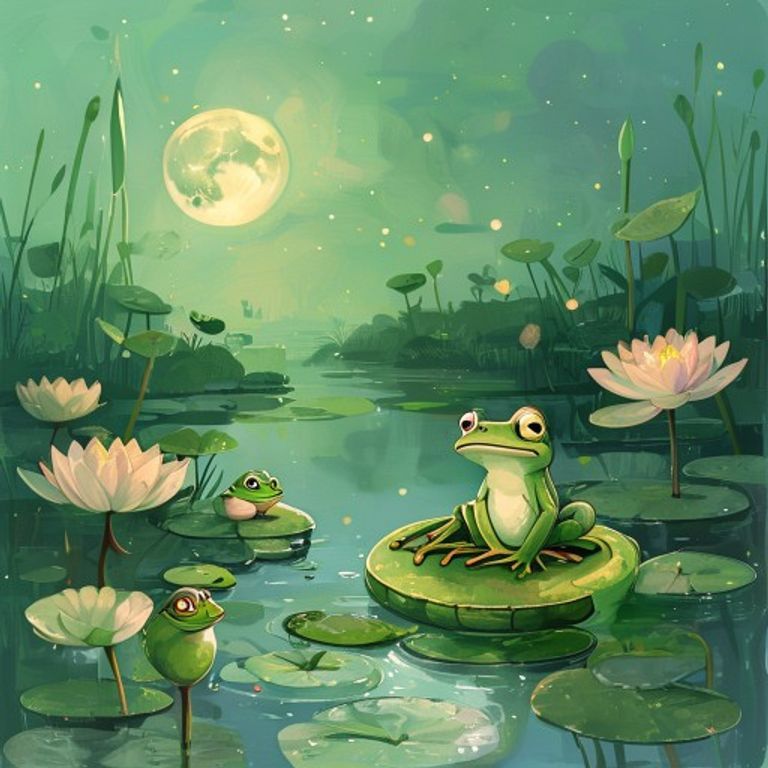
In the center of the Willowbrook Pond, where lily pads floated like green coins and dragonflies stitched the air with silver thread, there lived a frog named Ripple. He was the same mossy green as the pond's edge, with eyes the color of amber honey and webbed feet that could paddle so softly he barely disturbed the water.
But Ripple was different from every other frog in the pond.
He could not croak.
The Frog Who Had No Voice
In the world of frogs, croaking was everything. It was how you said good morning to the sun. It was how you warned your friends about the heron. It was how you told the pond that you were happy, or scared, or in love. A frog's croak was their heart, turned into sound and sent rippling across the water for everyone to hear.
But Ripple had been born with a throat that made no sound. When he opened his mouth, only silence came out. When he puffed up his throat-sac, it stayed flat and still. When the evening chorus began—all the frogs singing their different songs in harmony—Ripple sat on his lily pad and moved his mouth in silence, like a child pretending to sing.
At first, the other frogs tried to help him. His mother brought him special flies that were supposed to "clear the throat." His father took him to the deepest part of the pond, where the echoes were strongest, hoping the sound would "bounce back" into his voice. His brothers and sisters taught him breathing exercises. The old toad at the muddy bottom gave him a recipe for pond-weed tea that was "guaranteed to make any creature sing."
None of it worked.
"Poor Ripple," the other frogs would say. And they meant it kindly. But kindness can sound like pity when you are the one receiving it, and Ripple learned to sit at the edge of the lily pad cluster, separate from the chorus, watching the other frogs sing while his own throat remained stubbornly, permanently silent.
But Ripple was not empty. He was not broken. He was not "less than" the other frogs.
He was just different. And his difference became his gift.
Because Ripple could not speak, he learned to watch. While the other frogs were busy making noise, Ripple studied the water. He noticed how a happy frog's landing made gentle, spreading circles—like a smile made of water. He noticed how a frightened frog's splash was sharp and jagged, sending drops flying in all directions. He noticed how a lonely frog sat so still that the water around them became as smooth as glass, reflecting the sky like a mirror that had no one to look into it.
He learned to read the tilt of a lily pad—how it dipped lower when a frog was tired, how it trembled when a frog was anxious, how it turned toward the sun when a frog was hopeful. He learned to read the twitch of a frog's toes, the flare of their nostrils, the way their eyes widened or narrowed or looked away.
Ripple learned to understand feelings that had no sound.
The Night the Chorus Stopped
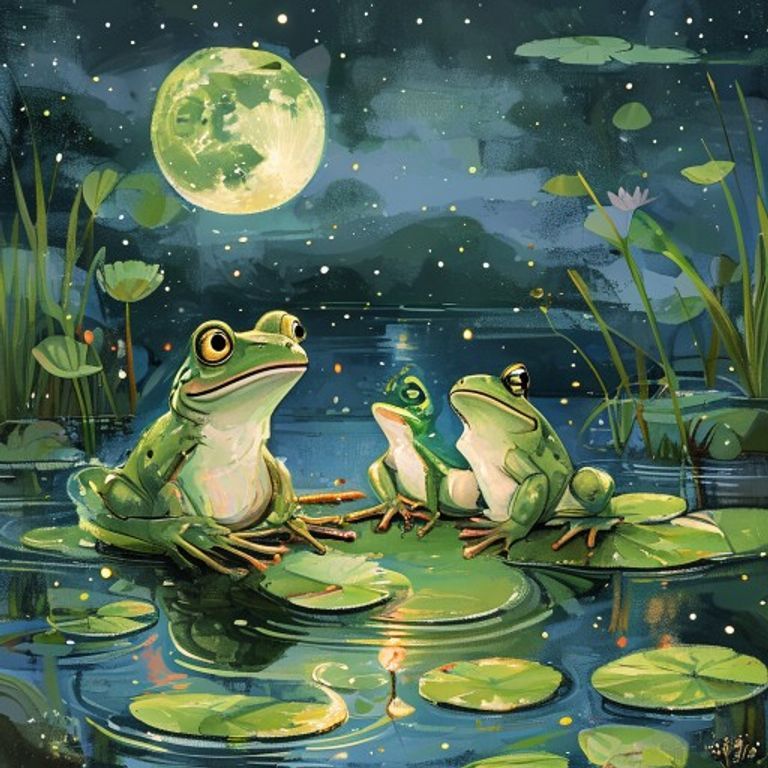
It happened on a warm summer evening, when the moon was round and white as a lily pad blossom and the air smelled of jasmine and warm mud. The frogs were singing their evening chorus—the deep voices of the bullfrogs, the trilling voices of the tree frogs, the rhythmic calls of the leopard frogs—all woven together into a tapestry of sound that had filled the pond every night for as long as anyone could remember.
But in the middle of the chorus, the oldest frog in the pond, Elder Croak, fell silent.
Not the brief pause of a frog catching their breath. Not the momentary stillness of a frog listening for a predator. Elder Croak's voice simply... stopped. Mid-croak. As if someone had gently placed a finger on his throat and held it there.
The other frogs didn't notice at first. The chorus was so loud, so full, so layered with so many voices that one missing voice was like one missing thread in a thick blanket. But Ripple noticed. Because Ripple had spent his whole life listening to what others could not hear. And he heard the silence where Elder Croak's voice should have been.
Ripple swam across the pond, his webbed feet barely stirring the water. He found Elder Croak on the largest lily pad, the one in the center of the pond where the moonlight fell most brightly. The old frog was sitting very still, his throat-sac flat and empty, his eyes half-closed, his breathing slow and shallow.
Ripple climbed onto the lily pad and sat beside him. He didn't try to croak a greeting. He didn't try to ask what was wrong. He simply sat there, his green body pressed gently against the old frog's cooler, bumpier skin, and watched the water.
He saw the tiny ripples that spread from Elder Croak's body—so faint, so slow, so tired. He saw the way the old frog's toes curled inward, not from cold but from something deeper. He saw the way Elder Croak's eyes, usually sharp and knowing, had turned soft and distant, looking at something that wasn't there.
Ripple understood, in the way that only someone who has spent a lifetime in silence can understand, that Elder Croak was not sick. He was not injured. He was... leaving. His voice had stopped because his story was ending. And he was afraid.
The Gift of Silence
The other frogs began to realize something was wrong. One by one, their voices trailed off as they noticed Elder Croak's silence. The chorus thinned. Then faltered. Then stopped completely, leaving the pond quieter than it had been in decades.
"Elder Croak?" called Bull, the biggest bullfrog, his voice booming across the still water. "Are you all right?"
Elder Croak did not answer. He couldn't. His voice was gone, and even if it had been there, he no longer had the strength to use it.
The frogs gathered around the great lily pad, their eyes wide with fear. They had never seen Elder Croak silent. He had been the voice of the pond for forty summers, the one who started the chorus every evening, the one who told stories on moonless nights, the one who settled disputes and welcomed newcomers and remembered the names of frogs who had left long ago.
"What do we do?" whispered Peeper, a small tree frog, her voice shaking.
"We should get him to the warm mud," said Splash, a young leopard frog. "The mud at the south end is supposed to cure everything."
"We should sing to him," suggested Trill, a musical tree frog. "Maybe if we sing loud enough, his voice will come back."
But Ripple knew that none of those things would help. Because Elder Croak didn't need mud, and he didn't need songs. He needed something that no frog had ever thought to give him.
He needed someone to sit with him in the silence.
So Ripple did something that no frog had ever done. He reached out with his webbed hand and placed it gently on Elder Croak's shoulder. The old frog's eyes opened—just a little—and looked at Ripple. And in that look, there was surprise, and confusion, and then... recognition.
Ripple couldn't say, "I'm here." He couldn't say, "You're not alone." He couldn't say, "It's okay to be afraid." But he could show him. He could press his shoulder against the old frog's shoulder and let his warmth seep into Elder Croak's cooling skin. He could adjust his position so that the moonlight fell on Elder Croak's face instead of his back. He could reach into the water with one foot and create a small, gentle current that brought cool, fresh water to lap against the old frog's dry sides.
He could be there. Fully. Completely. In the silence.
And that was enough.
The Lesson of the Lily Pad
The other frogs watched from the edges of the great lily pad, uncertain, afraid, not knowing what to do. They were so used to solving problems with sound—arguing, advising, singing, shouting—that the silence between Ripple and Elder Croak made them uncomfortable. It made them feel helpless.
But slowly, slowly, something began to change.
As Ripple sat with Elder Croak through the night, the old frog's breathing slowed even more. His eyes closed. His body grew cooler. But the expression on his face—the one that Ripple could see in the moonlight, the one that no sound could have revealed—was not fear anymore. It was peace.
And when the first pink fingers of dawn touched the eastern sky, Elder Croak's chest rose one last time... and did not fall again.
He was gone.
The frogs did not sing that morning. They sat on their lily pads in silence, looking at the still form of their oldest friend, and at the small green frog who had sat with him through the night.
"You didn't try to fix him," said Bull quietly, his usually booming voice barely a whisper. "You didn't try to make him better. You just... sat there."
Ripple looked at Bull. He opened his mouth, and of course, no sound came out. But he didn't need sound. He reached out with one foot and drew a single, perfect circle in the water between them. A ripple that spread outward, gentle and complete, until it touched the edge of the lily pad and disappeared.
And Bull understood.
Because sometimes, empathy is not a word. Sometimes it is not advice, or comfort, or a solution. Sometimes empathy is simply a circle in the water. A presence. A witness. The quiet certainty that someone is with you, even when there is nothing left to say.
The Pond's Heart
After Elder Croak's passing, something changed in Willowbrook Pond. Not the water, which was the same. Not the lily pads, which still floated like green coins. Not the dragonflies, which still stitched the air with silver thread.
What changed was the frogs.
They began to notice things they had never noticed before. They noticed how Peeper, the small tree frog, always sat at the very edge of the cluster, her songs a little quieter than the others, her eyes a little sadder. They noticed how Splash, the leopard frog, jumped a little too high and landed a little too hard, as if he was trying to prove something. They noticed how Trill's music, though beautiful, sometimes wobbled at the edges, like a song that was holding back tears.
And they began to come to Ripple.
Not because he could give them advice—he couldn't speak. Not because he could tell them what to do—he had no answers. They came to him because he could see them. Really see them. The parts they hid behind their songs. The feelings they buried beneath their croaks. The loneliness they covered with noise.
Peeper came to him one evening, her throat-sac trembling, and sat on his lily pad without saying a word. Ripple didn't ask what was wrong. He simply sat beside her, his green body warm against her cooler skin, and watched the water. After a while, Peeper began to cry—silent tears that rolled down her face and dropped onto the lily pad, making tiny dark spots on the green.
And Ripple reached out and drew another circle in the water. A ripple that spread outward, gentle and complete.
"My sister left the pond," Peeper whispered, even though Ripple couldn't have answered even if he'd wanted to. "She went to the river. She said the pond was too small. And I miss her so much, but I don't know how to say it without sounding like I'm holding her back."
Ripple didn't say, "You should tell her." He didn't say, "She'll come back." He didn't say, "It will get better." He simply sat with her in the silence, and let her feel what she felt, and let the feeling be enough.
And somehow, that was more comforting than any words could have been.
Splash came next, his jumps too high, his landings too hard, his eyes darting everywhere except to Ripple's face. He sat on the lily pad and fidgeted and opened his mouth and closed it and opened it again, and finally said, "I'm scared I'm not brave. Everyone says I'm the bravest frog in the pond because I jump so high. But I jump high because I'm scared. I'm scared of being still. I'm scared that if I stop moving, everyone will see that I'm just... small."
Ripple looked at him. Really looked at him. And then he did something surprising. He reached out with both feet and drew two circles in the water—one large, one small. The small circle was inside the large one. Perfectly. Completely. As if it belonged there.
And Splash understood. Small was not less. Small was just a different size of belonging.
One by one, the frogs came to Ripple. They came with their fears and their sadness and their secrets, and they sat with him in the silence, and they left lighter than they had arrived. Not because he fixed them. Not because he saved them. But because he saw them. Because he let them be exactly what they were, without trying to change them, without trying to make them better, without trying to turn their pain into something else.
The Silent Chorus
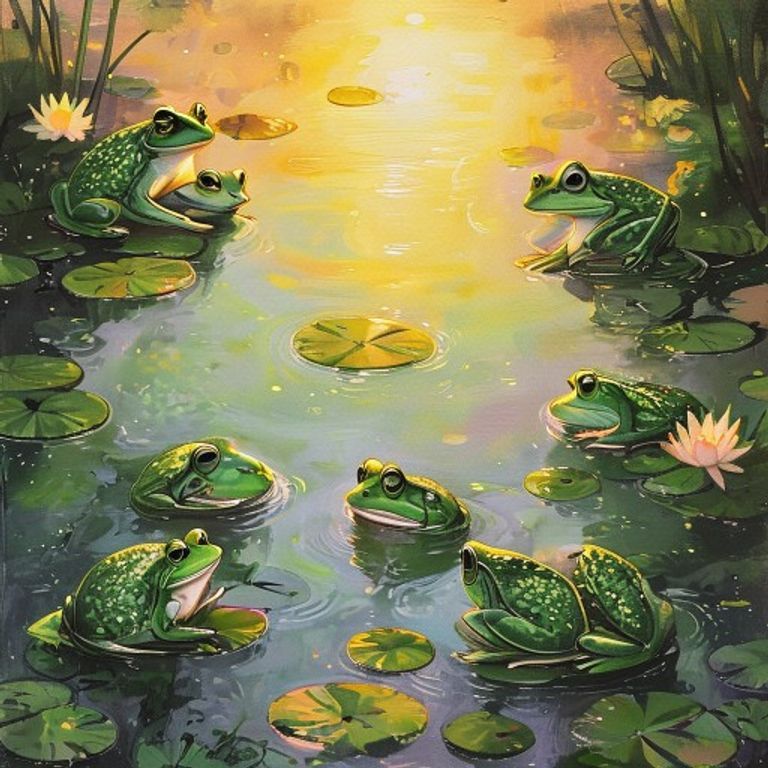
On the anniversary of Elder Croak's passing, the frogs of Willowbrook Pond did something they had never done before. They gathered on their lily pads as the sun set and the moon rose, and they did not sing.
They sat in silence.
Not the uncomfortable silence of not knowing what to say. Not the heavy silence of fear or sadness. But the full, rich, complete silence of being together without needing sound.
And in that silence, something magical happened.
Without the noise of their croaks, the frogs began to hear other things. They heard the wind moving through the reeds, making music that no frog throat could match. They heard the water lapping against the lily pads, a rhythm older than any chorus. They heard the dragonflies' wings, a thousand tiny heartbeats in the air. They heard their own breathing, synchronized, steady, alive.
And they heard, in the spaces between sounds, the thing that Ripple had always known was there.
They heard each other.
Not with their ears. With something deeper. Something that didn't need words or croaks or songs. Something that lived in the shared silence, the mutual breathing, the invisible thread that connected every frog on every lily pad in the moonlit pond.
Ripple sat in the center of it all, his throat-sac flat and still, his eyes closed, his body swaying gently with the movement of the water. And for the first time in his life, he did not feel separate. He did not feel "less than." He did not feel like the frog who couldn't sing.
He felt like the frog who had taught the pond to listen.
And that was a song more beautiful than any croak could ever be.
The Moral of the Story: Empathy is not about having the right words. It is not about knowing what to say or how to fix someone else's pain. Sometimes, the most powerful empathy is silence. It is sitting with someone in their darkest moment and not trying to make it brighter. It is being present when there is nothing to do but witness. It is letting someone feel what they feel, without rushing them toward feeling better. Ripple could not croak. He could not offer advice. He could not sing comfort or shout encouragement. But he could see. He could feel. He could sit in the silence and let it be full instead of empty. And that was enough. That was more than enough. That was everything. Because empathy is not a voice. It is a presence. It is not a solution. It is a shared breath. It is the courage to be with someone in their pain, without trying to take the pain away. And when you learn to do that—when you learn to be still, to listen, to see what others cannot see—you become the heart of every community you touch. Not because you are the loudest. But because you are the most there.