The Honeycomb Castle: A Story About Forgiveness
In the Whisperwood Forest, where the trees grew so tall they seemed to touch the clouds, and where the air always smelled of pine needles and wild honey, there lived a young bear named Bruno.
Bruno was not the biggest bear. He was not the strongest bear. He was not even the bravest bear.
But he was the bear who tried the hardest.
He tried to carry the heaviest logs for his papa's dam. He tried to climb the tallest trees to reach the sweetest berries. He tried to catch the fastest fish in the Crystal Creek, even though he usually ended up with nothing but a wet nose and a story to tell.
And most of all, he tried to make his grandmother proud.
Grandmother Bear—whom everyone called Honeyma—was the most beloved bear in all of Whisperwood. She baked honey cakes that made the whole forest smell like warmth. She told stories that made the stars lean down to listen. And every autumn, she won first prize at the Forest Fair for her honeycomb sculptures—delicate, golden creations that looked like lace made of sunlight.
This year, Honeyma had been working on her most beautiful sculpture ever.
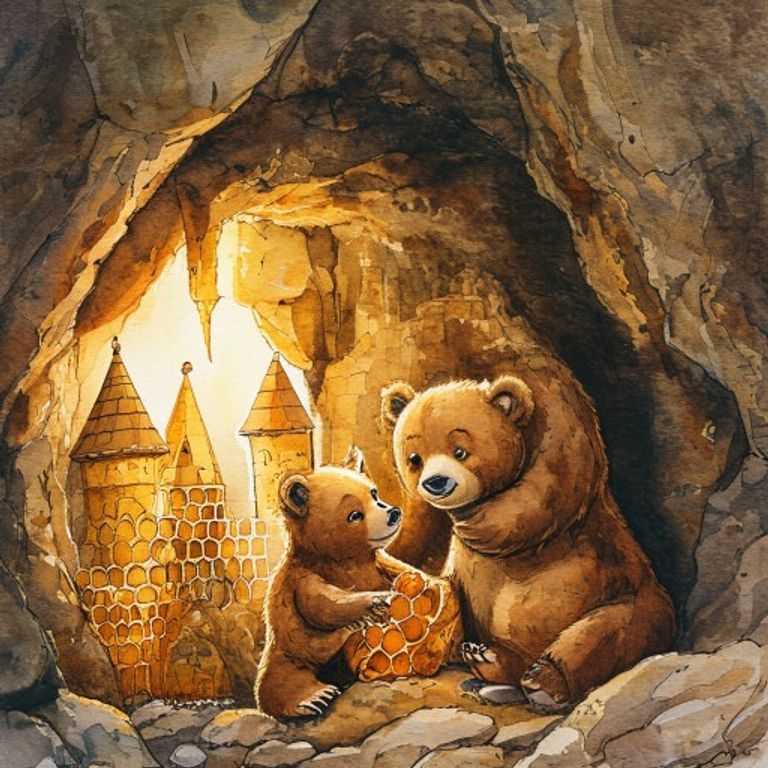
It was a honeycomb castle. Towers and turrets and tiny windows, all carved from beeswax and golden honey, glistening in the light of her cave fireplace. She had been working on it for three months. She had not let anyone see it, not even Bruno.
"It is a surprise," she said, her eyes twinkling like amber. "For the Fair. And for you, my little cub."
Bruno's heart swelled with pride. His grandmother was making something special, and it was partly for him! He could not wait to see it. He imagined the castle, tall and golden, and dreamed of how everyone at the Fair would gasp when they saw it.
The day before the Fair, Honeyma had to visit the other side of the forest to help Old Owl with his wing. She would be gone all morning.
"Do not touch anything in my workshop," Honeyma said, kissing Bruno's forehead. "Especially not the castle. It is very fragile."
"I promise," Bruno said, crossing his heart. "I will not even look at it."
But after Honeyma left, Bruno sat in their cozy cave, and he thought.
He thought about how hard his grandmother had worked. He thought about how tired she must be. And he thought about how wonderful it would be if, when she came home, the castle was not just finished, but displayed on a beautiful table, surrounded by wildflowers, ready for the Fair.
"I will surprise her," Bruno said to himself. "I will be so careful. I will move it just a tiny bit, to the table by the window. She will be so happy!"
He tiptoed into Honeyma's workshop.
The honeycomb castle sat on a stone pedestal in the center of the room. It was even more beautiful than Bruno had imagined. The towers caught the morning light and turned it into gold. The windows were so tiny and perfect, they looked like they belonged to a fairy tale.
Bruno took a deep breath.
He reached out his paws. He was going to lift the pedestal—just lift it, very carefully, and carry it to the window table.
But honeycomb is heavy.
And Bruno, try as he might, was still a small bear.
His paws slipped. The pedestal tilted. The castle wobbled.
And then, with a sound like the saddest sigh in the world, the honeycomb castle fell.
It did not just fall. It shattered.
The towers crumbled. The turrets dissolved into golden dust. The windows, so perfect and tiny, vanished into a pile of sticky, broken sweetness.
Bruno stood frozen.
He looked at the wreckage. He looked at his paws. He looked at the empty pedestal.
And then he ran.
He ran out of the workshop. He ran out of the cave. He ran into the Whisperwood Forest, past the berry bushes, past the Crystal Creek, past the old oak tree where he and Honeyma used to picnic.
He ran until his legs ached. He ran until he could not breathe. He ran until he found a hollow log deep in the thickest part of the forest, and he crawled inside, and he did not come out.
Bruno cried.
He cried because he had broken his grandmother's heart. He cried because he had ruined three months of work. He cried because he had promised not to touch the castle, and he had touched it, and now it was gone.
"I am the worst bear in the world," he whispered to the shadows in the log. "Grandmother will never forgive me. I will never forgive me."
Hours passed.
The sun climbed high in the sky. The afternoon shadows stretched across the forest floor. Birds sang their evening songs. And still Bruno hid.
He was hungry. He was thirsty. His fur was tangled with burrs. But he did not move. He could not face his grandmother. He could not face what he had done.
And then, as the sun began to set, painting the sky in shades of rose and amber, Bruno heard footsteps.
Soft footsteps. Slow footsteps. Footsteps he knew as well as his own heartbeat.
"Bruno?" Honeyma's voice was gentle, like rain on leaves. "Bruno, my little cub. Where are you?"
Bruno pressed himself deeper into the log. He held his breath. He closed his eyes.
"I know you are here," Honeyma said. "I can smell your honey on the blackberry bush. And your paw prints are in the mud by the creek. And your favorite acorn hat is lying on that mossy stone."
Bruno said nothing.
Honeyma sat down beside the log. She did not reach in. She did not pull him out. She just sat, and waited, and hummed the old song she used to sing when Bruno was very small.
"You are not angry?" Bruno whispered, his voice tiny and trembling.
"I was worried," Honeyma said. "I came home and found the castle broken, and you gone. I was afraid you were hurt. I was afraid you were lost. I was afraid..." her voice softened, "...that you thought I would stop loving you."
Bruno burst into tears.
"I ruined it!" he sobbed, crawling out of the log. "Your beautiful castle! Three months of work! And I promised not to touch it, and I touched it, and I broke it, and I ran away because I was too scared to tell you, and now you hate me, and I hate me, and—"
Honeyma pulled him into her arms.
She held him tight, the way she had when he was a baby bear, all soft and new. She rocked him. She stroked his tangled fur. She let him cry until there were no more tears left.
"Bruno," she said, when his sobs had quieted. "Look at me."
Bruno looked up. Honeyma's eyes were warm and wet, but they were not angry.
"Do you know what the castle was made of?" she asked.
"Honey," Bruno sniffed.
"Yes. But do you know what made it special?"
Bruno shook his head.
"It was special because I made it for you," Honeyma said. "Every tower, every window, every golden drop—I made it thinking of your face when you would see it. I made it thinking of how you would clap your paws and laugh. I made it because I love you, little cub. And do you know what happens to things made of love when they break?"
Bruno shook his head again.
"They can be rebuilt," Honeyma said. "But do you know what happens when love itself breaks?"
Bruno trembled. "What?"
"Nothing," Honeyma said, smiling through her tears. "Because love does not break, Bruno. Not real love. Real love is stronger than honeycomb. Real love is stronger than mistakes. Real love says, 'I am hurt, but I still choose you.' That is what forgiveness is."
Bruno stared at her. "You... you forgive me?"
"I forgave you the moment I saw the broken castle," Honeyma said. "Because I did not see a broken castle. I saw a little cub who tried to do something kind. Who wanted to surprise his grandmother. Who made a mistake, as all cubs do, as all bears do, as all creatures do."
She lifted his chin with her paw.
"But there is someone else who must forgive you, too."
"Who?" Bruno asked.
"You," Honeyma said. "You are angry at yourself. You are calling yourself the worst bear in the world. You ran away and hid in a log because you could not stand to be with yourself. But Bruno, my love—making a mistake does not make you bad. It makes you learning. And learning is beautiful."
Bruno thought about this.
He thought about how scared he had been. How sure he was that he was unlovable. How he had punished himself with hunger and loneliness, as if that would make the castle whole again.
"I do not know how to forgive myself," he whispered.
"Start small," Honeyma said. "Say, 'I made a mistake, but I am still good.' Say, 'I broke something, but I did not break love.' Say, 'I will do better tomorrow, and tomorrow, and tomorrow, because that is what growing up means.'"
Bruno closed his eyes.
"I made a mistake," he said, his voice shaking. "But I am still good."
"Yes," Honeyma whispered.
"I broke something," Bruno said, a little stronger. "But I did not break love."
"No," Honeyma said. "You did not."
"I will do better tomorrow," Bruno said, and now he was crying again, but they were different tears. Lighter tears. Tears that felt like rain washing dust away. "And tomorrow. And tomorrow. Because that is what growing up means."
Honeyma kissed his forehead. "Yes, my little cub. That is exactly what it means."
They walked home together, paw in paw, as the first stars began to appear.
The honeycomb castle was still broken. The pieces still lay on the workshop floor, golden and sad. But Honeyma did not sweep them away.
"We will rebuild it," she said. "Together. Not the same castle—a new one. With more windows, because you love windows. And a garden, because you love flowers. And a door big enough for two bears to walk through together."
Bruno's eyes grew wide. "Together?"
"Together," Honeyma said. "Because forgiveness is not just saying 'I am sorry.' It is saying 'I will try again, and I will let you help me.'"
That night, they did not finish the castle. They only gathered the pieces and talked about what the new one would look like. But that was enough.
The next day, they worked side by side. Bruno was clumsy—he spilled honey, he dropped wax, he made towers that leaned like tired trees. But Honeyma only laughed and showed him how to steady them. And slowly, very slowly, a new castle began to rise.
It was not as perfect as the first one. The windows were a little crooked. The towers were slightly uneven. The garden had flowers that looked more like blobs than blossoms.
But when they placed it on the pedestal by the window, the morning light hit it, and it glowed like a little sun.
And it was beautiful.
At the Forest Fair that year, Honeyma did not win first prize. She won something better.
She won the Children's Choice Award, because every young cub in the forest said the crooked castle with the blob flowers was their favorite thing at the Fair.
And when the judges asked Honeyma how she had made something so wonderfully imperfect, she put her paw around Bruno's shoulders and said, "I had help from someone who taught me that the most beautiful things are not the ones that never break. They are the ones we choose to rebuild together."
Bruno blushed all the way to his ears.
That night, as they walked home under a sky full of stars, Bruno stopped at the old oak tree where they used to picnic. He looked up at his grandmother, his heart full to bursting.
"Grandmother?" he said.
"Yes, little cub?"
"I forgive me," Bruno said. "I really do. And... I am sorry I ran away. I am sorry I hid. I am sorry I was too scared to tell you."
Honeyma smiled, and her smile was like the moon coming out from behind a cloud.
"I know," she said. "And I forgive you, too. Not because you said sorry. But because you came back. Because you tried again. Because you let me help you build something new."
She hugged him tight.
"That is what forgiveness is, Bruno. It is not forgetting. It is not pretending nothing happened. It is choosing to love someone anyway. And it is choosing to love yourself, even when you wish you had done better."
Bruno snuggled into her fur.
"I love you, Grandmother," he whispered.
"I love you, too," Honeyma said. "Even when you break castles. Even when you hide in logs. Even when you make mistakes. Always. Forever. No matter what."
And in the Whisperwood Forest, where the trees touched the clouds and the air smelled of pine needles and wild honey, a little bear and his grandmother walked home together, their paws touching, their hearts whole, their love stronger than anything that could ever break.
The End