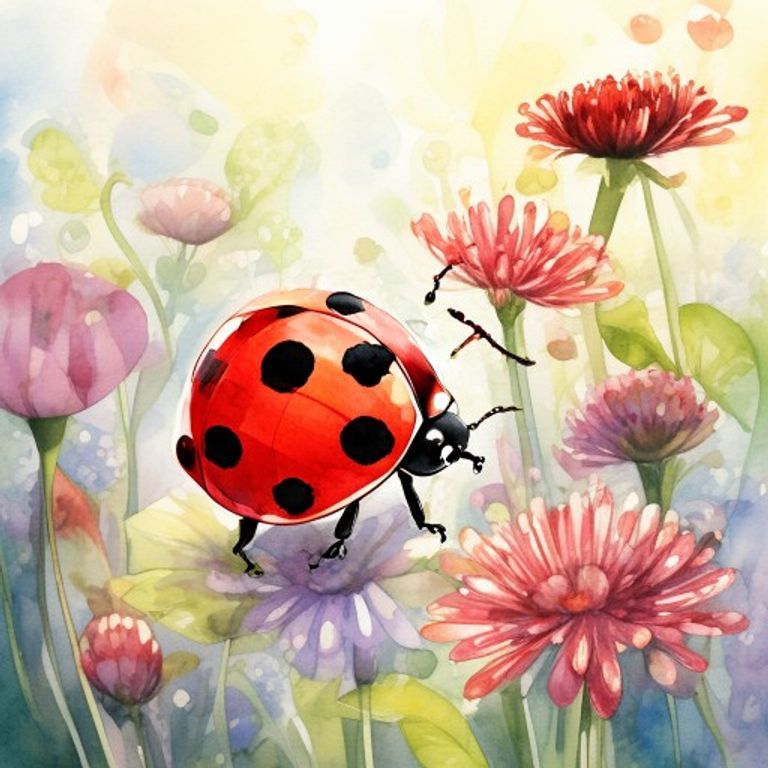
The Ladybug Who Learned to Glide: A Story About Perseverance
In the Garden of a Thousand Blooms, where every flower was a different color and every leaf held a drop of morning dew like a tiny diamond, there lived a young ladybug named Dot.
Dot was not like the other ladybugs.
She had the same round red shell. She had the same black spots—seven of them, perfectly arranged like a constellation. She had the same bright eyes and the same cheerful walk.
But when she tried to fly, something went wrong.
Her left wing, the one with the third spot, did not open the way it should. It unfolded halfway, then caught, then trembled. And when Dot tried to take off, she did not soar into the air like her brothers and sisters. She wobbled. She sputtered. She spun in a circle like a leaf caught in a whirlwind.
And then she fell.
The first time, she landed in a patch of soft clover. The second time, she tumbled into a dandelion puff and came out covered in white fluff. The third time, she plopped into a puddle and had to walk home dripping wet, her spots looking more like dark smudges.
The other ladybugs laughed.
"Look at Dot!" they would call, circling overhead in perfect formation. "She spins like a top!"
"Maybe she is not a ladybug at all," said Stripe, the fastest flyer in the garden. "Maybe she is a beetle who forgot how to walk."
"Maybe she should stick to crawling," said Sparkle, who could hover in place for a whole minute without moving.

Dot would sit on her favorite leaf—a broad, warm leaf of lamb's ear that felt like velvet—and watch them fly. Watch them dive and soar and chase each other through the roses. Watch them disappear over the garden wall to explore the world beyond.
She wanted to go with them. More than anything.
One evening, as the sun was painting the sky in shades of orange and gold, Dot sat on her velvet leaf and felt tears prick her eyes.
Not real tears—ladybugs do not cry the way humans do. But her heart felt heavy. Her spots felt dim. And her broken wing hung at her side like a leaf after a storm.
"Why do you sit alone, little one?"
The voice was soft and warm and very, very old. Dot turned.
On the leaf beside her sat a moth.
Not just any moth. This moth was ancient. His wings were the color of autumn leaves—gold and amber and deep, rich brown. They were tattered at the edges, full of holes, as if he had flown through a thousand storms.
"I am Silverwing," the moth said. "And I have been watching you."
"Watching me fall?" Dot said, her voice small.
"Watching you try," Silverwing said. "There is a difference."
Dot looked at the old moth's wings. "Yours are broken too," she said.
Silverwing laughed—a sound like rustling silk. "These? These are not broken, little one. These are experienced. Every hole is a story. Every tatter is a lesson."
He spread his wings wide. In the sunset light, they glowed like stained glass.
"I was not always a good flyer," Silverwing said. "When I was young, I was small. Smaller than you. The other moths could fly for miles without resting. I could barely make it from one flower to the next. They called me Shortwing."
Dot's eyes grew wide. "What did you do?"
"I kept trying," Silverwing said. "But I did not try to fly like them. I learned to fly like me."
He fluttered his tattered wings. They moved in a pattern Dot had never seen—slow, deliberate, each beat catching the air in a different way.
"I cannot fly fast," Silverwing said. "But I can fly far. I cannot fly high, but I can fly quiet. I learned to ride the warm air that rises from the stones at midday. I learned to glide between the flowers instead of racing over them. I learned that every creature has a way of moving that is theirs alone."
Dot looked at her own half-open wing. "But mine is broken," she said. "Not just small. Broken."
Silverwing tilted his head. "Is it? Or is it just different?"
He hopped closer. He examined Dot's wing with eyes that had seen a hundred summers.
"Your wing does not open fully," he said. "That is true. But it still moves. It still catches air. It still has power. You just have not learned how to use it."
"How do I learn?" Dot asked.
"The same way every creature learns anything worth knowing," Silverwing said. "You practice."
That night, Dot did not sleep.
She climbed to the top of the lamb's ear leaf. She took a deep breath. And she jumped.
Her wings opened—her right one fully, her left one halfway. She wobbled. She spun. She fell.
She landed in the clover.
She climbed back up.
She jumped again.
She fell again.
She jumped again.
And again.
And again.
By the time the moon was high in the sky, Dot had jumped thirty-seven times. She had fallen thirty-seven times. Her shell was scratched. Her legs were tired. Her heart was sore.
But on the thirty-eighth time, something changed.
She did not try to open her left wing all the way. Instead, she let it stay half-open, the way it wanted to be. She tilted her body to the right, just a little. She beat her right wing harder than her left.
And she did not fall.
She wobbled. She dipped. She rose and fell like a leaf on the wind. But she did not crash.
She glided.
For three whole seconds, Dot flew.
She landed on a daisy petal. She sat there, trembling, amazed.
"I did it," she whispered. "I flew."
The next morning, the other ladybugs found her on the daisy.
"Look!" Stripe laughed. "Dot is on a flower! Did you crawl all the way up there?"
"No," Dot said. "I flew."
The ladybugs laughed. "Flew? You? Show us, then!"
Dot took a breath. She launched herself from the daisy.
She did not fly like them. She did not dive and soar. She glided in a wide, wobbling circle, her body tilted, her half-wing catching the air in its strange, awkward way.
But she flew.
She landed back on the daisy. The other ladybugs stared.
"That was... different," Sparkle admitted.
"That was flying?" Stripe asked.
"That was my flying," Dot said.
Over the next week, Dot practiced every day.
She learned to launch from high leaves so she had more time in the air. She learned to catch the warm breezes that drifted through the garden in the afternoon. She learned to tuck her legs just so, to angle her shell just right, to trust her half-wing to do what it could do, instead of demanding it do what it could not.
She fell many times. Hundreds of times. She landed in soup bowls left out for the cat. She got tangled in a spider web and had to be rescued by a friendly bumblebee. She once crash-landed in a gardener's hat and had to wait until he took it off to escape.
But she kept trying.
And slowly, very slowly, she got better.
She could glide from the lamb's ear to the rose bush now. She could circle the garden wall. She could ride the wind all the way to the old stone fountain and back.
She was not the fastest flyer. She was not the most elegant. But she was the most determined.

One afternoon, a storm came.
Not a gentle rain. Not a passing shower. This was a true summer storm—thunder that shook the flowers, lightning that split the sky, wind that tore petals from the roses and sent them spinning through the air.
The ladybugs huddled under the broad leaves of the rhubarb plant. They clung to the stems. They hid from the wind.
But Dot was not with them.
She had been practicing at the far end of the garden, near the compost heap, when the storm struck. Now she was caught in the open, the wind tearing at her, the rain pounding down.
She tried to fly. She could not. The wind was too strong, too wild, too angry.
She clung to a twig. She held on with all six legs. But the wind tore at her, pulling, pulling, pulling.
And then the twig snapped.
Dot tumbled through the air. She was spinning, falling, the world a blur of rain and green and gray.
She hit the ground. The wind rolled her across the garden path, faster and faster, toward the storm drain.
If she fell in, she would be lost. The drain was dark and deep and full of rushing water.
Dot spread her wings. Her right one caught the air. Her left one caught it too, in its strange, half-open way.
She did not try to fly. She tried to glide.
She angled her body. She caught the wind—not fighting it, but riding it, the way Silverwing had taught her.
She glided over the drain. She glided past the rain barrel. She glided all the way to the wall of the old stone fountain, where she caught the lip with her legs and held on, trembling, gasping, but safe.
The storm passed.
The sun returned. The flowers lifted their heads. The garden sparkled with raindrops like a thousand tiny diamonds.
Dot sat on the fountain's edge, her wings spread wide, letting them dry in the warm air.
The other ladybugs found her there.
"You survived the storm!" Stripe said, amazed.
"I glided through it," Dot said.
"How?" Sparkle asked. "The wind was too strong for any of us. We had to hide."
Dot looked at her half-wing. At the spot that did not open. At the imperfection that had made her different.
"Because I learned to fly with what I have," she said. "Not with what I wish I had."
Silverwing appeared, landing on the fountain beside her. His tattered wings glowed in the afternoon sun.
"Perseverance," the old moth said, "is not about becoming perfect. It is about refusing to stop until you find your own way."
The ladybugs looked at Dot. Really looked at her. At the scratches on her shell. At the determination in her eyes. At the way she sat, confident and calm, on the edge of the fountain.
"Will you teach us?" Stripe asked quietly. "To glide the way you do?"
Dot smiled. It was a small smile, but it was bright.
"I will teach you what I learned," she said. "That falling is not failing. That trying again is braver than giving up. That every creature has wings of their own, even if they do not look like everyone else's."
From that day on, Dot became the teacher of the garden.
She taught the young ladybugs to glide. She taught the old caterpillars to trust their wings when they became butterflies. She taught the bumblebees to rest when they were tired, and the ants to keep marching even when the crumb was heavy.
And every evening, as the sun set and the garden glowed with golden light, Dot would launch herself from the highest leaf of the tallest rose bush.
She would not fly like the others. She would glide in her wide, wobbling, beautiful circle, her half-wing catching the air, her heart full of joy.
And below her, all the creatures of the Garden of a Thousand Blooms would look up and watch.
Not because she was the fastest.
Not because she was the most graceful.
But because she had never given up.
And in the end, that is what made her fly higher than anyone.
The End