The Oak Who Learned to Bend: A Story About Respect
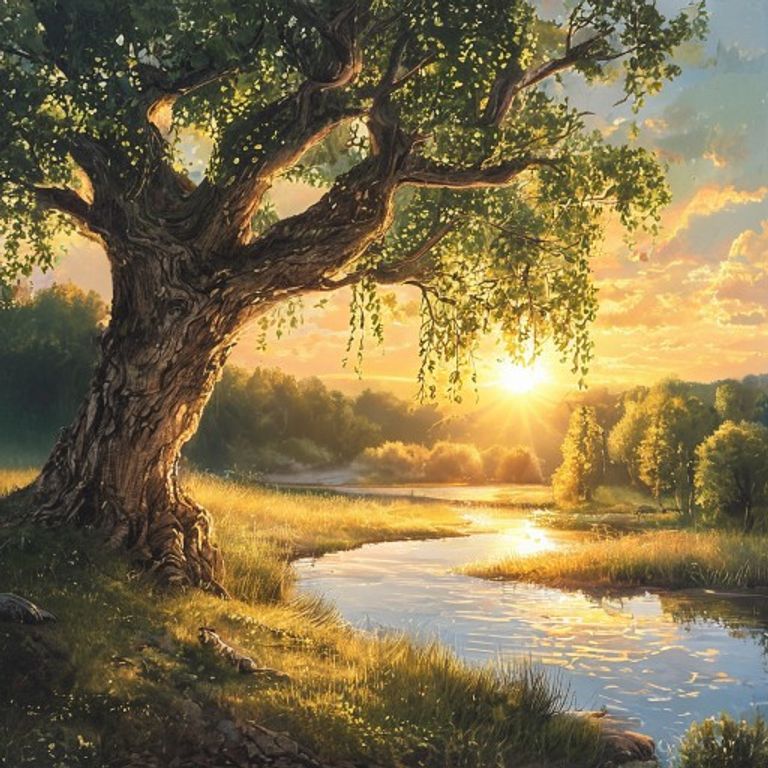
At the edge of the Whispering River, where the water ran clear as glass and the reeds swayed in rhythms older than memory, there grew a grove of trees. And in that grove, the proudest tree of all was a young oak named Oakley.
Oakley had grown quickly. While the other saplings had stretched slowly toward the sun, reaching up inch by inch through the crowded canopy, Oakley had shot upward like a green flame. His trunk was thick and straight, his bark rough and rugged, his branches strong enough to hold a family of squirrels, a nest of robins, and a family of raccoons all at the same time. His leaves were broad and dark green, and in autumn they turned the color of burnt copper, falling in a glorious crimson carpet that the forest creatures danced upon.
Oakley was strong. Oakley was tall. And Oakley, though he would never have said it out loud, believed that being strong and tall meant being better than the other trees.
Especially the willow.
The Willow by the Water
The willow had stood by the river for two hundred years. Her trunk was not thick like Oakley's—it was slender and smooth, the color of pale honey. Her branches did not reach upward toward the sky—they fell downward like a waterfall of green, trailing into the water so that fish sometimes nibbled at her trailing leaves. When the wind blew, the willow did not stand firm and defiant like Oakley. She bent. She swayed. She dipped her branches so low they swept the ground, and then she rose again, laughing in the breeze.
"Look at her," Oakley would whisper to the birches on windy days, his leaves rustling with disapproval. "She cannot even hold her own branches up. The wind pushes her around like a reed. She dips and sways and bows. Where is her pride? Where is her strength?"
The birches, who were tall and thin and clattered together in the slightest breeze, said nothing. They had learned long ago that the willow's silence held more wisdom than Oakley's thundering judgments.
But Oakley did not notice the birches' quiet. He only noticed the willow's bending. And he thought it was weakness.
The squirrels who lived in Oakley's branches loved him dearly. He was strong and steady, and his broad limbs made perfect highways for their chases. The raccoons loved him too—his trunk had a hollow that stayed warm and dry through the rainiest nights. The robins sang from his highest branches, and in spring their songs rang out across the grove like bells.
But when the wind grew strong, Oakley did not bend. He stood straight and stiff, his branches rigid, his trunk unyielding. "A tree that bends is a tree that has given up," he told the young saplings who looked up to him. "Strength means standing firm. Strength means never yielding. Strength means being so solid that nothing can move you."
And the willow, who heard everything the wind carried to her trailing branches, said nothing. She simply dipped lower, let the breeze comb through her hair of leaves, and rose again when the gust had passed.
The Storm That Changed Everything
It came without warning, the way the worst storms always do.
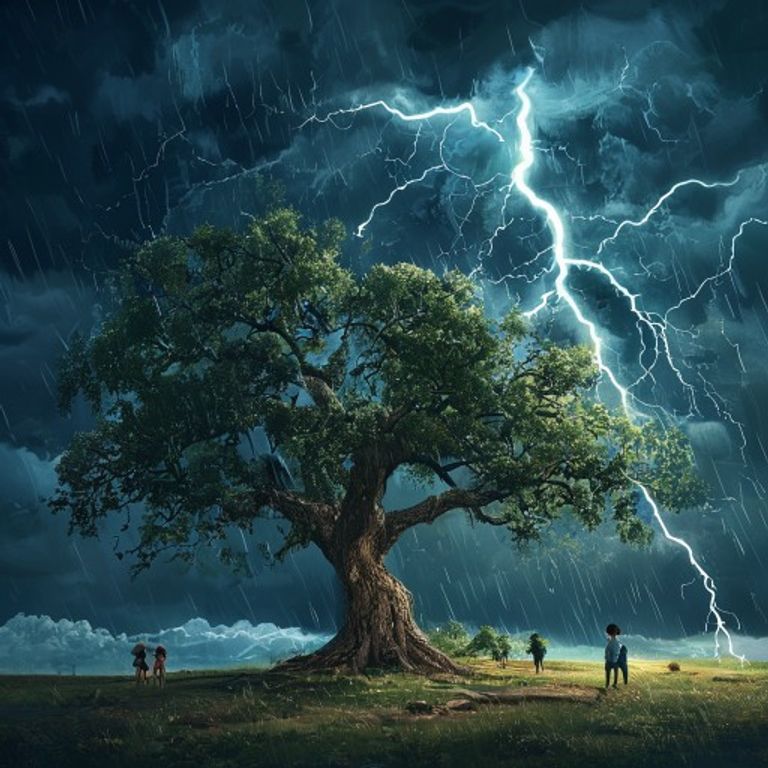
The morning had been golden and soft, with butterflies drifting between wildflowers and the river singing its gentle song. But by afternoon, the sky had turned the color of bruised plums, and the wind began to whisper warnings through the grass.
"Storm coming," said Birch One, trembling slightly.
"A bad one," said Birch Two, her leaves already turning over to show their silver undersides.
The willow, who had lived through two hundred summers and two hundred winters, knew the signs better than any tree in the grove. She felt the change in the air pressure, the shift in the river's song, the way the birds had gone suddenly quiet. She began to sway—not from the wind yet, but from readiness. She loosened her roots just enough to feel the ground's response. She let her branches fall lower, lower, until they trailed in the river like green fingers testing the water.
"Look at her," Oakley scoffed, though there was a tightness in his bark that hadn't been there before. "She's already giving up, and the storm hasn't even arrived. This is why you must be strong, young saplings. This is why you must never—"
But the wind hit before he could finish.
It came roaring down the river valley like a living thing, a wall of air so powerful that the birches bent nearly double, their trunks creaking like old doors. The wildflowers flattened against the ground. The river rose in white-capped fury, slamming against its banks. Rain fell not in drops but in sheets, blinding and cold.
Oakley stood firm. He locked his roots into the earth, spreading them wide and deep. He stiffened every branch. He held his trunk so straight it ached. I am strong, he told himself. I will not bend. I will not break. I am an oak.
The first gust hit him like a giant's fist. His leaves tore away in clumps, spinning into the darkness. His smaller branches whipped wildly, cracking against his own trunk. But he held. He held.
The second gust was stronger. It came from a different direction, twisting, unpredictable. Oakley felt something shift in his roots—a tiny tearing, deep underground, where the soil was becoming soft from the pounding rain. He gripped harder. I will not move.
Through the howling wind, through the lashing rain, Oakley could see the willow. And what he saw made him furious.
She was bent so far over that her top branches touched the ground. She looked like a green waterfall frozen in mid-pour, a cascading curve of leaves and branches that had surrendered completely to the storm. The wind raged through her, but it could not grab her—she moved with it, not against it. She flowed like water, like silk, like a dancer who had practiced this choreography for two hundred years.
"Coward!" Oakley wanted to shout, but the wind stole his words. "Weakling!"
Then the third gust came.
It was not just wind. It was a twisting, spinning column of air that slammed into Oakley's trunk at an angle no straight tree could withstand. He felt the crack before he heard it—a deep, sickening sound from somewhere inside his heartwood, a sound like lightning striking stone. His trunk shuddered. His roots, already loosened by the saturated soil, tore free on one side.
Oakley fell.
Not all the way—his remaining roots held him at a terrible angle, his trunk leaning drunkenly toward the river, his highest branches dragging in the mud. But he had fallen. The proud oak. The strong oak. The tree that had never bent.
He had broken instead.
The Morning After
The storm passed before dawn, the way summer storms do, leaving behind a world washed clean and smelling of wet earth and fresh beginnings. The river, which had raged like a monster, now murmured gently, as embarrassed by its own fury as a child after a tantrum. The wildflowers lifted their heads, beaded with raindrops that caught the morning light and turned each petal into a tiny prism.
The birches had lost some branches, but they stood tall, clattering their leaves in the gentle breeze as if to say, "We made it. We made it."
The willow rose slowly, gracefully, her branches lifting from the ground like a dancer rising from a bow. She had lost a few trailing stems, and one branch had snapped near the water's edge, but she was whole. She was unbroken. She swayed gently in the morning air, her leaves whispering secrets to the river.
And Oakley lay at a terrible angle, his trunk cracked, his roots half-torn from the earth, his leaves scattered across the grove like fallen soldiers.
The squirrels huddled in the hollow of his trunk, trembling but safe. The robins' nest had survived, wedged in a crook of a lower branch. The raccoons peered out from the hollow, their eyes wide and worried.
"Oakley?" squeaked Nutmeg, the smallest squirrel, pressing her tiny paws against his bark. "Are you... are you dying?"
Oakley did not answer. He could not answer. He was in too much pain—the deep, aching pain of a tree whose heartwood has cracked, whose roots have torn, whose pride has fallen harder than his trunk.
He watched the willow swaying gently by the river, whole and beautiful and unbroken. And for the first time, he did not see weakness. He saw something he did not have a name for.
The willow's branches reached toward him—not in triumph, not in mockery, but in something softer. Something like... care.
The Lesson of the Willow
It took three days for the forest's healers to arrive. The old badger who knew which mushrooms could bind wood. The beaver who understood how to brace a leaning trunk. The woodpecker who could tell, by tapping, where the cracks ran deepest.
But even as they worked—packing mud and moss into his cracks, weaving willow branches into braces, propping his trunk with carefully placed stones—Oakley could not stop watching the willow.
He watched her on the fourth day, when a gentle breeze blew through the grove. She bent with it, her branches trailing across the grass, and then she rose again, unharmed, unhurried, unafraid.
"Why?" Oakley finally asked, on the fifth day, when the healers had gone and he was braced and bound and very, very still. "Why do you bend?"
The willow's leaves rustled softly, a sound like distant laughter. "Because I can."
"But... but strength is standing firm. Strength is not moving. Strength is—"
"Strength is surviving," the willow said gently. "Strength is being here, in this grove, two hundred years after I first opened my leaves to the sun. Strength is sheltering the heron who nests in my branches. Strength is feeding the fish who nibble my trailing leaves. Strength is outlasting storms that would have shattered a tree that could not bend."
She swayed, and her shadow fell across Oakley's broken trunk like a gentle hand.
"You thought my bending was weakness," she said. "But bending is how I survive. Every time I dip toward the ground, I let the wind pass through me instead of fighting it. Every time I sway, I move with the force that would break me. I do not resist the storm, Oakley. I dance with it. And because I dance, I am still here."
Oakley was silent for a long time. The wind moved through his remaining leaves, and he did not try to hold them rigid. He let them move. He let them flutter. And it felt strange, but it did not feel weak.
"I thought respect was about being the strongest," he said quietly. "I thought respect was about being the tallest, the straightest, the one who never yields."
"And now?" the willow asked.
"Now..." Oakley looked at his cracked trunk, at the willow braces that held him up, at the stones that kept him from falling further. "Now I think respect is about understanding that strength comes in many forms. And that the old ways... the ways I mocked... might be wiser than I knew."
The Tree That Learned to Bend
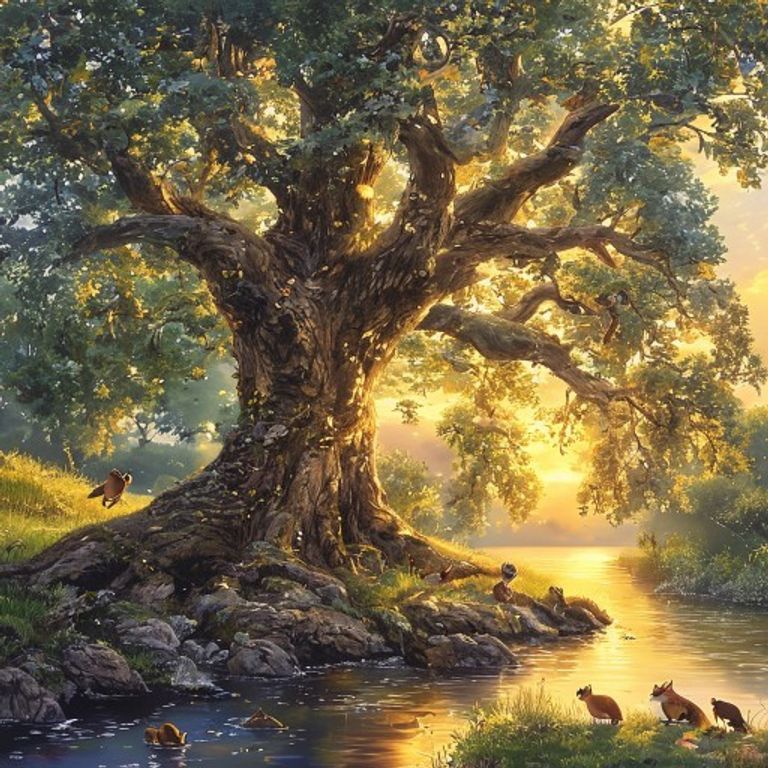
It took a full year for Oakley to heal. A full year of standing braced and bound, of growing new roots to replace the torn ones, of feeling the crack in his trunk slowly knitting together with new wood.
But he was not the same tree.
He no longer mocked the willow's swaying. He no longer told the saplings that rigidity was the only strength. When the wind blew, he let his branches move—just a little, at first, then more, then freely. He discovered that moving with the wind did not mean surrendering to it. He discovered that a tree could be both strong and flexible, both firm and flowing.
And he discovered something else.
When he bent with the wind, the squirrels could ride his branches like swings, squealing with delight. When he swayed, the robins' nests rocked gently, lulling the babies to sleep. When he moved with the breeze instead of against it, his leaves made music—a soft, rustling song that the whole grove gathered to hear.
"You have learned," the willow said one evening, as the sun turned the river to gold and the fireflies began their dance.
"I have learned to respect you," Oakley said. "Not because you are stronger than me. Not because you are better. But because you are different, and your difference is wisdom I had not yet earned."
The willow's branches dipped toward him, and for a moment, her trailing leaves brushed his highest branch—a touch as soft as a whisper.
"That," she said, "is the truest respect. Not fear. Not obedience. Not copying. But seeing the wisdom in another's way. Honoring the difference. Learning from it. Growing because of it."
And in the years that followed, Oakley became the strangest oak anyone had ever seen. He was still strong—strong enough to hold the squirrels and the robins and the raccoons. He was still tall—tall enough to touch the sky. But he was also graceful. When the wind blew, he swayed. When storms came, he bent. And when they passed, he rose again, whole and unbroken, with a new understanding carved into his rings:
The tree that bends does not break. And the tree that respects the wisdom of others grows stronger than the tree that stands alone.
The Moral of the Story: Respect is not about fear, or obedience, or thinking someone else is better than you. Respect is about recognizing that wisdom comes in many forms. It is about understanding that the way someone else does things—the way they move through the world, the way they handle their challenges, the way they have survived what would have broken you—might be a kind of strength you have not yet learned. The willow did not mock the oak for being rigid. She simply lived her own way, surviving storms through flexibility, sheltering creatures through grace. And when the oak finally stopped judging and started seeing, he discovered that respect was the doorway to wisdom. He did not become a willow—he remained an oak. But he became an oak who understood that there is more than one way to be strong. More than one way to survive. More than one way to be worthy of admiration. And when we respect the differences in others—when we honor the wisdom in their ways, even if those ways are not our ways—we grow beyond the limits of our own understanding. We become not just stronger, but wiser. Not just taller, but deeper. Not just one tree standing alone, but part of a grove where every tree, in its own way, holds up the sky.