The Eagle Who Forgot How to Fly: A Story About Self-Confidence
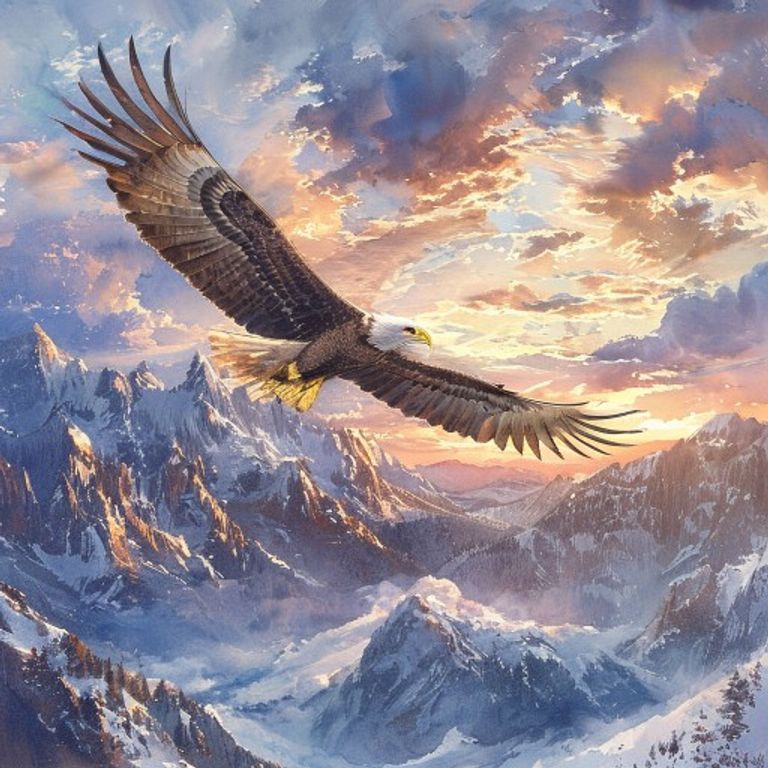
In the high mountain valley of Silverpeak, where the air was so thin it tasted like crystal and the clouds drifted below the cliffs like herds of silent sheep, there lived a young eagle named Aria. She was not yet fully grown — her tail feathers still had the brown tips of youth, her beak was not yet the fierce yellow of adulthood — but she flew like no eagle the valley had ever seen.
She could soar higher than the red-tailed hawks, dive faster than the falcons, and catch fish so large that the elder eagles would click their beaks in admiration. She was fearless, bold, and absolutely certain of herself. When she spread her seven-foot wings and caught an updraft, the whole valley seemed to hold its breath.
"Aria the Swift," the young eagles called her, with a mixture of envy and awe.
"Aria the Fearless," the hawks muttered, grudgingly respectful.
Even the ravens, who made fun of everyone, would tilt their heads and say, "That one? She'll be a legend."
Aria believed them. She believed every word. Her confidence was not arrogance — she really was that good. She had worked for it, practiced until her wings ached, hunted until her talons were sharp as needles. She had earned her confidence, wingbeat by wingbeat, dive by dive, fish by fish. And she was proud of it.
She thought her confidence lived in her wings.
She was about to learn how wrong she was.
The Fall
It was the third day of the autumn wind festival, when the mountain air turned wild and unpredictable and only the bravest flyers dared leave the aerie. Aria loved these days. The rougher the wind, the more she shone. While other eagles clung to the cliff face, waiting for calmer skies, Aria would launch herself into the gale, riding the turbulence like a leaf in a stream, turning what scared everyone else into her own personal playground.
On this particular morning, she spotted a silver salmon swimming in the deep pool where the glacier melt met the mountain river. It was the largest fish she had ever seen — nearly as long as her own body, gleaming like a piece of the moon that had fallen into the water.
Aria circled once, calculating the angle. The wind was coming from the east, sharp and sudden, gusting between the cliffs in unpredictable bursts. Most eagles would have waited. Aria did not wait. She folded her wings and dropped.
The dive was perfect — for three seconds. Then a rogue gust, hard as a stone wall, slammed into her from below just as she extended her talons toward the water. The impact twisted her body. She tried to correct, tried to pull up, but her right wing caught the edge of the granite cliff at full speed.
There was a sound like a dry branch breaking. Then Aria was tumbling, spinning, falling through air that no longer held her up. She hit the water hard — not the clean splash of a hunting eagle, but the messy, painful crash of something broken. The river carried her downstream, bouncing her off rocks, filling her lungs with cold water, until she washed up on a gravel bar near the willow thickets, half-drowned and utterly helpless.
When she finally dragged herself onto the shore, she tried to spread her wings to shake the water off. Her right wing opened halfway and stopped. Something inside it — something deep, something important — had snapped. She could feel it, a wrongness where there should have been strength, a silence where there should have been power.
Aria sat on the gravel bar, water dripping from her feathers, and watched her own reflection in the river. A broken eagle. A grounded eagle. An eagle who could no longer fly.
For the first time in her life, she did not know who she was.
The Ground
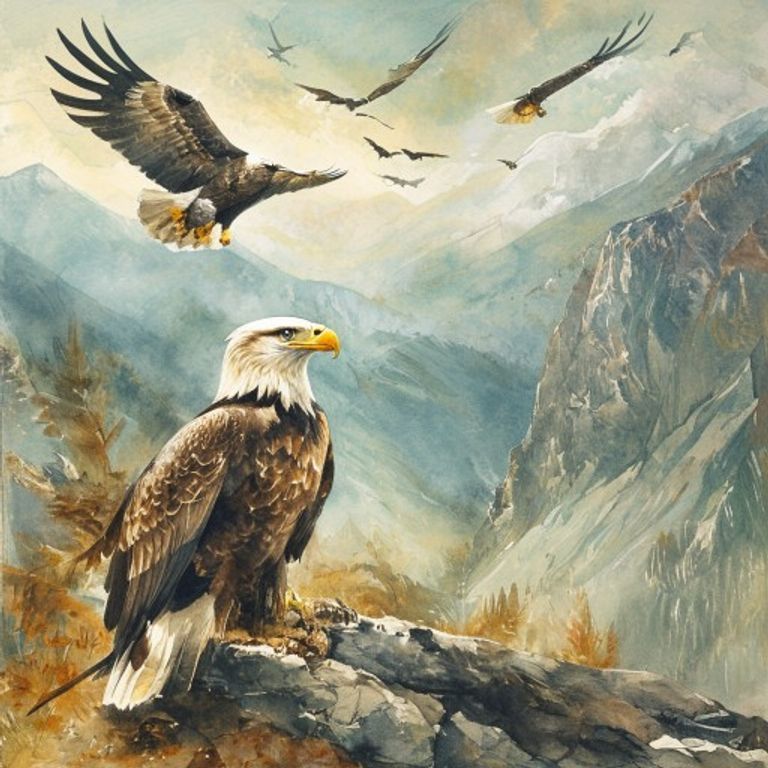
The healer eagle, an ancient female named Graywing who had survived a lightning strike and a wolf attack in her long life, examined Aria's wing with gentle talons. "The bone will heal," she said. "But slowly. Three months, perhaps four. And even then, the wing may never be what it was. You will fly again, child. But you may never soar like you did before."
Three months. Four months. To Aria, who had never been still for more than a morning, this sounded like a lifetime. She sat in the lower ledge of the aerie — the ground-level ledge reserved for the old, the sick, and the dying — and watched the other eagles fly.
She watched the young eagles practice their dives, clumsy and brave. She watched the adult eagles return with fish, graceful and efficient. She watched the sunsets from below, looking up at the birds silhouetted against the orange sky, and she felt something inside her chest that she had never felt before.
It was not pain. Pain she could have handled. It was hollowness. A vast, echoing emptiness where her confidence used to live. She had not realized until now that her sense of herself — her very identity — was built entirely on what she could do. She was Aria the Swift. Aria the Fearless. Aria the Legend-in-the-Making. Without her flying, who was she?
Just Aria. And Just Aria felt like no one at all.
The other eagles were kind, at first. They brought her fish. They told her stories of other eagles who had recovered from worse injuries. They said, "You'll be back in the sky before spring." But Aria could hear the pity in their voices. She could see the way they looked at her wing, then quickly looked away. She could sense the unspoken thought: She was the best. And now she's broken. What a shame.
After a month, the visits grew less frequent. The other eagles had lives to live, fish to catch, skies to conquer. Aria sat alone on her ledge, watching the world happen above her, and felt herself shrinking. She stopped preening her feathers. She stopped eating properly. She stopped looking up.
She was disappearing. And no one seemed to notice.
The Sparrow
On the thirty-seventh day of her grounding, a small brown sparrow landed on the edge of her ledge. He was ordinary in every way — brown feathers, black eyes, a beak slightly too large for his head. He carried a single red berry in his beak, which he dropped at Aria's feet.
"I'm Pip," he said. "You probably don't remember me."
Aria did not look at him. "I don't talk to sparrows."
"Most eagles don't," Pip agreed cheerfully. "But I'm not most sparrows. I talk to everyone. It's my thing." He hopped closer. "I brought you a berry. Mountain ash. Very sour, but good for healing. Or so I've heard. I'm not a healer. I'm just a sparrow who pays attention."
Aria still did not look at him. "Why are you here?"
"Because you're here," Pip said simply. "And you look lonely."
"I'm not lonely. I'm resting. I'll be flying again soon."
Pip tilted his head. "Graywing says your wing may never fully heal. She told the whole valley yesterday."
Aria's heart tightened. She had known this, deep down. But hearing it spoken out loud — hearing that the whole valley knew — was like having her broken wing stepped on.
"Then why are you here?" she asked, her voice sharp. "To pity the broken eagle? To tell your sparrow friends you visited the famous Aria before she faded away?"
Pip did not flinch. He sat down on the ledge, small and round, and looked at her with eyes that were neither impressed nor disappointed. They were just... kind.
"I'm here because three months ago, before you fell, you saved my nest."
Aria blinked. "What?"
"A goshawk was circling the lower meadow. I had three eggs. I was too small to fight, too slow to run. You saw him from the sky — you must have been a thousand feet up — and you dove. Not to hunt. Not to show off. Just to chase him away. You never even came down to see if I was okay. You just flew back up and went on with your day." Pip shrugged his tiny shoulders. "I never got to thank you. So I'm thanking you now. And since you can't fly away, I figured I'd keep visiting until you believed me."
Aria stared at him. She had no memory of this. She had chased away goshawks dozens of times — they were threats to the whole valley, not just sparrows. She had never thought about who might be below, who might be grateful, who might remember. She had just done it, because that's what a good flyer did.
"That was nothing," she said quietly.
"It was not nothing to me," Pip said. "It was everything."
The Remembering
Pip came back every day. He did not bring berries every time — sometimes he brought news of the valley, sometimes a funny story about the squirrels, sometimes just his own small company. He did not treat Aria like a fallen hero or a broken bird. He treated her like a friend. He argued with her about which clouds looked like dragons. He complained about the crows who stole his breakfast. He asked her opinion on where to build his next nest, as if a grounded eagle's perspective on ground-level real estate was genuinely valuable.
And slowly, very slowly, Aria started to talk back.
At first it was just one-sentence replies. Then two sentences. Then, one rainy afternoon, she found herself telling Pip about the feeling of diving — the way the wind compressed against her feathers, the way the world narrowed to a single point of silver water, the way time seemed to stretch and hold its breath just before impact.
"That sounds terrifying," Pip said.
"It was exhilarating," Aria said. And then, quietly: "I miss it so much it hurts."
Pip nodded. "I imagine. But Aria — can I tell you something? I don't miss your diving. I never saw your diving. I only know you from here, on this ledge, with your broken wing and your sad eyes and your stories about clouds. And I like this you. Not because you're broken. Just because you're you."
Aria looked at him for a long moment. "You don't understand. I was special. I was the best. And now I'm just... a bird who can't fly."
"You were never just a bird who could fly," Pip said. "You were always a bird who helped. Who noticed. Who cared. The flying was just how you got around. It wasn't you."
"But what if the flying was the only good thing about me?" Aria whispered. "What if without it, there's nothing left?"
Pip hopped onto her good wing — not afraid of her size, not impressed by her former glory — and looked directly into her golden eye. "Then let me show you what's left. Come with me."
The Walking
Pip did not take her flying. He took her walking. Down from the aerie, along the riverbank, through the willow thickets, into the parts of the valley that Aria had only ever seen from above. She had flown over these meadows a hundred times, but she had never walked through them. She had never felt the grass under her talons. She had never noticed the way the sunlight filtered through the willow branches in shifting patterns. She had never heard the river's voice up close — not the distant rush she knew from the sky, but the intimate gurgle and bubble of water speaking to stone.
"You see more from the ground than from the sky," Pip said one morning, as they stood on a fallen log watching a family of otters play in the river. "Up there, everything is small. Down here, everything is close."
Aria discovered he was right. From the air, she had known where the fish were. But from the ground, she learned why the fish were there — which currents carried the most food, which shadows offered the most safety, which stones warmed the water just enough to attract the big ones. She started sharing this knowledge. When the young eagles practiced their diving, she would call out from the riverbank: "Too far left — the current's stronger there!" or "Wait three more seconds — the big one always circles before surfacing!"
At first the young eagles ignored her. What could a grounded eagle know? But slowly, they started to listen. Her advice was good. Better than good — it was precise, detailed, rooted in a ground-level understanding that no flying eagle had ever developed.
She also discovered she had a talent for spotting danger from below. A fox creeping through the tall grass. A weasel near the rabbit warren. A hawk shadow on the eastern ridge. From the ground, she could see the signs that flying eagles missed — the twitch of a grass blade, the sudden silence of insects, the shape of a shadow against the wrong color of earth. She became the valley's ground-guard, the watcher who saw what the sky-watchers could not.
And she was good at it. Not "good for a broken eagle." Just good.
But she still did not feel confident. She felt useful, yes. She felt busy, yes. But confidence? That was something that lived in soaring, in diving, in catching the wind. It did not live in walking along a riverbank, calling warnings to rabbits.
She was wrong about that too. She just didn't know it yet.
The Storm
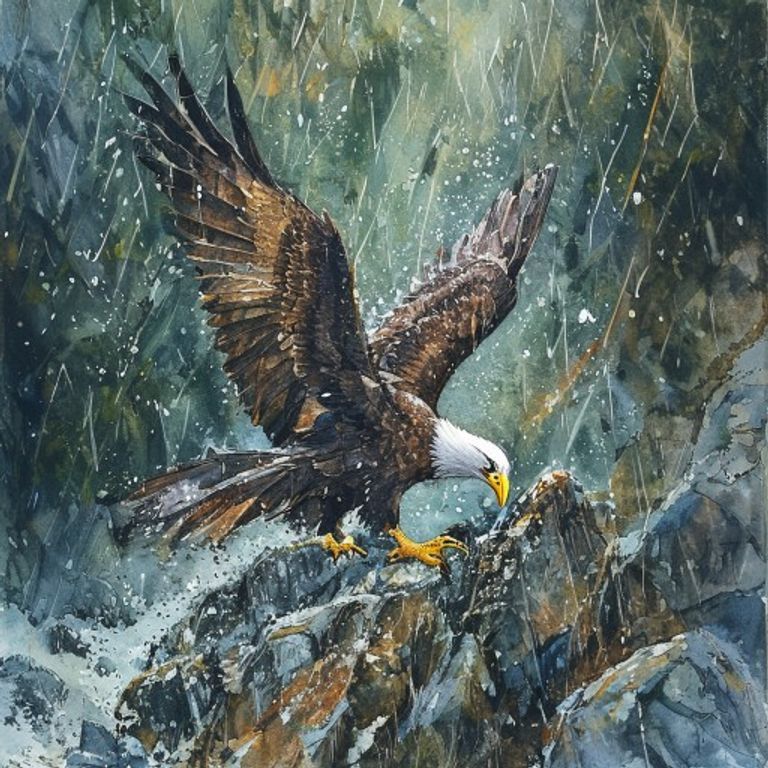
It came on the eighty-ninth day of her grounding, a storm so fierce that even the elder eagles huddled in the deepest crevices of the aerie. The wind howled through the valley like a living thing, tearing branches from trees, turning the river into a churning beast, hurling hailstones the size of sparrow eggs against every surface.
Aria was on the ground, having walked down to check on a family of ground-nesting warblers she had been watching. When the storm hit, she tried to climb back to the aerie, but the wind was too strong. She found shelter in a hollow beneath a granite overhang, huddled with Pip and three terrified warblers, and waited.
That was when they heard the cry.
It was faint, almost lost in the wind, but Aria knew the sound. It was a young eagle's call — not a hunting cry, not a battle cry, but a cry of pure terror. A cry of someone trapped.
"The ravine," Aria said, her heart pounding. "The narrow ravine below the eastern cliff. The wind funnels through there — it can pin a bird against the rock face."
She had flown through that ravine a dozen times. She knew every ledge, every handhold, every place where the wind twisted and turned. But she had known it from above. From the air. From the freedom of flight.
Now she was on the ground. In a storm. With a broken wing.
"You can't go out there," Pip said, his voice tight. "Your wing —"
"My wing is broken," Aria said. "My heart is not."
She launched herself into the storm. Not flying — she could not fly. But running. Leaping from rock to rock. Using her talons to grip the wet stone. Using her knowledge of the ground, of the ravine, of every crack and crevice she had explored during her months of walking. The wind tried to throw her back. The hail tried to blind her. But she kept moving, kept climbing, kept calling out to the trapped eagle above the roar of the storm.
She found the young eagle — a yearling named Storm, ironically — pinned against the cliff face by a wind so strong he could not spread his wings. His talons were bleeding from gripping the rock. His eyes were wide with panic.
Aria did not try to fly him out. She could not fly. Instead, she climbed up to him, talon by talon, until she was beside him. She wedged her own body between him and the wind, creating a shield. She showed him the handholds she had memorized during her walking months — the narrow ledge three feet down, the crack in the granite wide enough for talons, the sheltered nook behind the waterfall.
"Follow me," she shouted over the wind. "One hold at a time. Don't look down. Don't look up. Just look at my tail feathers and follow."
And he did. Inch by inch, clawhold by clawhold, they descended the cliff face. Aria's broken wing ached with every movement. Her muscles burned. But she did not stop. She could not stop. Because someone needed her. And for the first time since her fall, she felt something she had not felt in months.
She felt certain. Not of her flying. Not of her strength. But of herself. Of who she was when someone needed her. Of who she had always been, even when she was soaring so high she had forgotten to look down.
They reached the bottom of the ravine just as the storm began to break. The young eagle — Storm — collapsed against her, trembling, grateful, alive. And Aria held him, her broken wing around his shaking body, and felt something warm and bright and unbreakable bloom inside her chest.
It was not her flying confidence. It was deeper than that. It was the confidence of someone who had walked through fire and discovered that she was still standing. The confidence of someone who had lost everything she thought made her special, and discovered that she was still special — just in a different way. The confidence of someone who had been stripped down to nothing and found that nothing was not empty. Nothing was just... room to grow.
The New Sky
Spring came. The snow melted. The valley bloomed with wildflowers so bright they looked like spilled paint across the green meadows. And Aria's wing healed — not completely, not perfectly, but enough.
She flew again. For the first time in four months, she spread her wings and felt the air hold her up. It was different now — her right wing had a slight tremor, a hesitation in the strong gusts. She could not soar as high as before. She could not dive as fast. She would never again be Aria the Swift, Aria the Fearless, Aria the Legend-in-the-Making.
But she did not need to be.
She was Aria the Watcher now. Aria the Ground-Guard. Aria the one who knew both sky and earth, who could read the wind from above and the signs from below. She was the eagle who had fallen and risen again, not on wings alone, but on something stronger. On character. On heart. On the knowledge that she was more than what she could do.
Young eagles still came to her for advice. Not because she was the fastest, but because she was the wisest. Because she had known failure and found her way back. Because she had walked where they had only flown, and seen what they had never noticed.
And Pip still visited her every day. Not out of gratitude anymore — out of friendship. Out of the simple, stubborn, beautiful fact that he had seen her at her lowest and chosen to stay.
One evening, as the sun set behind the western peaks and painted the valley in shades of amber and rose, Aria sat on her ledge — not the ground-level ledge anymore, but a middle ledge, a ledge for eagles who had earned their place through something deeper than flying skill. Pip landed beside her with a berry.
"Do you miss it?" he asked quietly. "Being the best?"
Aria thought for a long moment. The wind ruffled her feathers — the healed wing, the still-broken-in-places wing, the wings that carried her now in a different way than before.
"I don't miss it," she said finally. "Because I never really had it. I had skill. I had speed. I had the admiration of others. But I didn't have confidence. I had performance. True confidence — the kind that doesn't break when your wing breaks — that's something else. That's knowing who you are even when you can't do what you used to do. That's trusting yourself not because you're the best, but because you've been the worst and survived it. That's understanding that you are not your achievements. You are not your skills. You are the person who gets up when you fall. The person who helps when it hurts. The person who keeps going even when the sky says you should stop."
She looked at Pip, her golden eyes warm and steady and utterly at peace. "That's the confidence I have now. And it's worth more than every dive I ever made."
Pip nodded, satisfied. "Good. Because I liked the old Aria. But I love this one."
And together, they watched the sun disappear behind the mountains — one eagle with imperfect wings, one sparrow with an oversized beak, both of them exactly enough, both of them perfectly confident in who they had become.
The Moral of the Story: Self-confidence is not about being the best at what you do. It is not about never failing, never falling, never breaking. True self-confidence is about knowing who you are even when everything that made you feel special has been taken away. Aria believed her confidence lived in her wings — in her speed, her skill, her perfection. But when her wing broke, she discovered that her confidence had never been in her wings at all. It had been waiting inside her heart, quiet and patient, waiting for her to realize that she was more than what she could do. The world will tell you that confidence comes from achievement — from winning, from succeeding, from being better than everyone else. But that is not confidence. That is performance. Real confidence is quieter. It is the voice inside you that says, "I am still me, even when I fail. I am still worthy, even when I cannot fly. I am still enough, even when I am broken." And the most beautiful thing about true confidence is this: once you find it, no one can take it away. Not a broken wing. Not a lost race. Not a cruel word. Because it does not live in what you do. It lives in who you are. And who you are — the kind, brave, resilient, loving person who gets up when you fall — that is something no storm can ever break.