The Girl Who Thought She Knew Everything: A Story About Humility
The Girl Who Thought She Knew Everything: A Story About Humility
In the town of Greenwood, where the schoolhouse was made of red brick and the playground was shaded by ancient oaks, there lived a girl named Sophia. She was ten years old, with hair as dark as midnight and eyes as sharp as a hawk's. She was the smartest child in her class, and she knew it.
She knew the capital of every country. She knew the multiplication tables up to twenty. She knew the names of all the planets, the layers of the earth, and the lifecycle of a butterfly. And she made sure everyone else knew that she knew.
"Sophia, do you know the answer?" her teacher, Mrs. Maple, would ask.
"Of course I do," Sophia would reply, her voice dripping with confidence. "The answer is obvious."
She would raise her hand before Mrs. Maple even finished asking the question. She would correct other children when they made mistakes. She would roll her eyes when someone struggled with a problem she found easy.
"Sophia, you are very smart," Mrs. Maple said one day, after Sophia had interrupted another student for the third time. "But being smart is not just about knowing things. It is also about being humble."
"Humble?" Sophia scoffed. "Why should I be humble? I am the best in the class."
"Being humble means understanding that you do not know everything," Mrs. Maple said gently. "It means listening to others. It means learning from your mistakes. It means admitting when you are wrong."
"I am never wrong," Sophia declared.
But she was about to be.
The next week, Greenwood School announced a science fair. Each student had to create a project, and the winner would represent the school at the regional competition. Sophia was thrilled. This was her chance to prove, once and for all, that she was the smartest child in town.
She chose a project on rockets. She read books, watched videos, and designed a small rocket that she was sure would fly higher than any other project. She worked alone, refusing help from her classmates, convinced that their ideas would only drag her down.
"Sophia, would you like to work with us?" asked Oliver, a quiet boy who loved birds. "We are building a bird feeder that tracks which species visit. You could help us with the data."
"No, thank you," Sophia said, not even looking up from her rocket plans. "Your project is... simple. I am working on something much more impressive."
Oliver's face fell, but he nodded and walked away.

The day of the science fair arrived. The gymnasium was filled with tables and displays, projects of every kind: volcanoes, robots, gardens, circuits. Sophia's rocket sat on a table in the center, sleek and silver, surrounded by her detailed diagrams and calculations.
The judges walked from table to table, asking questions, taking notes. When they reached Sophia's project, she stood tall, ready to impress them with her knowledge.
"Tell us about your rocket," one judge said.
Sophia launched into a speech about propulsion, aerodynamics, and fuel ratios. She spoke for ten minutes without pausing, using words that even the judges had to think about.
"Very impressive," the judge said. "But tell us, what happens if the wind changes direction during launch?"
Sophia blinked. "The wind?"
"Yes. You have designed your rocket for a straight upward trajectory. But what if the wind blows it off course?"
"It... it will not matter," Sophia said, though her voice was less certain now. "The rocket is designed to go up."
"But rockets do not fly in a vacuum," the judge said. "They fly in the real world, where wind, temperature, and air pressure all play a role. Did you test your rocket in different conditions?"
Sophia felt her cheeks flush. "I... I did not think about that."
"That is the difference between knowing things and understanding them," the judge said kindly. "You have knowledge, Sophia. But knowledge without humility is like a rocket without stabilizers. It might fly high, but it will eventually crash."
The judges moved on. Sophia stood at her table, her confidence crumbling like wet paper.

Then she heard a commotion across the gymnasium. She walked over and saw a crowd gathered around Oliver's table. His bird feeder was not just a feeder—it was a work of art. It had a small camera that took photos of visiting birds, a sensor that recorded their weight, and a tiny screen that displayed their species in real time.
"I worked with my sister, who knows about cameras," Oliver was saying, his face glowing with pride. "And my neighbor, who is an electrician, helped with the wiring. And my grandmother suggested the design, because she loves birds."
The judges were amazed. "You built this with help from others?" one asked.
"Yes," Oliver said. "I am not good at everything. But I am good at asking for help. And learning from people who know more than me."
Sophia watched, her heart heavy. She had refused Oliver's offer to collaborate. She had dismissed his project as simple. And now, his project—built with humility, teamwork, and the wisdom to ask for help—was winning the science fair.
Oliver's project took first place. Sophia's rocket took third.
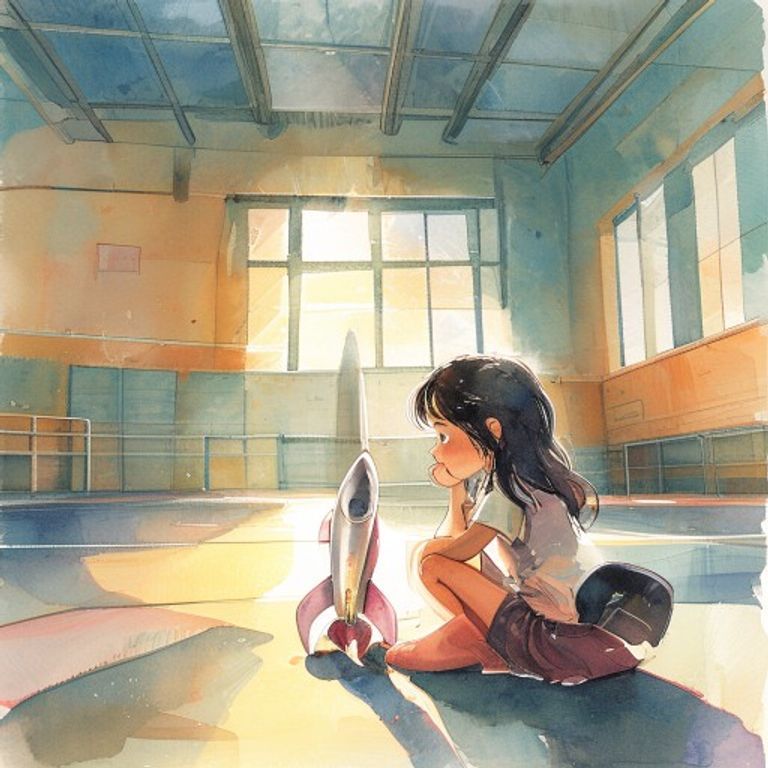
After the ceremony, Sophia sat alone in the empty gymnasium, her silver rocket gleaming under the fluorescent lights. She thought about what Mrs. Maple had said. She thought about the judge's words. She thought about Oliver's smile, so bright and genuine, because he had not just built a project—he had built friendships.
"Sophia?"
She looked up. Oliver was standing there, holding his blue ribbon.
"I am sorry I did not work with you," Sophia said, her voice small. "I thought I was too good to need help. I thought I knew everything. But I was wrong."
Oliver smiled, a kind, forgiving smile. "It is okay. I used to think I knew everything too. Then I tried to build a birdhouse by myself, and it fell apart. That is when I learned that being smart is not about knowing everything. It is about being willing to learn."
"How did you learn to be humble?" Sophia asked.
"My grandfather told me something," Oliver said. "He said, 'The tallest trees have the deepest roots. The wisest people know how much they do not know.' I did not understand it at first. But now I do. Humility is not about thinking you are less than others. It is about knowing that everyone has something to teach you."
Sophia looked at her rocket, then at Oliver's bird feeder. She saw the difference. Her rocket was impressive, but it was alone. Oliver's feeder was simple, but it was surrounded by the love and help of many people.
"Can you teach me?" Sophia asked. "How to be humble?"
Oliver laughed. "I cannot teach you. But I can show you. Come to my house this weekend. We are building a bigger bird feeder for the park. You can help. And I can teach you about birds. And maybe you can teach me about rockets."
Sophia smiled, a real smile, one that did not depend on being the best. "I would like that."
Moral of the Story: Humility is not about thinking you are less than others. It is about knowing that everyone has something to teach you. Sophia was the smartest child in her class, but her pride blinded her to the wisdom of others. She thought she knew everything, and that stopped her from learning. Oliver, on the other hand, knew that he did not know everything. He asked for help. He learned from others. And because of his humility, he built something amazing. So remember: being smart is not about knowing everything. It is about being willing to learn. The wisest people are not the ones who know the most. They are the ones who know how much they do not know.
Age Range: 4-8 years | Reading Time: ~10 minutes | Core Value: Humility