The Starlight Blanket: A Story About Love
The Starlight Blanket: A Story About Love
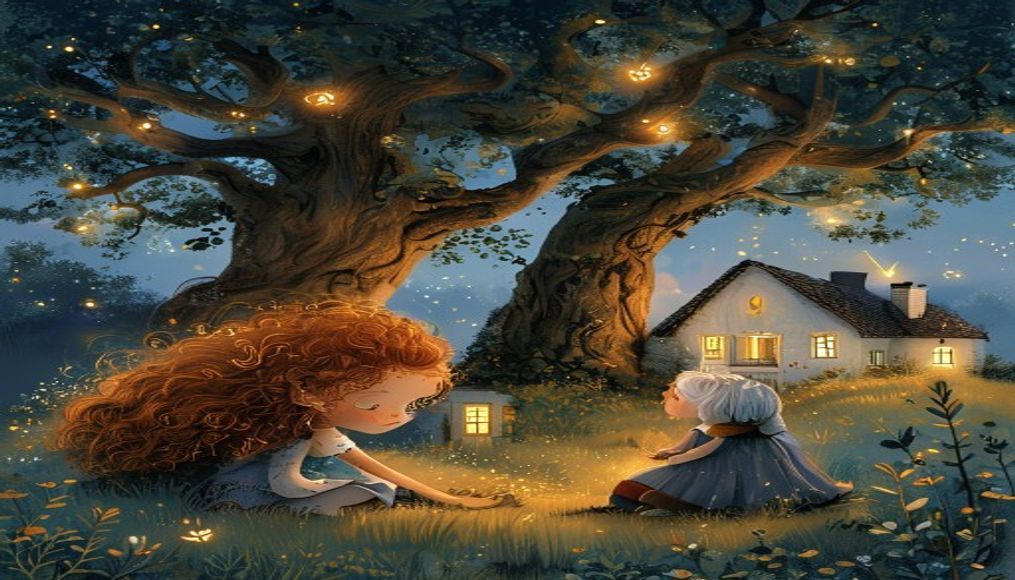
High above the sleepy village of Silverbrook, where the river wound like a ribbon through emerald meadows, stood Willow Hill. At the very top of that hill, beneath the spreading branches of the Ancient Oak, sat a small cottage with blue shutters and a chimney that always seemed to puff cheerful little clouds of smoke. This was the home of Grandma Mae, and every summer, it became the home of her granddaughter Elara too.
Elara was seven years old, with wild curly auburn hair that refused to be tamed by any ribbon, and a constellation of freckles across her nose that multiplied every summer she spent in the sunshine. She arrived at Grandma Mae's cottage on the first day of July, her small suitcase bumping against her legs as she ran up the cobblestone path.
"Grandma!" she called, bursting through the kitchen door.
Grandma Mae stood by the stove, her silver hair braided neatly down her back, her warm brown eyes crinkling at the corners. She smelled of cinnamon and fresh bread, just as she always had. But something was different this year. When she turned to Elara, her smile was as bright as ever, but her movements were slower, her hands trembling slightly as she wiped them on her flour-dusted apron.
"There's my starlight girl," Grandma Mae said, gathering Elara into a hug that felt just as warm and safe as always. "Come, I've made your favorite cinnamon rolls."
That first evening, they sat on the porch swing watching the sunset paint the valley in shades of rose and gold. Old Barnaby, Grandma Mae's gentle draft horse with the white blaze on his nose, grazed peacefully in the meadow below. The fireflies began their nightly dance, tiny lanterns flickering on and off in the tall grass.
But as the days passed, Elara noticed things. Grandma Mae would put the teapot in the pantry instead of the stove. She would call Elara by her mother's name—Lily—and then laugh and shake her head, saying, "Of course, you're Elara. Forgive an old woman's wandering mind." Most troubling of all, Elara began finding her grandmother asleep in her knitting chair at odd hours, a half-finished project in her lap, her silver head nodding forward.
One night, when the moon was full and round as a silver coin, Elara woke to the sound of soft clicking. She crept down the stairs and found Grandma Mae in the parlor, knitting needles moving in the lamplight. But Grandma Mae's hands were shaking, and Elara could see dropped stitches and uneven rows in the fabric.
"Grandma?" Elara whispered. "What are you making?"
Grandma Mae looked up, her eyes momentarily confused. Then she smiled. "It's a blanket, starlight. For your mother. She's going to have a baby, you know. In the city." She held up the work—a beautiful pattern of stars and moons in soft blue yarn. "I want the baby to have something made with love."
Elara climbed into her grandmother's lap, careful not to disturb the knitting. "It's beautiful, Grandma."
"It was beautiful," Grandma Mae said softly, touching a section where the stitches had gone wrong. "But my hands don't remember what they used to do. I look at the pattern, and sometimes... sometimes it looks like a tangle of spaghetti." She laughed, but her eyes were sad. "I may not finish it in time."
Elara felt something squeeze inside her chest. She thought of all the summers Grandma Mae had taught her things—how to identify birds by their songs, how to bake bread that rose soft and golden, how to find the first star of evening. Now Grandma Mae needed help, and Elara wanted more than anything to be the one to give it.
"Teach me," Elara said firmly. "Teach me to knit, Grandma. I'll help you finish it."
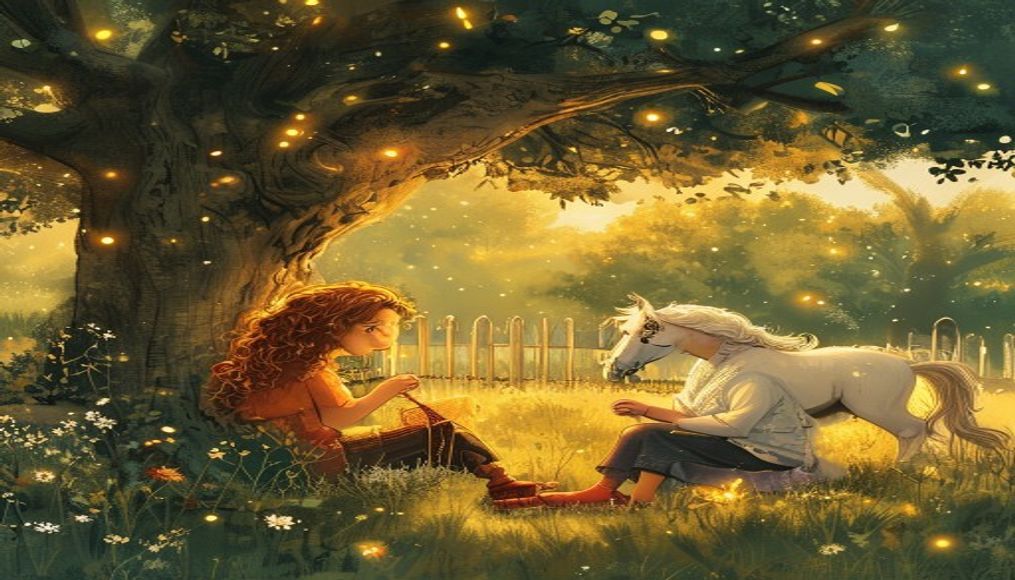
The next morning, they set up under the Ancient Oak. Grandma Mae brought her knitting basket, two pairs of needles, and the softest yarn the color of midnight. Old Barnaby watched from the fence, his gentle eyes curious.
"Hold the needles like this, starlight," Grandma Mae said, positioning Elara's small fingers. "The right hand guides, the left hand holds. Like you're holding a baby bird—firm enough that it won't fly away, gentle enough that you won't hurt it."
Elara's first stitches were terrible. They were too tight, then too loose. She dropped stitches and added stitches where none belonged. A row that should have been straight looked like a mountain range. She gritted her teeth and tried again.
But Grandma Mae never criticized. She simply smiled her warm smile and said, "Every knitter's first scarf looks like a roller coaster. Your mother made one that could have qualified as modern art."
They worked together as the sun crossed the sky. Grandma Mae would knit a row, her hands trembling but determined, and then Elara would try to copy the pattern. When Grandma Mae's hands shook too badly, Elara would hold them steady with her own small fingers. When Elara made mistakes, Grandma Mae would show her how to fix them—"tinking," she called it, which was "knit" spelled backward.
As the fireflies began to emerge, Grandma Mae told stories of Elara's mother as a child. How Lily had tried to build a spaceship from old boxes in this very meadow. How she'd once spent an entire afternoon talking to Old Barnaby, convinced he understood every word. How she'd cried when she had to leave for the city, but had promised to come back every summer.
"Love is like knitting, starlight," Grandma Mae said one evening, her needles clicking softly. "It's made one stitch at a time. Some days the pattern is clear, and some days it's a tangled mess. But if you keep going, if you don't give up, something beautiful emerges."
The days turned into weeks. The blanket grew longer, a tapestry of perfect rows and imperfect rows, of Grandma Mae's careful stitches beside Elara's wobbly ones. They worked in the morning when Grandma Mae's mind was clearest, and in the evening when the fireflies kept them company. Sometimes Grandma Mae would fall asleep against the tree trunk, and Elara would carefully tuck the blanket around her, then pick up the needles and continue alone in the starlight.
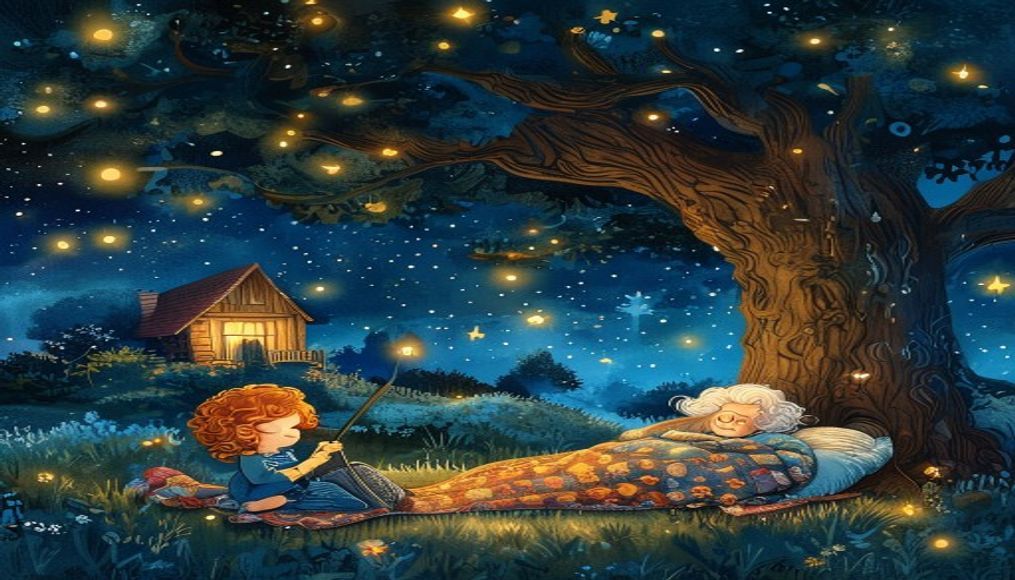
One night, as Elara sat alone under the oak, the stars so bright they hurt to look at, she realized something important. Love wasn't just the beautiful things you made for people. Love was also sitting with them when they were forgetful. Love was patience when hands shook and minds wandered. Love was learning a skill you didn't think you could learn, because someone you loved needed help. Love was finishing what they started when they couldn't finish it themselves.
She looked at the blanket in her lap—lumpy in places, with sections that were wider or narrower than they should be, with stars that looked more like flowers and moons that looked more like potatoes. It was imperfect. But it was also the most beautiful thing Elara had ever made, because every stitch held love.
On the last day of summer, they finally finished. Grandma Mae held up the blanket, her eyes shining. "Look at that, starlight. Look at what we made together."
They sent it to the city wrapped in brown paper and tied with string, with a note in Grandma Mae's shaky handwriting: "For the new little one, made with love and starlight."
Autumn came to Willow Hill, turning the Ancient Oak into a torch of gold and crimson. Elara returned to her parents' house, to school and friends and ordinary days. But she thought often of Grandma Mae, of the clicking needles and the fireflies and the lessons learned under the stars.
Then, one November afternoon, a letter arrived. Inside was a photograph: Elara's mother, laughing and crying at the same time, holding a tiny baby wrapped in the starlight blanket. The baby's name was Rose, and she was sleeping peacefully against the soft blue yarn, surrounded by imperfect stars and lumpy moons and more love than any store-bought blanket could ever hold.
Elara ran to show Grandma Mae, who framed the photograph and hung it where she could see it from her knitting chair. "Look at that, starlight," Grandma Mae said, her hand finding Elara's. "Look at what love made."
And as Elara sat beside her grandmother that winter evening, the fireflies long gone but the stars still bright above Willow Hill, she understood. Love wasn't perfect. Love was patient when someone forgot your name. Love was sitting under an oak tree, learning to knit with trembling hands. Love was finishing a blanket stitch by stitch, even when you were small and the task felt too big for your fingers.
Love was showing up, again and again, not because you had to, but because your heart wouldn't let you do otherwise.
And that, Elara knew, was the most magical thing of all.
The Moral of the Story: Love is not always found in grand gestures or perfect gifts. Sometimes love is sitting quietly with someone whose memory is fading. Love is learning their craft even when your fingers fumble. Love is finishing what they started because you care enough to try. The starlight blanket was lumpy and uneven, but it held more love than any perfection could contain. Love means showing up, again and again, even when you're small and the task feels too big—because love doesn't need perfection. It just needs you.