The Candle Girl: A Story About Gratitude
The Candle Girl: A Story About Gratitude
In the village of Lumenford, where the streets were lined with lanterns that glowed every evening at dusk, there lived a girl named Lila who was seven years old, with hair the color of honey and eyes like dark amber. She was small for her age, quiet, and often overlooked in a village that bustled with farmers and merchants and craftsmen who were always in a hurry, always busy, always wanting more.
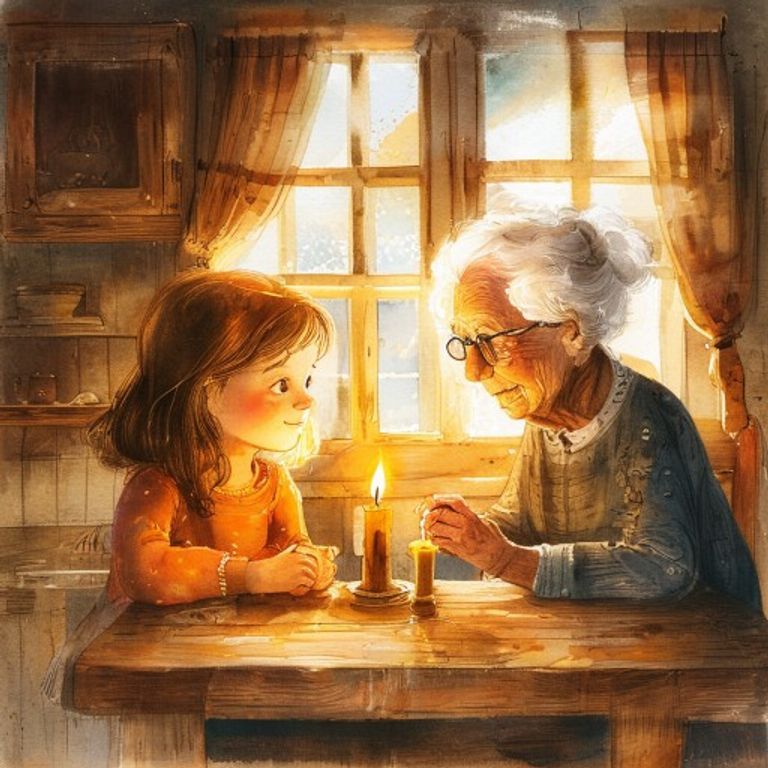
Lila lived with her grandmother, Nana Rose, in a cottage at the edge of the village, near the river that ran silver in the moonlight. Nana Rose was old, her hair white as winter frost, her hands knotted with arthritis, her back bent from years of carrying water and kneading bread. But her eyes—her eyes were still bright, the color of summer sky, and they held a warmth that made strangers feel at home.
Nana Rose had a practice. Every morning, before the sun rose, she would light a single candle on the kitchen table. She would sit in its flickering glow and whisper five things she was grateful for. Lila had heard her do this since she was a baby, and though she did not fully understand the words, she understood the feeling. When Nana Rose lit her candle, the cottage felt safe. The walls seemed thicker. The air smelled of honey and warmth.
"Why do you do that?" Lila asked one morning, as the candle flame danced and Nana Rose whispered her thanks.
Nana Rose smiled, her wrinkles deepening like rivers on a map. "Because gratitude is a candle, little one. When you light it, the darkness shrinks."
"But it's not dark," Lila said, looking out the window at the gray dawn.
"Not outside," Nana Rose agreed. "But inside. The world has many kinds of darkness."
Lila thought about this. She thought about it as she walked to the village school, past the bakery where Mr. Cress grumbled about the price of flour, past the tailor's shop where Miss Vex complained about her aching fingers, past the marketplace where voices rose in argument over the cost of eggs and the quality of cheese.
Everyone in Lumenford seemed unhappy. Everyone wanted something they did not have. And the more they wanted, the less they seemed to notice what they already possessed.
Lila did not understand why. She had so little—an old cottage, a bent grandmother, clothes that had been patched so many times the original fabric was barely visible—but she felt rich. Because every evening, Nana Rose would make soup from vegetables that neighbors shared, and they would eat by candlelight, and Nana Rose would tell stories of the old days, and Lila would fall asleep feeling that the world was kind.
She wished others could feel this way too.
The storm came on a Thursday.
It was not predicted. The sky had been clear at noon, blue and bright, with clouds so white they looked painted. But by evening, the wind rose. It howled through the streets of Lumenford, tearing shutters from windows, ripping signs from shops, sending the village lanterns swinging wildly until, one by one, they went out.
Then the rain came. Not gentle rain, but a torrent, a flood from the sky, turning the streets to rivers and the rivers to monsters. The power lines that brought electricity to the village snapped. The lights went out. The village was plunged into darkness.
People huddled in their homes, cold and frightened. Without light, without heat, the storm seemed worse than it was. Children cried. Adults argued. The darkness did not just hide the village—it seemed to amplify every fear, every worry, every complaint.
Lila and Nana Rose sat in their cottage, the only light a single candle that Nana Rose had lit when the power failed.
"It's so dark," Lila whispered, watching the candle flame shiver in the draft.
"Yes," Nana Rose said calmly. "But we have this candle. And we have each other. And we have a roof that keeps the rain out. That is enough to be grateful for."
"But everyone else is scared," Lila said. She could hear the crying from nearby cottages, the raised voices, the panic.
"They have forgotten how to be grateful," Nana Rose said softly. "And in forgetting, they have let the darkness grow inside them."
Lila looked at the candle. It was small, its flame no bigger than her thumb. But it pushed back the shadows. It made the room feel like a nest, a shelter, a place where the storm could not reach.
"What if we shared the candle?" Lila asked suddenly.
Nana Rose raised an eyebrow. "Shared it?"
"What if everyone had a candle? What if everyone said thank you, like you do? Would the darkness shrink for them too?"
Nana Rose was quiet for a moment. Then she smiled, a smile that lit her face more brightly than any candle. "Yes, little one. I believe it would."
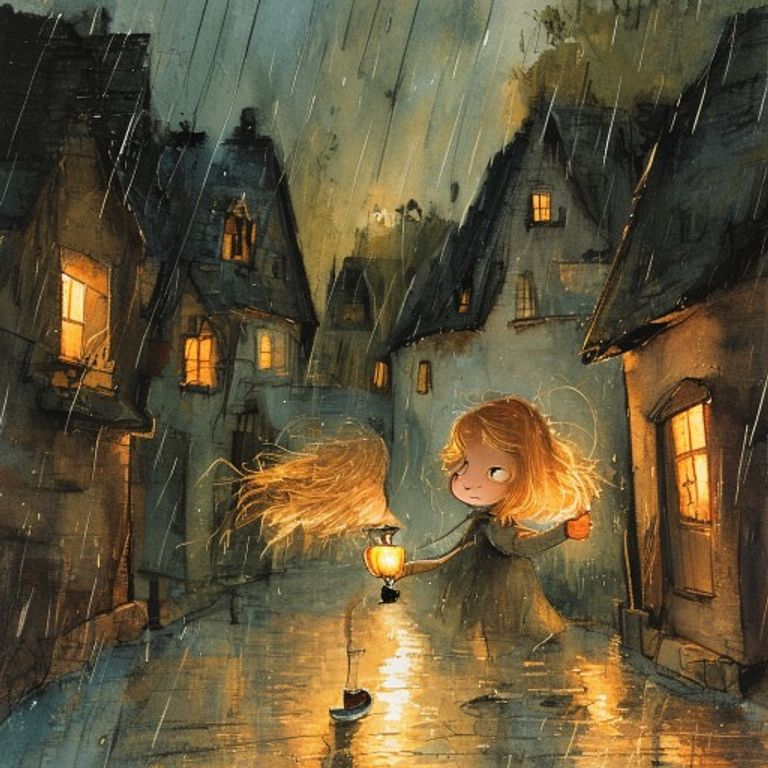
Lila wrapped herself in her coat, pulled on her boots, and stepped out into the storm.
The wind was fierce, the rain stinging her face like needles. But she held Nana Rose's candle in a jar to protect it, and the flame glowed steady, a small star in the chaos.
She went first to the bakery, where Mr. Cress sat in the dark, cursing the storm and his ruined bread.
"Mr. Cress," Lila said, pushing open the door. "I brought you light."
Mr. Cress looked up, surprised. He had not expected visitors. Not in this weather. Not from a child.
"What do you want?" he grumbled. "I'm busy being miserable."
"I want to give you this candle," Lila said, holding out the jar. "But first, you have to tell me one thing you're grateful for."
Mr. Cress stared. "Grateful? In this mess? The storm ruined my oven! My bread is spoiled! I'm losing money!"
"Just one thing," Lila persisted, her amber eyes steady. "Anything."
Mr. Cress opened his mouth to argue, but the candle flame caught his attention. It was so small. So fragile. Yet it burned. It did not complain about the wind. It simply glowed.
"I..." he began, then stopped. He thought. "I suppose I'm grateful my daughter is safe. She's sleeping upstairs."
Lila smiled. "That's a good one."
She handed him the candle. And something strange happened. As Mr. Cress held it, his face softened. The lines of anger smoothed. He looked at the flame, then at his daughter's room upstairs, and his eyes filled with tears.
"I hadn't thought of that," he whispered. "I was so busy complaining about the bread..."
"Complaining makes the darkness bigger," Lila said, repeating Nana Rose's words. "Gratitude makes it smaller."
She left him with the candle and ran through the rain to the next house.
Lila went to seven houses that night.
At each one, she offered a candle and asked for one grateful thing.
Miss Vex, the tailor, was grateful for her sewing needle, which had been her mother's. When she said it aloud, she found the needle in the dark and threaded it by candlelight, and the simple act of sewing made her calm.
The Miller family was grateful for their cat, who purred on their daughter's lap and kept her warm. When they said it, they noticed the cat for the first time in days, really noticed her, and the daughter laughed.
Old Mr. Barnaby, who lived alone, was grateful for the rain because it meant his well would be full. When he said it, he stopped cursing the storm and started listening to it, and realized it sounded like music.
Each person who spoke their gratitude received a candle. And each candle, when lit, seemed to burn brighter than physics should allow. The light did not just illuminate rooms. It illuminated hearts.
By the time Lila reached the last house, she was soaked and shivering. But she held the final candle, and it burned warm against her palm.
The last house belonged to the village mayor, a stern man named Alderman Thorne, who lived in the largest cottage and complained the loudest about taxes and weather and the price of everything. He was sitting in his dark parlor, wrapped in blankets, muttering about the injustice of it all.
"Alderman Thorne," Lila said, pushing open his heavy door. "I have a candle for you. But first, tell me one thing you're grateful for."
Alderman Thorne looked at the child standing in his doorway, dripping rainwater onto his fine rug, and his first instinct was to send her away. But there was something about her. Something steady. Something that reminded him of his own mother, long dead, who had been gentle in a world that was often hard.
"I'm grateful," he said slowly, "that someone cared enough to bring me light."
Lila smiled and handed him the candle.
The storm raged all night. But something changed in Lumenford.
In the cottages where candles burned, people gathered. They shared food they had forgotten they had—bread that was slightly stale but still good, cheese that was strong but nourishing, apples that were bruised but sweet. They told stories by candlelight. They sang songs. They remembered that they were not alone.
And in the remembering, the darkness did not seem so dark.
By morning, the storm had passed. The sun rose over a village that was wet and windblown but strangely peaceful. People emerged from their homes and looked at each other with eyes that held a new softness.
Mr. Cress gave his ruined bread to the birds. Miss Vex offered to mend a neighbor's coat for free. Mr. Barnaby stood in his garden, listening to his full well, smiling at the raindrops on the leaves.
And Alderman Thorne walked to Nana Rose's cottage, carrying a basket of oranges.
"For the girl," he said, his voice gruff but kind. "And for you. For... reminding us."
Nana Rose accepted the oranges, her sky-blue eyes twinkling. "It was not me, Alderman. It was the child. Children remember what adults forget."
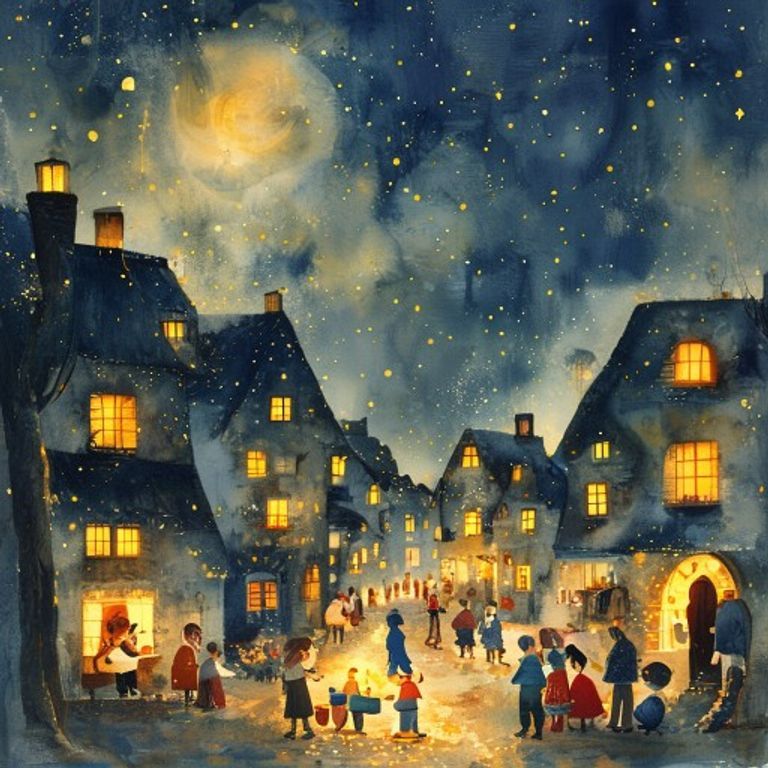
Lila became known in Lumenford as the Candle Girl.
Not because she carried candles, but because she carried light. Wherever she went, she asked people what they were grateful for. And in the asking, she taught them to see.
She asked the baker to be grateful for the smell of yeast. She asked the tailor to be grateful for the feel of wool. She asked the teacher to be grateful for the sound of children laughing. She asked the doctor to be grateful for the strength of healing.
And every time someone answered, something shifted. The village became softer. Kinder. Slower. People began to notice the small things they had rushed past before—the way the morning light hit the church steeple, the way the river sang over stones, the way a stranger's smile could warm a whole day.
Years later, when Lila was grown and Nana Rose was gone, the village of Lumenford still practiced gratitude. Every evening, at dusk, the villagers would light a candle in their window and whisper one thing they were thankful for. The candles burned in rows, like golden flowers, and travelers who passed through would stop and stare, wondering at the village that glowed from within.
And if they asked why, the villagers would smile and say, "A girl taught us that gratitude is light. And light, once shared, can never be lost."
Moral of the Story: Gratitude is not about having everything you want. It is about seeing the value in what you already have. When the storm plunged Lumenford into darkness, the villagers were frightened because they focused on what they had lost—the light, the warmth, the comfort. But Lila, taught by her wise grandmother, understood that gratitude is like candlelight. It does not seem like much on its own. But when you light it, the darkness shrinks. When you share it, the light grows. Every person who spoke one grateful word received a candle, and the candle did not just illuminate their room—it illuminated their heart. Mr. Cress found his daughter safe. Miss Vex found her mother's needle. Mr. Barnaby found music in the rain. Alderman Thorne found that someone cared. Gratitude does not change the storm. It changes how we see the storm. It does not give us more. It helps us see that we already have enough. The baker who is grateful for yeast can bake again. The tailor who is grateful for wool can sew again. The doctor who is grateful for healing can heal again. Gratitude is the light that lets us find our way through the darkness. It is the warmth that keeps us going when the world is cold. And the most beautiful thing about gratitude is that it multiplies. When you share it, it grows. When you teach it, it spreads. Lila did not have much. She had an old cottage, a bent grandmother, patched clothes. But she had gratitude. And because she had gratitude, she had light. And because she had light, she could share it. That is the power of gratitude. It does not require wealth. It does not require status. It only requires attention. The attention to notice what is good. The attention to say thank you. The attention to let the light in. And once you let it in, you will find that the darkness was never as deep as you thought. That the storm was never as strong as it seemed. That you have always had enough light—you just needed to light the candle.
Age Range: 4-8 years | Reading Time: ~10 minutes | Core Value: Gratitude