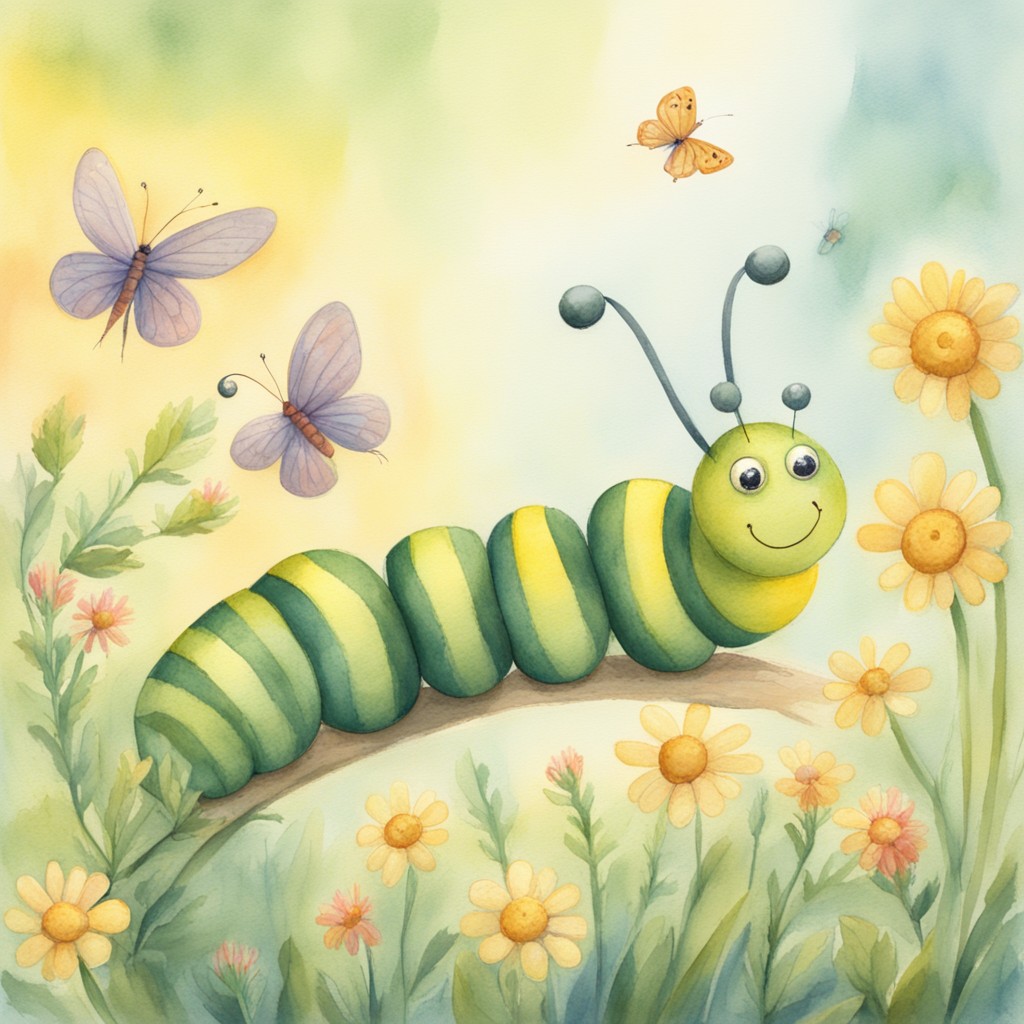
The Leaf Who Wouldnt Let Go: A Story About Patience
In the heart of Blossom Brook Gardens, where roses climbed trellises like children scrambling up playground equipment and daisies danced in every breeze, there lived a small garden patch known simply as "The Quiet Corner." It wasn't the grandest part of the garden. It didn't have the towering sunflowers that watched over the eastern wall, nor the bubbling fountain that sang to the south. But The Quiet Corner had something magical all its own: a milkweed bush that stood in a patch of warm sunlight, its leaves soft and fuzzy and smelling of summer sweetness.
On the underside of one particularly broad leaf, curled like a tiny green hammock, lived a caterpillar named Milo.
Milo was bright green with stripes of lemon-yellow and tiny black dots that ran along his sides like a parade of miniature soldiers. He was no bigger than a child's thumbnail, soft as a whisper, and perpetually in motion. Even when he rested, his little legs twitched with barely contained energy.
Milo loved being a caterpillar. He loved the feel of warm leaf-flesh beneath his many feet. He loved the taste of milkweed—so fresh, so sweet, so perfectly satisfying. He loved the way morning dew collected on the leaf above him and dripped down like a tiny waterfall, just for him to drink.
But most of all, Milo loved to watch the butterflies.
Every day, from his safe spot beneath the milkweed leaf, Milo would gaze upward through the garden foliage and watch them. The butterflies of Blossom Brook Gardens were legendary. There were Monarchs with wings like stained glass windows, orange and black and impossibly beautiful. There were Swallowtails with tails that streamed behind them like royal banners. There were Painted Ladies with patterns so intricate they looked like someone had spilled a jewelry box across their wings.
And they could fly.
Oh, how they could fly! They danced on breezes that Milo could only feel as gentle leaf-shivers. They soared above the garden walls to places Milo could only imagine. They rested on flowers that grew high above his reach, sipping nectar from blooms that smelled of paradise.
"I want to be a butterfly," Milo declared one morning, watching a Monarch glide past his leaf like a living sunset. "I want to fly. I want to see the world. I want to drink nectar from the tallest flowers."
His neighbor, Old Sage, was a caterpillar who had lived on the adjacent leaf for longer than anyone could remember. Old Sage was fuzzy and gray-green, with a calm demeanor that made him seem wise beyond his years.
"You will be a butterfly," Old Sage said, munching contentedly on his own leaf. "In time."
"When?" Milo demanded. "Tomorrow? Next week? How long must I wait?"
Old Sage laughed—a soft, rustling sound. "Oh, little one. Not nearly so soon. You must grow first. Eat. Rest. Grow some more. Then, when you're ready, you will spin a chrysalis and transform."
"Transform?" Milo's eyes grew wide. "Into a butterfly? Just like that?"
"Not just like that," Old Sage said gently. "It takes time. It takes patience. The chrysalis is not a quick nap, Milo. It's a long, deep sleep. And the waiting... the waiting is the hardest part."
"How long?" Milo asked, his voice smaller now.
"Weeks," Old Sage said. "Perhaps longer."
Milo felt his heart sink. Weeks? He couldn't imagine waiting days, let alone weeks. He was a creature of now, of immediate gratification, of instant results. When he was hungry, he ate. When he was tired, he slept. When he wanted something, he wanted it immediately.
"That's too long," Milo whispered. "I don't want to wait."
"No one does," Old Sage replied. "But some things cannot be rushed. Some things must unfold in their own time, like a flower opening to the sun. You cannot pull petals open, Milo. You must let them bloom."
Despite his impatience, Milo did what caterpillars do: he ate. And ate. And ate some more.
Each day, he grew a little bigger. Each day, his stripes became a little brighter. Each day, he felt change happening inside him, slow and subtle, like water wearing away stone.
But Milo still watched the butterflies. And he still felt the ache of wanting.
"Why can't I just become a butterfly now?" he asked Old Sage after two weeks of eating. "I'm bigger. I'm stronger. I've done the work."
"You haven't done all the work," Old Sage said. "Growing is only the first part. The real work happens inside the chrysalis, where no one can see. Where you must be alone. Where you must wait without knowing exactly what comes next."
"That sounds terrible," Milo said.
"It sounds terrible," Old Sage agreed. "But it's also where the magic happens. It's where you become who you're meant to be."
One warm morning, when the dew still clung to the grass like scattered diamonds, Milo woke up feeling different. His skin felt tight, almost uncomfortable. His appetite, usually endless, had vanished. A strange urge pulled at him—an instinct older than thought, deeper than desire.
He needed to find a place to spin his chrysalis.
"It's time," Old Sage said, watching Milo wriggle with restless energy. "You're ready."
"I'm scared," Milo admitted.
"Of course you are," Old Sage said. "Change is always scary. Waiting is always hard. But you are stronger than your fear, Milo. And the butterfly you will become is worth every moment of uncertainty."
With Old Sage's words wrapped around his heart like a warm blanket, Milo set out to find his place. He chose a sturdy stem near the base of the milkweed bush, where he would be protected from wind and rain but still able to feel the sun's warmth. Using silk from his own body—a magic he hadn't known he possessed—he began to spin. Around and around, layer after layer, until he was enclosed in a golden-green chrysalis that looked like a tiny jewel suspended among the leaves.
"Goodbye for now, little one," Old Sage called from his leaf. "I'll be here when you return."
"Goodbye," Milo whispered from inside his chrysalis. "And thank you."
Then the waiting began.
The first day wasn't so bad. Milo slept a lot. He dreamed of flying, of flowers, of warm sun on his wings. The chrysalis was cozy, like a sleeping bag made of his own hope.
The second day was harder. Milo woke up and wanted to move. His little legs twitched, but there was nowhere to go. He was surrounded by walls of silk and determination.
"Be still," the chrysalis seemed to say. "Trust the process."
"But I'm bored," Milo complained. "And uncomfortable. And I don't know what's happening."
"That's the point," whispered the garden wind. "Patience is not about knowing. It's about trusting even when you don't know."
The third day was worse. Milo felt strange things happening inside his body. Parts of him were dissolving. Parts of him were rearranging. It didn't hurt exactly, but it felt wrong—like his very self was being undone and rebuilt from scratch.
"I'm disappearing," he cried, panic fluttering in his chest. "I'm losing myself."
"You're not losing yourself," Old Sage called from nearby. "You're finding your true self. The caterpillar was wonderful, Milo, but he was only the beginning. The butterfly is who you were always meant to become."
"But what if I don't like who I become?" Milo asked, his voice trembling.
"Then you adapt," Old Sage said simply. "But first, you wait. First, you trust. First, you let the transformation happen without trying to control it."

Days passed. Then a week. Then two.
Milo's world was reduced to the inside of his chrysalis—a small, private universe of darkness and change. He couldn't see the garden. He couldn't feel the breeze. He couldn't watch the butterflies soar overhead.
All he could do was wait.
And in the waiting, strange things happened. He began to notice things he never had before. The rhythm of his own heartbeat, steady and persistent. The warmth of sunlight filtering through the golden-green walls of his chrysalis. The sound of rain tapping against his outer shell, like a lullaby sung by the sky.
He began to think about his life as a caterpillar—not with longing, but with gratitude. He remembered the taste of milkweed. The feel of morning dew. The sound of Old Sage's wise voice. The sight of butterflies dancing overhead.
He realized that every moment of his caterpillar life had been preparing him for this. Every leaf he ate had given him the energy to transform. Every day he lived had taught him something he needed. Even his impatience—especially his impatience—had brought him to this moment where patience was his only option.
"Maybe waiting isn't empty," Milo thought one quiet afternoon. "Maybe it's full. Full of growing. Full of changing. Full of becoming."
It was a small thought, barely a whisper in the darkness. But it was the beginning of patience.
On the seventeenth day, Milo woke up feeling different. His chrysalis felt tight—too tight. His body felt new—strange and expanded and ready. An urgency pulsed through him, different from the restless energy of his caterpillar days. This urgency had direction. This urgency had purpose.
He pushed.
The chrysalis resisted at first, its walls holding him in that familiar embrace. But Milo pushed again, harder, and a small crack appeared. Golden light poured in, blinding and beautiful. He pushed once more, with all his new strength, and the chrysalis split open.
The world that greeted him was more beautiful than he remembered. The garden was alive with morning—the kind of morning that makes everything look painted with fresh color. The roses were deeper red. The grass was brighter green. The sky was an impossible blue, like someone had spilled a bucket of summer overhead.
But Milo barely noticed any of it. Because he was different now. Radically, impossibly different.
He clung to the broken shell of his chrysalis, his new legs gripping the stem with an instinct he didn't know he had. And he looked down at himself.
Wings.
He had wings. They were still wet, still crumpled, still folded like origami that hadn't been properly opened. But they were wings—delicate membranes stretched across intricate veins, patterned with orange and black and white in a design that took his breath away.
"I'm a butterfly," Milo whispered, and the whisper came out in a voice he didn't recognize—soft and musical, like wind chimes in a gentle breeze.
"You are," said Old Sage, who had watched the entire emergence from his nearby leaf. The old caterpillar's eyes glistened with pride. "And you were worth the wait."
But the waiting wasn't quite over. Milo soon discovered that wings, like all good things, need time to be ready. His were too soft to fly. Too wet to open fully. Too new to trust.
"How long?" he asked Old Sage, trying not to sound impatient.
"A few hours," Old Sage said. "Maybe until afternoon. Your wings must dry. The veins must harden. The muscles must learn their new work."
"More waiting," Milo sighed.
"More becoming," Old Sage corrected gently.
So Milo waited. And in this waiting, he discovered something wonderful: he could watch the garden in a way he never had before. His caterpillar eyes had been small, ground-level, focused on leaves and stems and the underside of petals. But his butterfly eyes—oh, his butterfly eyes!—saw everything.
He saw the way sunlight turned dewdrops into prisms, casting tiny rainbows across the grass. He saw the intricate patterns on flower petals, each one unique as a fingerprint. He saw the dance of bees from bloom to bloom, their pollen baskets overflowing with golden treasure. He saw birds soaring overhead, their wings catching thermals he could now feel against his own newly drying wings.
He saw the garden not as a caterpillar sees it—close, immediate, hungry—but as a butterfly sees it: vast, connected, full of possibility.
And when his wings finally dried, when the veins hardened like delicate scaffolding, when the muscles remembered their ancient purpose, Milo spread those wings and felt the air catch them.
He flew.
The first flight was clumsy. He tipped left, then right, then nearly crashed into a daisy. But he adjusted. He learned. He felt the wind and responded, tilting, gliding, rising.
By his third attempt, he was circling the milkweed bush. By his fifth, he was above the garden wall. By his tenth, he was soaring over Blossom Brook Gardens, looking down at the world he had known from below, now seeing it from above.
The sunflowers were golden crowns. The fountain was a silver mirror. The roses were scattered rubies. And The Quiet Corner, with its milkweed bush and its chrysalis shells and its patient old caterpillar, was a patch of pure green magic.
Milo flew higher. He caught a thermal and rose with it, spinning in the warm air, feeling the sun on his wings and the wind in his face. He was free. He was flying. He was everything he had ever wanted to be.
And he understood, finally, why the waiting had been necessary.

He found the tallest flower in the garden—a hollyhock that stretched toward the sky like a pink and white tower. He landed on its highest bloom, his wings folding neatly, and looked out over the world.
"Old Sage was right," Milo thought. "I couldn't have flown as a caterpillar. I needed the waiting. I needed the transformation. I needed the patience to let it all happen in its own time."
A Monarch butterfly landed beside him on the same flower—a beautiful creature with wings that had seen many summers.
"You're new," the Monarch observed, her voice like honey.
"Today is my first flight," Milo said, still breathless with wonder.
"Welcome," she said. "The sky has been waiting for you."
"I had to wait for it first," Milo replied, and they both laughed—the soft, musical laughter of butterflies.
The Monarch tilted her head, studying him. "You understand something that many never learn, young one. You understand that the waiting is not wasted time. It is invested time. Every moment in your chrysalis was building the wings that now carry you."
"I didn't understand it then," Milo admitted. "I was impatient. I wanted to skip ahead. I thought waiting was empty."
"And now?"
"Now I know that waiting is full," Milo said. "Full of growing. Full of changing. Full of becoming who you're meant to be."
"Then you are wise, young butterfly. Wiser than many who have flown for years."
As the afternoon sun began to dip toward the garden wall, painting everything in shades of amber and gold, Milo flew back to The Quiet Corner. He wanted to see Old Sage. He wanted to thank him. He wanted to show him what patience had made.
He found the old caterpillar on his familiar leaf, munching contentedly, watching the sunset with calm eyes.
"Old Sage!" Milo called, landing on a nearby stem. His wings caught the sunset light and glowed like stained glass. "Look at me!"
Old Sage looked. And for a moment, the old caterpillar's composure cracked, and Milo saw tears glistening in his eyes.
"You are beautiful," Old Sage whispered. "More beautiful than I imagined."
"I couldn't have done it without you," Milo said. "Without your wisdom. Without your patience with my impatience."
Old Sage shook his head. "I only told you what every caterpillar must learn. The waiting is the work, Milo. The stillness is the preparation. The patience is the path."
"Will you become a butterfly too?" Milo asked.
Old Sage smiled, a sad, sweet smile. "I am old, little one. My time for transformation has passed. But I don't mind. I have lived a good life on this leaf. I have watched generations of caterpillars become butterflies. And now, in my final days, I have the privilege of seeing you soar. That is enough for me."
Milo felt his heart ache. "But I want you to fly with me."
"And I will," Old Sage said. "In my way. Every time you pass this leaf, every time you remember our talks, every time you feel the urge to rush and choose to wait instead—I will be with you. Patience is not just something I taught you, Milo. It's something you will teach others, in time."
Milo spent the rest of his days flying through Blossom Brook Gardens, visiting flowers he had only dreamed of as a caterpillar. He drank nectar from hollyhocks and sunflowers. He rested on rose petals that felt like velvet beneath his feet. He soared over the garden wall and discovered meadows beyond, full of clover and wildflowers and butterflies he had never known existed.
But he always returned to The Quiet Corner. He always visited Old Sage's leaf. And he always, always took time to rest, to watch, to wait.
Because Milo had learned the secret that transforms a caterpillar into a butterfly, a seed into a flower, a dream into reality:
Good things take time.
And the waiting—the long, hard, uncertain waiting—is never wasted. It is where the magic happens. It is where we become who we are meant to be.
THE END
Moral of the Story: Patience is not simply the ability to wait—it is the wisdom to understand that some things cannot be rushed. Transformation, growth, and becoming who we are meant to be all require time that cannot be hurried. When we learn to trust the process, even in the darkness of uncertainty, we discover that waiting is not empty time but filled with invisible, essential work. The caterpillar does not become a butterfly by demanding it happen faster; it happens through patience, trust, and the courage to let go of who we were in order to become who we are meant to be.