The Acorn That Changed Everything: A Story About Gratitude
In the heart of Whispering Woods, where ancient oaks stretched their branches toward the sky like friends linking arms, there lived a young squirrel named Nutmeg.
Nutmeg was small for his age, with fur the color of toasted cinnamon and a tail so fluffy it looked like a feather duster had been dipped in autumn paint. He lived in a cozy hollow in the trunk of Grandmother Oak, the oldest tree in the forest. His home was lined with soft moss, warmed by dried leaves, and smelled perpetually of sweet bark and distant pine.
But Nutmeg was not happy.
In fact, Nutmeg spent most of his days complaining.
"My nest is too small," he would mutter, looking at his snug hollow. "Squirrels in the East Woods have nests twice this size."
"My tail is too fluffy," he would sigh, watching it swish behind him. "Other squirrels have sleek, aerodynamic tails. I probably can't run as fast because of all this fluff."
"These acorns are too plain," he would grumble, turning over the shiny brown nuts he'd gathered. "I heard the acorns in Maple Ridge are golden and twice as sweet."
Nothing was ever quite right for Nutmeg. The morning sunshine was too bright. The evening breeze was too chilly. The stream water was too cold. The berries were too tart. Even when the other squirrels chattered excitedly about the beautiful day, Nutmeg would find something to criticize.
"The sky is too blue," he once said. "It hurts my eyes."
His friend Hazel, a cheerful red squirrel who lived in the neighboring Hickory Tree, would often try to cheer him up.
"Nutmeg, look at how the sunlight filters through the leaves!" she'd exclaim. "Isn't it magical?"
"It's just sunlight," Nutmeg would reply. "And it's making my fur too warm."
Hazel would sigh but never give up on him. She saw something in Nutmeg that he couldn't see in himself—a good heart hidden beneath layers of complaints.
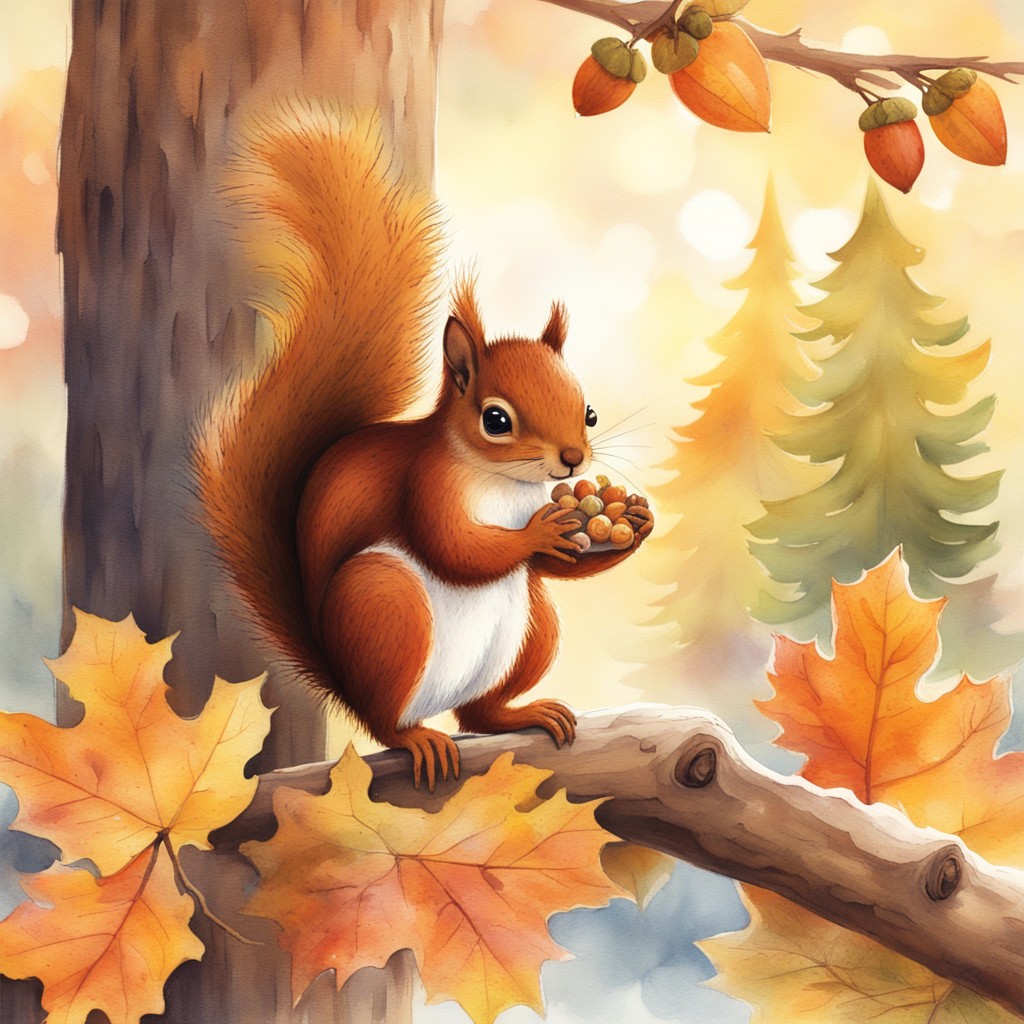
As autumn painted the forest in shades of amber, crimson, and gold, the squirrels of Whispering Woods began their most important task: gathering winter supplies.
Every squirrel had their system. The wise elders taught that a squirrel needed at least three hundred acorns to survive the winter comfortably.
Nutmeg had gathered only fifty.
He'd been too busy complaining to work efficiently. While other squirrels scampered from dawn to dusk, their cheeks bulging with treasures, Nutmeg would find reasons to stop and grumble.
"This acorn has a crack," he'd say, tossing aside a perfectly good nut. "I don't want cracked acorns."
"That branch is too high," he'd complain, giving up on a tree loaded with fruit. "Why should I have to work so hard?"
"My paws are tired," he'd whine, resting when he'd only been gathering for an hour. "Other squirrels have stronger paws."
Hazel had gathered nearly four hundred acorns. She was prepared. She was ready. But she worried about Nutmeg.
"You need to gather more," she told him one crisp morning, her breath making small clouds in the cool air. "Winter is coming soon. The first frost could be any day."
"I'll gather more later," Nutmeg said, lounging on a warm rock. "Right now, the sun feels nice. Why rush?"
But Hazel knew something Nutmeg refused to see: winter didn't wait for anyone. Not even for squirrels who wanted to nap in the sun.
The first snow came three weeks earlier than anyone expected.
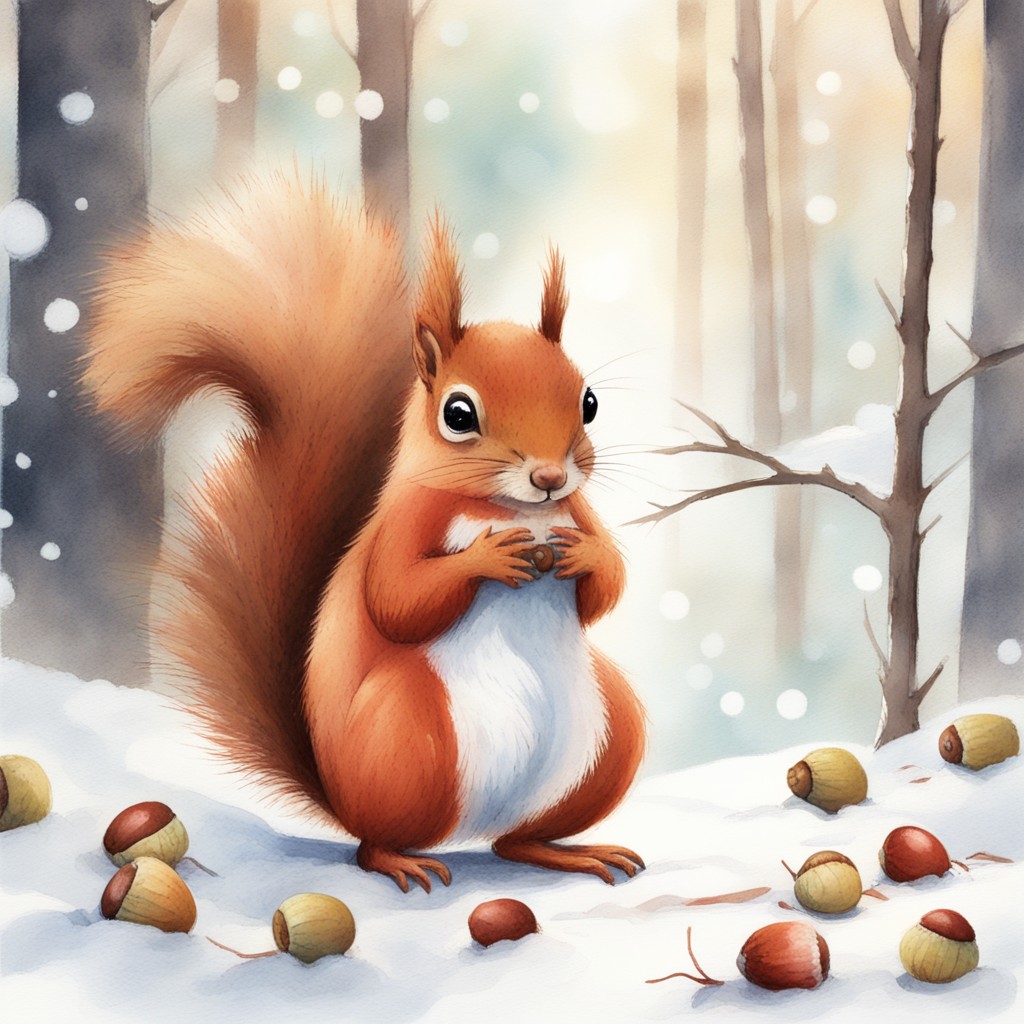
It started as a gentle whisper—soft flakes drifting from a gray sky like tiny feathers. By evening, the whisper had become a song. By morning, a symphony. The snow fell heavily, steadily, relentlessly, blanketing Whispering Woods in white silence.
Nutmeg woke to a world transformed. His cozy hollow was cold—colder than he'd ever felt. When he peeked outside, his heart sank. The forest was buried. The ground was invisible. The trees looked like they'd been dipped in sugar frosting.
"How am I supposed to find my acorns?" he cried, his voice small and frightened. "I buried them under the big oak, but I can't see the ground anymore!"
Hazel appeared at his doorway, her red fur dusted with snowflakes. "Nutmeg, how many acorns do you have stored in your hollow?"
Nutmeg counted miserably. "Fifty. Maybe sixty."
Hazel's eyes widened. "That's not enough. Not nearly enough. The snow will last for months."
Nutmeg felt a cold that had nothing to do with the weather. "What am I going to do?"
Hazel thought for a moment. "I'll share mine. I have extra."
"But you worked so hard for them," Nutmeg protested, though his stomach growled at the thought of food.
"That's what friends do," Hazel said simply. "But Nutmeg, you need to learn something important. You need to learn to appreciate what you have. Because I can't always be there to fill the gaps that your complaining creates."
Hazel brought Nutmeg twenty acorns. It wasn't much, but it was something. She also brought him a thick bundle of dried grass to help insulate his hollow against the cold.
The winter was hard. Harder than Nutmeg had imagined possible.
The cold seemed to seep into his bones, making his joints ache. The days were short and gray, the nights long and darker than he'd ever experienced. His meager store of acorns shrank quickly, despite careful rationing. By the time the Winter Solstice arrived, Nutmeg had only ten acorns left, and the snow showed no signs of melting.
He spent his days huddled in his hollow, wrapped in dried grass, trying to stay warm. He thought about all the times he'd complained about his cozy home, and now he was grateful for every bit of moss and leaf that kept the cold at bay.
He thought about all the times he'd criticized the acorns as "too plain," and now he would have given anything for a single one.
He thought about all the times he'd found fault with the sunshine, and now he prayed for even a glimpse of it through the gray winter clouds.
And he thought about Hazel—her kindness, her generosity, her willingness to help even when he had done nothing to deserve it.
One particularly cold night, with the wind howling outside like a lonely wolf, Nutmeg made a decision. When spring came—and it would come, the elders always said—he would change. He would stop complaining. He would start appreciating. He would be grateful for what he had, rather than bitter about what he didn't.
"If I survive this winter," he whispered to the darkness, "I will be different. I promise."
The turning point came on the coldest day of winter.
The temperature had dropped so low that the air hurt to breathe. Nutmeg's hollow, despite his best efforts, had become an icebox. He was down to his last three acorns, and he'd been saving them for what he feared might be his final days.
He ventured outside only because he heard a faint cry—a sound of distress that cut through the wind.
Following the sound, Nutmeg found Old Thornby, the ancient hedgehog who lived near the frozen stream. The old hedgehog had fallen into a snowdrift and couldn't get out. His spines were coated in ice, his breathing shallow, his eyes closed.
Without thinking, Nutmeg began to dig. His small paws, so often criticized as "too weak," worked tirelessly, throwing aside snow in frantic bursts. The cold bit at his fur. The wind stung his eyes. But he didn't stop.
"Help!" he called, his voice carrying through the silent forest. "Someone, please help!"
Hazel heard his call. So did several other creatures—a badger family, a pair of rabbits, even a young fox who normally would have seen a hedgehog as prey. They came together, digging and lifting and carrying, until Old Thornby was freed and brought to a warm burrow.
When it was over, when the danger had passed, the animals stood together in the snow, panting and exhausted but alive.
"Thank you," Old Thornby whispered, his voice trembling. "I thought I was done for."
"We help each other," the badger matriarch said firmly. "That's how we survive."
Nutmeg looked at the assembled creatures—different species, different sizes, different natures—and felt something shift inside him. In this moment, none of their differences mattered. What mattered was that they had come together. What mattered was that they had helped.
And what mattered most to Nutmeg was that he had been part of it. His "weak" paws had dug through snow. His "too fluffy" tail had helped brush ice from the hedgehog's spines. His "small" body had squeezed into spaces larger creatures couldn't reach.
For the first time, he saw himself not as a collection of shortcomings, but as someone who had something to offer.
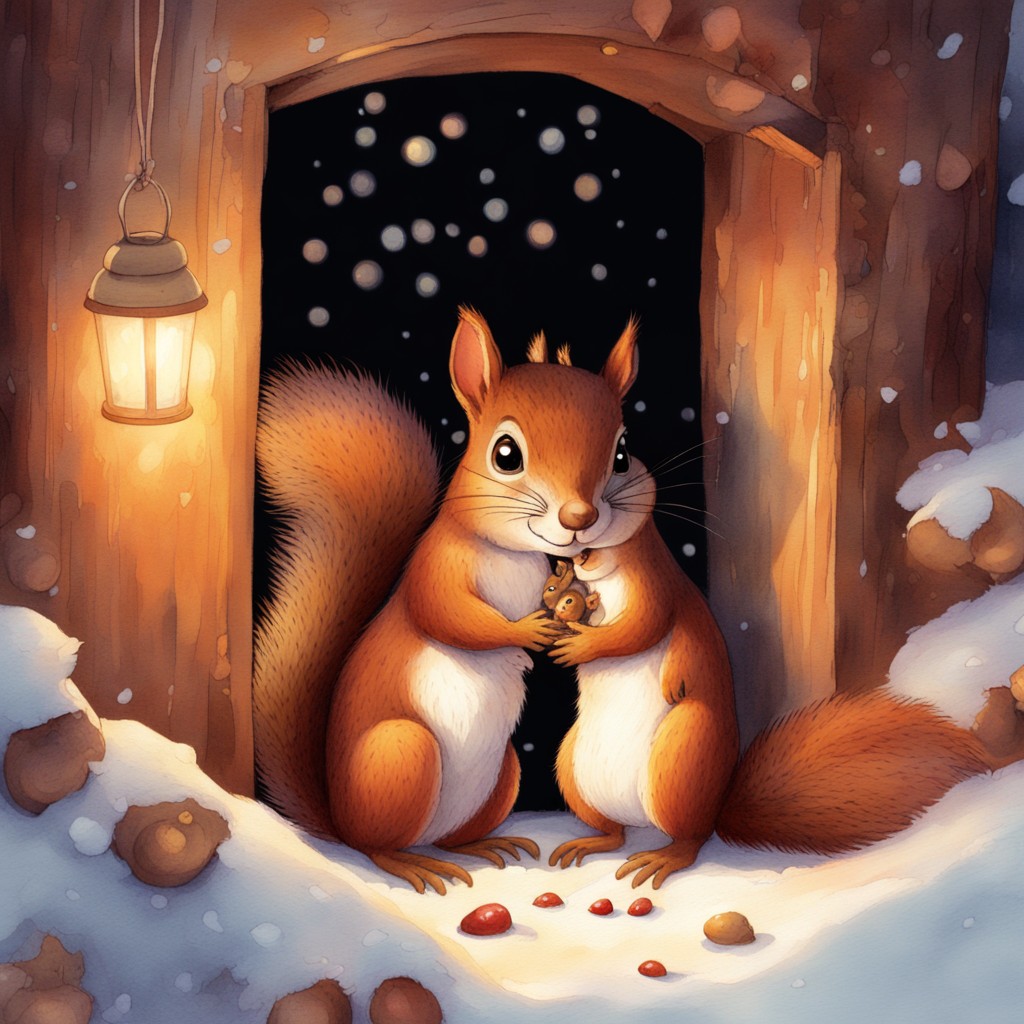
That night, Hazel found Nutmeg sitting outside his hollow, looking up at the winter sky. The clouds had parted, revealing a scattering of stars so bright they looked like someone had spilled diamonds across black velvet.
"You're not inside," she observed, sitting beside him. "Aren't you cold?"
"A little," Nutmeg admitted. "But look at the sky, Hazel. When have we ever seen so many stars?"
Hazel looked up, surprised. "You... you're appreciating something?"
Nutmeg laughed—a small, self-conscious sound. "I know. It's strange. But sitting here, after today, after almost losing Old Thornby... I realize how much I've taken for granted. The stars. The snow. The friends who help me even when I don't deserve it. The acorns that keep me alive. The hollow that shelters me. Even my fluffy tail—today it helped warm a freezing hedgehog."
He turned to her, his eyes glistening. "I've spent so much time wanting more, complaining about what I have, comparing myself to others. And all that time, I had everything I needed. I just couldn't see it."
Hazel leaned against him, her warmth a comfort in the cold. "Welcome to gratitude, Nutmeg. It's a nice place to live."
"How do I stay here?" he asked. "How do I keep appreciating things when it's so easy to fall back into complaining?"
"You practice," Hazel said simply. "Every day, find three things to be grateful for. Even tiny things. The warmth of the sun. The taste of an acorn. the sound of a friend's voice. The more you look for good things, the more you find. It's like... like gathering acorns, but instead of storing them in your hollow, you store them in your heart."
Nutmeg thought about this. "Three things. Every day."
"Even on hard days. Especially on hard days. Because gratitude isn't about having a perfect life. It's about seeing the perfect moments in an imperfect life."
Spring came slowly, as springs do after hard winters. The snow retreated like a shy animal, revealing patches of brown earth that quickly greened with new life. Buds appeared on bare branches. Streams broke free of their ice prisons and sang once more. The forest filled with birdsong, and the scent of new growth hung sweet in the air.
Nutmeg emerged from his hollow on the first truly warm day, thinner than he'd been but alive. And different.
The first thing he noticed was the warmth of the sun on his fur. Instead of complaining that it was "too bright," he closed his eyes and let it soak into his bones, storing the warmth like a precious gift.
The second thing he noticed was the scent of blooming wildflowers—violets, primroses, and early dandelions that painted the forest floor in purple, yellow, and white. Instead of dismissing them as "just flowers," he breathed deeply and thought, "How lucky am I to smell such beauty?"
The third thing he noticed was Hazel, waiting for him with a fresh acorn she'd found.
"Welcome back to the world," she said, grinning.
"Thank you," Nutmeg replied, and he meant it with every fiber of his being. "For the acorn. For the friendship. For saving my life this winter. For teaching me about gratitude."
Hazel blinked, surprised by the sincerity in his voice. "You're different, Nutmeg."
"I hope so," he said. "I want to be."
As the seasons turned and summer arrived in full glory, Nutmeg kept his promise.
Every morning, before he began gathering, he sat on his favorite branch and named three things he was grateful for.
"I'm grateful for this sturdy branch that holds me safely."
"I'm grateful for the cool morning breeze that wakes me up."
"I'm grateful for the sound of Hazel's chatter, which always makes me smile."
Some days the three things were big—the health of his friends, the abundance of summer berries, the safety of Grandmother Oak's strong trunk.
Some days they were small—a perfectly shaped leaf, a particularly sweet berry, a funny-shaped cloud that made him laugh.
But every day, Nutmeg found his three things. And every day, his heart grew a little fuller.
He noticed he worked harder, too. Not because he was afraid of winter, but because he appreciated the abundance of summer and wanted to honor it by preparing wisely. He gathered acorns with joy rather than resentment, thinking of each one as a gift from the forest rather than a chore to complete.
"This acorn is perfect," he'd say, holding up a plump brown nut. "Thank you, oak tree."
By autumn, Nutmeg had gathered five hundred acorns—more than any squirrel in Whispering Woods. Not because he was the fastest or the strongest or the most clever. But because he was the most grateful, and gratitude had given him the energy to keep going when others grew tired.
On the first day of the new autumn, as the leaves began their annual dance of color, Nutmeg sat with Hazel on a high branch overlooking the forest.
"Do you remember last autumn?" he asked. "When I complained about everything?"
Hazel laughed. "I remember. I was worried about you."
"I was worried about me, too," Nutmeg admitted. "But Hazel, I want to tell you something. Last winter, when I was cold and hungry and scared, I made a promise. I promised that if I survived, I would learn gratitude. And I have. But I also learned something else."
"What's that?"
"I learned that gratitude isn't just about saying thank you for good things. It's about finding something to appreciate even in hard things. The winter was terrible. I was hungry. I was cold. I was frightened. But that winter taught me what I had. It taught me who my friends were. It taught me that I was stronger than I thought. It taught me that a fluffy tail and small paws and a warm hollow were gifts, not shortcomings."
He looked out at the forest, his eyes soft with emotion. "So in a strange way, I'm grateful for the hard winter, too. Because without it, I might still be the squirrel who complained about blue skies."
Hazel wrapped her tail around his. "That's the deepest gratitude of all, Nutmeg. Being thankful not just for the easy blessings, but for the hard lessons. That's when gratitude becomes wisdom."
Nutmeg smiled, a genuine, warm smile that reached his eyes. "Then I am wise, Hazel. Because I am grateful for everything. The good and the bad. The easy and the hard. The sunshine and the snow. The abundance and the scarcity. The friendship and the solitude."
He looked at her, his heart overflowing. "Especially the friendship."
That winter, when the snows came again, Nutmeg was ready. His hollow was stuffed with acorns, lined with warm grass, prepared for whatever the cold months might bring.
But more importantly, his heart was ready. When the first snow fell, he didn't complain. He watched it drift down, each flake unique and beautiful, and he felt grateful for the quiet magic of winter.
When the cold settled in, he didn't grumble. He curled in his cozy nest, surrounded by the abundance he'd gathered, and felt grateful for the warmth and safety.
And when Hazel came to visit, as she always did, he didn't take her for granted. He thanked her for coming. He shared his acorns gladly. He listened to her stories with full attention. And he told her, every single time, how grateful he was for her friendship.
Because Nutmeg had learned the secret that many creatures never discover: gratitude isn't something you feel when life is perfect. It's something you practice until life feels perfect, even when it isn't.
And the more you practice, the more perfect it becomes.
THE END
Moral of the Story: Gratitude is not about having everything you want—it's about appreciating everything you have. When we constantly focus on what we're missing, we blind ourselves to the abundance already surrounding us. True gratitude is a practice: deliberately noticing and appreciating the good in our lives, both big and small. The remarkable thing about gratitude is that the more we express it, the more we have to be grateful for. It transforms ordinary moments into blessings, hard times into lessons, and simple gifts into treasures beyond measure.