The Garden of Two Hearts: A Story About Friendship
The Garden of Two Hearts: A Story About Friendship
In the rolling hills of Meadowbrook, where buttercups nodded in the breeze and honeybees hummed lullabies to the clover, lived two children who were as different as the sun and the moon.
Lily was small and quiet, with hair the color of autumn wheat and eyes like the sky after a rainstorm. She loved to sit in her grandmother's garden, sketching the flowers in a leather-bound book, her pencil moving in soft, careful strokes. She was shy, preferring the company of plants to people, and she spoke so softly that sometimes the wind carried her words away before anyone could hear them.
Max was tall and loud, with hair that stuck up in every direction like a dandelion gone to seed. He loved to run and jump and climb, and he laughed with his whole body, throwing his head back so far that he sometimes stumbled. He was fearless, racing through the meadow without looking where he stepped, and he talked so much that his teachers often had to remind him to take a breath.
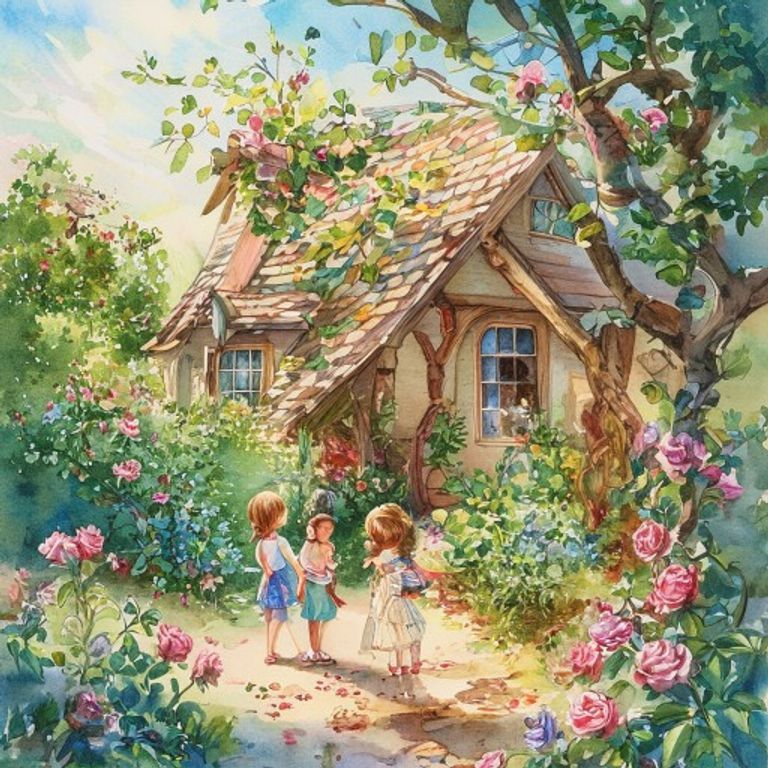
They lived next door to each other in identical cottages with thatched roofs and rose-covered fences. But they had never spoken. Not really. Lily thought Max was too wild. Max thought Lily was too quiet. And so they passed each other every morning, walking to the village school, their eyes fixed on the ground, their hearts closed like fists.
Then came the summer of the Great Drought.
The rains stopped in June. By July, the meadow was brown and brittle. The buttercups drooped. The clover crunched underfoot. And the stream that ran through the village slowed to a trickle, then to a thread, then to nothing but damp stones.
Lily's grandmother's garden suffered the most. The old woman had tended it for fifty years, coaxing roses and peonies and delphiniums from the rich soil. But now the soil was dust, and the flowers were dying.
"Please," Grandmother whispered to the sky, her hands gnarled with age. "Please send rain."
But the sky remained stubbornly blue, cloudless and cruel.
Lily sat in the garden every evening, sketching the wilted flowers, her tears falling on the parched earth. She felt helpless. She was just one small girl. What could she do against the endless sky?
Meanwhile, Max was also suffering. Without the stream, there was no swimming, no fishing, no splashing. The meadow was too dry for running. The trees were too brittle for climbing. He paced around his yard like a caged fox, bored and restless and lonely.
One evening, as the sun bled into the hills, Max saw Lily sitting alone in her garden, surrounded by dying flowers, her sketchbook fallen open on her lap. He watched her for a long moment, something unfamiliar stirring in his chest.
"She looks sad," he thought. "Sadder than me."
He had never spoken to Lily. He didn't know what to say. But his feet carried him across the grass anyway, past the rose-covered fence, into the garden that was not his.
"Um," he said, his voice too loud, as always. "Hi."
Lily jumped, her pencil rolling into a patch of dry earth. She looked up at Max, her eyes wide and wary.
"Hi," she whispered.
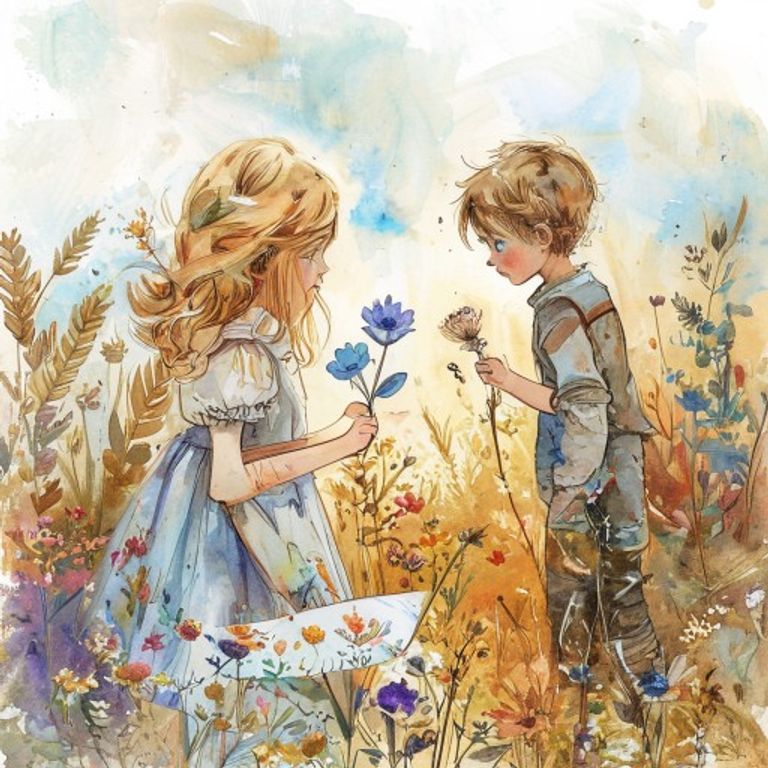
Max shuffled his feet. "I... I noticed your flowers are dying. Mine too. My mom's tomatoes are all crispy."
Lily nodded, her throat tight. "My grandmother's garden. She's had it forever. And now..." Her voice broke. "Now it's all going to die."
Max looked at the wilted roses, the drooping delphiniums. He looked at Lily's tear-streaked face. And something inside him shifted.
"Maybe," he said slowly, "we can save them."
Lily blinked. "How? The stream is dry. The well is almost empty. We can't water all these flowers."
"Not with water," Max said, his mind racing. "With shade! If we build shade structures, the sun won't bake them so badly. And if we mulch them with straw, the soil will stay moist longer. My grandfather taught me that before he... before he passed."
Lily sat up straighter. "And I know where the old irrigation channels are. My grandmother showed me once. They were built a hundred years ago, before the modern well. They might still work if we clear them."
Max grinned, his whole face lighting up. "Then let's do it!"
"Now?" Lily asked. "It's almost dark."
"Tomorrow!" Max said. "At dawn! Meet me here, with tools and... and whatever you think we need."
Lily found herself smiling, just a little. "Okay. Tomorrow."
That night, she couldn't sleep. She had never had a friend before. Not really. She was too quiet, too different. But Max had seen her. Really seen her. And he hadn't laughed or teased or walked away.
The next morning, they met as the sun crested the hills. Lily brought her grandmother's old gardening tools, polished and sharp. She brought seeds she had saved from last year, precious and hopeful. She brought her sketchbook, with detailed drawings of the old irrigation channels.
Max brought wooden poles and old bedsheets for shade. He brought a wheelbarrow and strong rope. He brought his grandfather's irrigation maps, yellowed with age but still legible. And he brought a jar of lemonade, sweating in the morning cool.
"For breaks," he said, thrusting it at Lily. "You have to stay hydrated!"
They worked all morning. Max used his strength to lift the heavy poles, to dig the blocked channels, to carry buckets of precious well water. Lily used her knowledge to place the shade just right, to guide the water to the thirstiest plants, to whisper encouragement to the drooping flowers.
"You're strong," Lily said, watching Max lift a log that she couldn't have budged.
"You're smart," Max replied, watching Lily redirect a channel with a few precise stones.
By noon, the garden looked different. Shade cloths fluttered over the most fragile plants. Water trickled through restored channels, reaching roots that had been parched for weeks. And Lily and Max sat under the old apple tree, sharing the lemonade, their faces flushed with sun and effort.
"I didn't know you were so..." Max paused, searching for the right word. "So capable."
Lily laughed, a sound like wind chimes. "I didn't know you were so... thoughtful."
They talked. Really talked, for the first time. Max learned that Lily wasn't quiet because she had nothing to say. She was quiet because she was always thinking, observing, noticing things others missed. Lily learned that Max wasn't loud because he wanted attention. He was loud because he felt everything so deeply that it couldn't be contained.
"I get scared sometimes," Max admitted, scuffing his shoe in the dirt. "When I'm running too fast. When I'm climbing too high. But if I stop, everyone will see I'm scared. So I just... keep going. Louder and faster."
Lily reached out, her small hand covering his larger one. "You don't have to be loud for me," she said. "You can just be you."
Max felt something unlock in his chest. "And you don't have to hide for me. You can say anything. Even if it's quiet. I'll listen."
The friendship bloomed like the flowers they were saving.
Over the next weeks, they worked every morning in the garden. They laughed when Max tripped over a watering can and soaked himself. They cried when a rose bush was too far gone to save. They celebrated when the first new bud appeared, small and green and stubbornly alive.
But the drought continued. And the village well was running lower every day.
"We need more water," Lily said one evening, studying her sketches. "The well won't last. But there's an underground spring, about a mile north. My grandmother told me stories about it."
"A mile?" Max said. "We can't carry water that far. Not enough to matter."
"Not carry," Lily said, her eyes bright. "Channel. If we dig a trench from the spring to the garden, gravity will do the work."
Max stared at her. "A mile-long trench? That's impossible. We're just kids."
"Not if we get help," Lily said. And for the first time in her life, she wasn't afraid to ask. "Max, you know everyone in the village. You talk to everyone. Will you... will you help me ask?"
Max grinned. "Watch me."
The next day, Max went door to door. He talked to farmers and teachers and shopkeepers. He told them about Lily's plan, about the spring, about the garden that could be saved. He used his loud voice, his endless energy, his gift for making people believe.
"Lily's the smartest person I know," he told them. "She has maps and plans and everything. We just need strong backs to help dig."
And they came. Twenty villagers, young and old, inspired by two children who refused to give up.
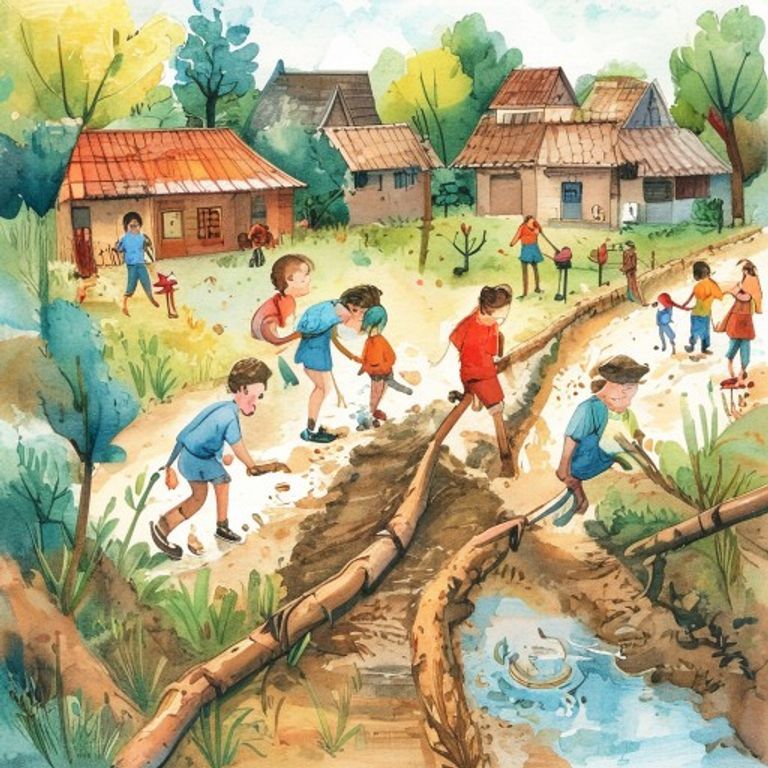
Lily directed them with quiet confidence. She showed them where to dig, how deep, how wide. She calculated the slope so the water would flow just right. She drew maps in the dirt with a stick, her quiet voice carrying farther than she ever thought possible.
They dug for three days. The trench was long and straight and true. And on the third evening, water began to flow. Not a flood, but a steady, gentle stream, carrying life from the hidden spring to the thirsty garden.
The villagers cheered. Lily's grandmother wept with joy. And Max lifted Lily onto his shoulders, parading her through the village, shouting: "She did it! She saved the garden!"
"We did it," Lily corrected, laughing and blushing. "Together."
The rains returned in August, gentle and persistent, as if the sky had finally noticed the village's suffering. The meadow greened. The stream refilled. And the garden flourished as it never had before, fed by the new channel that Lily and Max had built.
But more than the garden had been saved. Two lonely hearts had found each other. A quiet girl had discovered her voice. A loud boy had discovered the power of listening.
Years later, when Lily was a famous botanical illustrator and Max was a community organizer, they would still meet in that garden every summer. They would sit under the apple tree, now grown massive and gnarled, and remember the summer they became friends.
"You know what the best part was?" Max would ask, his hair now gray but still sticking up in every direction.
"The lemonade?" Lily would tease, her voice still soft but confident.
"No," Max would say, taking her hand. "The best part was discovering that being different doesn't mean being alone. You were quiet. I was loud. You were careful. I was wild. But together, we were exactly what each other needed."
And in the garden that had brought them together, where roses climbed the fence and delphiniums reached for the sky, two old friends would sit in comfortable silence, listening to the bees hum their eternal lullabies.
Moral of the Story: Friendship is about finding someone who sees your differences not as flaws, but as gifts. Lily was quiet. Max was loud. She was careful. He was wild. Alone, they were lonely and misunderstood. But together, their differences became strengths. She had the plans. He had the energy. She noticed what others missed. He connected with everyone he met. True friendship is not about being the same. It is about being complementary. About filling each other's gaps. About seeing the best in someone else, and helping them see it too. So do not look for friends who are just like you. Look for friends who make you more than you could be alone.
Age Range: 4-8 years | Reading Time: ~10 minutes | Core Value: Friendship