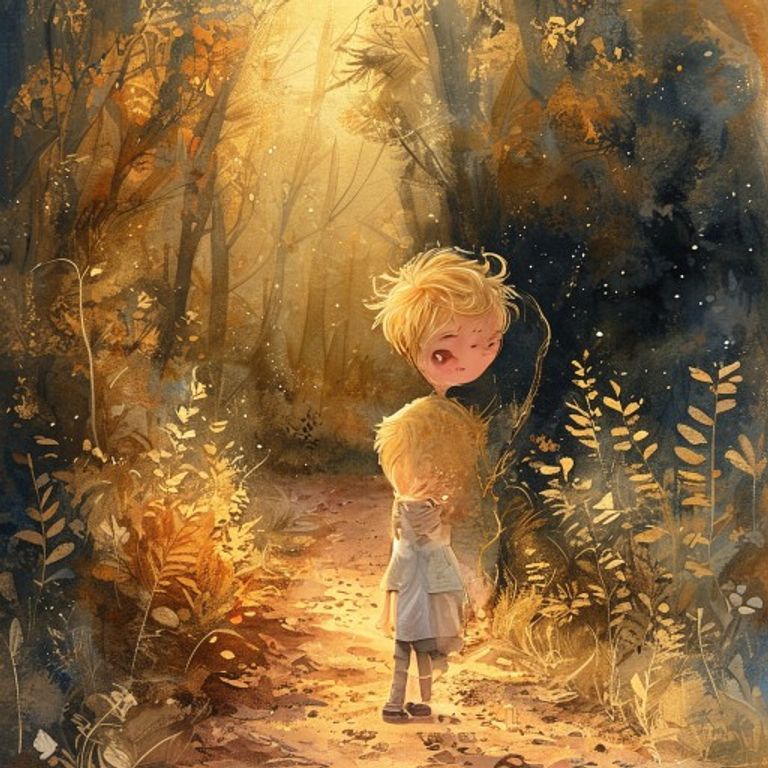
The True Path: A Story About Integrity
The True Path: A Story About Integrity
In the village of Oakhaven, where cobblestone streets wound between half-timbered houses and the ancient oak tree in the town square had stood for five hundred years, there lived a boy named Elias who was known for one thing: he never broke a promise.
Elias was twelve years old, with freckles scattered across his nose like cinnamon on warm milk, and hair the color of autumn wheat that always fell into his eyes. He was neither the tallest nor the strongest nor the fastest child in Oakhaven. But when Elias said he would do something, it was as certain as the sun rising over the eastern hills. The villagers called him "Elias the True," and though he blushed at the nickname, he wore it like a quiet badge of honor.
His father was the village clockmaker, a patient man with silver-rimmed spectacles and ink-stained fingers who taught Elias that "a mechanism is only as trustworthy as its smallest gear." His mother was the village baker, a warm woman who smelled perpetually of cinnamon and yeast, who taught him that "a recipe followed with honesty feeds more than the body." Between them, Elias had learned that integrity was not a grand gesture but a thousand small choices, made consistently, day after day.
The annual Harvest Festival was approaching, the most important celebration in Oakhaven. For generations, the festival had culminated in the Great Race—a three-mile run through the surrounding forest, across the Stone Bridge, and back to the town square. The winner received the Golden Acorn, a trophy carved from the wood of the ancient oak itself, and the honor of lighting the Harvest Bonfire.
This year, something extraordinary happened. A stranger arrived in Oakhaven.
His name was Caspian, and he came from the capital city with polished boots, a silver medallion around his neck, and a smile that seemed to say he already knew he would win. He was sixteen, broad-shouldered and long-legged, and he moved with the easy confidence of someone who had never been told no.
"I've won races in three provinces," Caspian announced at the village tavern, his voice carrying to every corner. "This Golden Acorn will look splendid in my family's hall."
The villagers murmured. The Great Race had always been for Oakhaven children, a tradition that bound the community together. But the rules technically allowed any young person to enter, and Caspian's father had made a generous donation to the festival fund.
Elias watched Caspian from across the tavern, his hands wrapped around a mug of his mother's apple cider. He felt a strange mix of feelings—intimidation, certainly, for Caspian was everything Elias was not. But also something else. A quiet certainty that the race was not about the Golden Acorn. It was about showing up, doing your best, and honoring the path you ran.
The morning of the race dawned golden and crisp. The forest path was lined with villagers holding ribbons and bells. Children sat in the oak tree's branches, their legs swinging like pendulums. Elias stood at the starting line in his worn leather shoes and his father's old running tunic, his heart beating like a small drum against his ribs.
Caspian stood beside him, stretching his long legs, his silver medallion catching the sun. He didn't look at Elias. He didn't need to.
The mayor's wife, a stout woman with a voice like a trumpet, raised the starting flag. "On your marks! Get set! Go!"
They ran.
Caspian shot forward like an arrow, his long legs eating the ground. Elias settled into his steady pace, the pace he had practiced every morning for three months, feet striking the earth in a rhythm that matched his heartbeat.
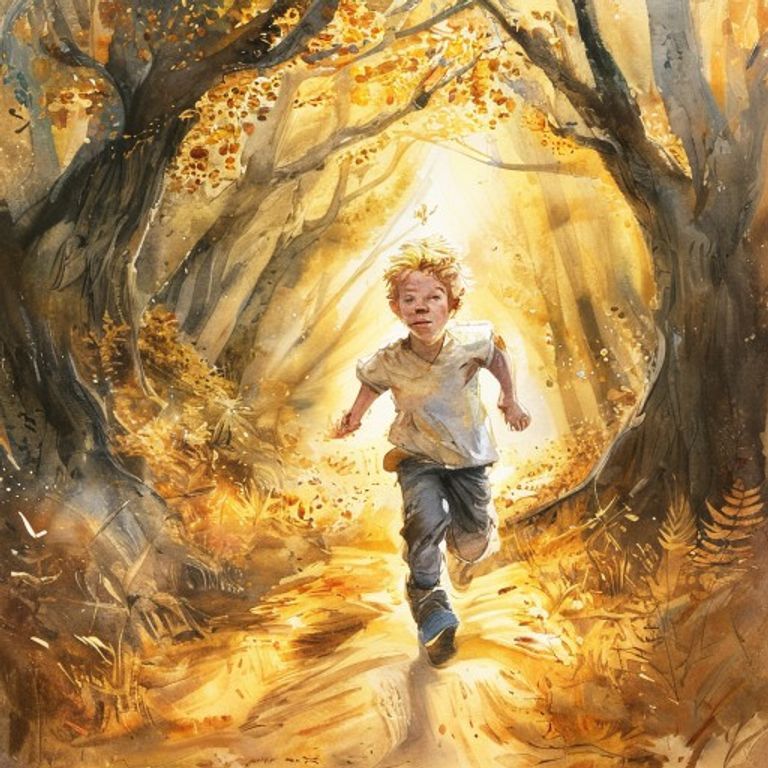
The forest path wound between ancient trees, their branches forming a cathedral of green and gold. Elias ran past the old well where he had once helped a lost calf find its mother. Past the blackberry brambles where he had promised his little sister he would fill her basket. Past the stone cairn that marked the halfway point.
At the cairn, something caught his eye.
Caspian was not ahead of him. In fact, Elias could see him stopped at the edge of the path, bent over, examining something on the ground. As Elias drew closer, he saw what it was: a narrow side trail, barely visible, that cut through the undergrowth and rejoined the main path just before the Stone Bridge.
A shortcut.
Elias had heard of it in whispers—the "Hollow Path," used by poachers and woodsmen who knew the forest intimately. It shaved nearly half a mile off the race route, but it was forbidden by the festival rules. The race was not merely about speed; it was about character, about following the true path even when no one was watching.
Caspian looked up and saw Elias approaching. Their eyes met. For a moment, something flickered in Caspian's gaze—surprise, then calculation, then a smile that did not reach his eyes.
"You won't tell," Caspian said. It was not a question. "You seem like the type who minds his own business. And besides, no one will know. The judges can't see this far into the forest."
Elias stopped running. He stood at the fork in the path, his chest heaving, his mind racing faster than his feet ever had.
He thought of his father, bent over clock mechanisms at midnight, refusing to use cheaper springs even when customers would never know the difference. He thought of his mother, refusing to sell yesterday's bread as fresh even when it cost her a few coins. He thought of the thousand small choices that had made him "Elias the True."
He thought of the Golden Acorn, gleaming in his imagination. He thought of Caspian, already disappearing into the Hollow Path, the silver medallion flashing between the trees.
"Integrity," his father had told him once, holding up a tiny gear no bigger than a fingernail, "is doing the right thing even when the wrong thing would never be discovered. Because you know. The gear knows. The mechanism knows. The universe keeps a different kind of account than the one in my ledger."
Elias looked at the main path, longer and harder but true. He looked at the Hollow Path, where Caspian's footsteps were already fading into silence.
Then he ran.
He ran on the main path, his worn shoes striking the honest earth, his breath coming in ragged gasps that tasted of pine and integrity. He ran past the place where the paths rejoined, his eyes fixed ahead, refusing to look for Caspian in the undergrowth. He ran across the Stone Bridge, its ancient arches framing the river below like a blessing. He ran through the final meadow, the town square visible now, the ancient oak rising above the crowd like a green mountain.
The villagers were cheering. But their cheers faded into confusion as Caspian crossed the finish line first, his face flushed but not with honest exertion, his breathing too easy for someone who had run three miles.
"The winner!" the mayor's wife announced, holding up Caspian's hand. "Caspian of the capital!"
Elias crossed the finish line two minutes later, his legs shaking, his chest burning, his heart heavier than his tired body. The villagers clapped politely, but their eyes were on Caspian, on the Golden Acorn, on the celebration already beginning.
That evening, as the Harvest Bonfire blazed and Caspian stood with the Golden Acorn around his neck like a conqueror's medal, Elias sat on the edge of the square, watching the flames. His mother found him there, her flour-dusted hands gentle on his shoulders.
"You ran the true path," she said. It was not a question.
Elias nodded, his throat tight. "I saw him take the Hollow Path."
His mother was quiet for a long moment. Then she sat beside him, her warmth radiating like the bakery oven. "Your father is looking for you. He has something to show you."
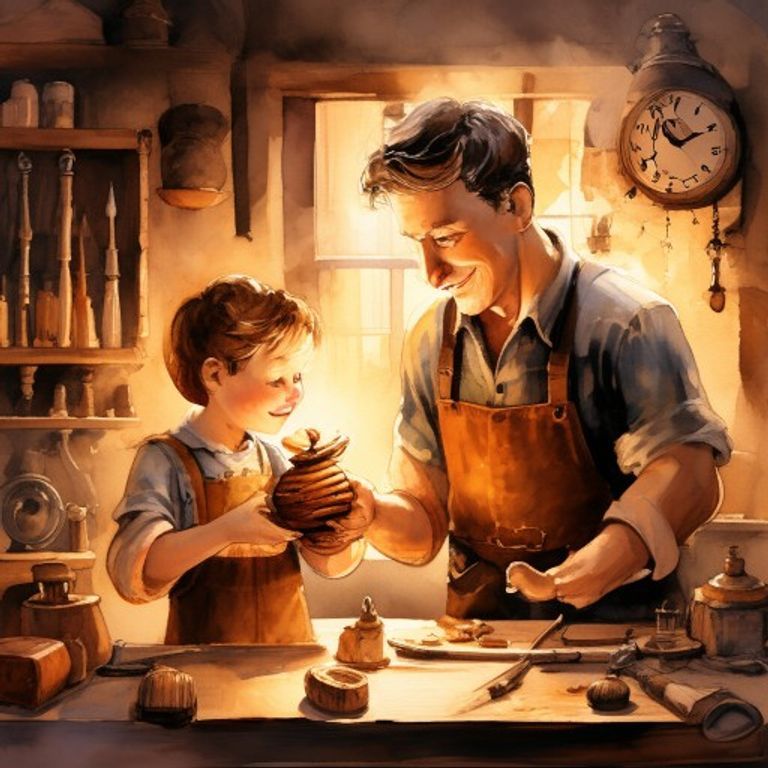
In the clockmaker's workshop, lit by candles and the glow of his father's magnifying lamp, Elias found something extraordinary. His father had worked all afternoon, not on a customer's clock, but on a creation of his own. It was a small wooden acorn, carved from oak, polished until it gleamed like captured moonlight. At its base, his father had engraved tiny words: "For Elias, who ran the true path."
"This is not the Golden Acorn," his father said, his ink-stained hands trembling slightly. "This is something else. Something only you can earn, because only you know the truth of your race. The Golden Acorn will hang in a stranger's hall, and eventually it will be forgotten. But this—" he pressed the wooden acorn into Elias's palm, "—this is who you are. And who you are is more important than what you win."
Elias held the acorn, feeling its smooth weight, reading the words that no one else would ever see. He thought of Caspian, standing by the bonfire with stolen glory, and he felt not anger but something like pity. Caspian had won the race but lost something larger. He had traded his integrity for a trophy, and the universe had accepted the bargain.
But then, something unexpected happened.
The next morning, as the festival grounds were being cleaned and the last revelers were departing, Caspian appeared at the clockmaker's door. He stood there without his silver medallion, without his polished boots, looking like any other boy who had lost something precious and didn't know how to find it.
"I didn't sleep," Caspian said, his voice barely audible. "Every time I closed my eyes, I saw that fork in the path. I saw you run the right way. And I saw myself... I saw myself choose wrong."
Elias's father invited him in. They sat in the workshop among the ticking clocks, the mechanisms marking time with patient, honest rhythm.
"What do you want?" Elias asked, not unkindly.
Caspian reached into his pocket and pulled out the Golden Acorn. He held it out with both hands, like an offering. "I want to give this back. I didn't earn it. You did. Or at least, you earned something I can't name, and I want to try to understand what it is."
Elias looked at the Golden Acorn, then at the wooden acorn his father had given him. He understood, suddenly, that integrity was not a shield against disappointment. It was a light that showed you the way, and sometimes, miraculously, showed others the way too.
"Keep the Golden Acorn," Elias said. "But run the race again next year. The true path. I'll be waiting at the finish line."
Caspian's eyes filled with tears. "Why are you being kind to me? I cheated. I stole your victory."
"You didn't steal anything I value," Elias said, and the words came easily, because they were true. "The victory I wanted was not the trophy. It was the knowing. The being able to sleep. The looking in the mirror and recognizing the person who looks back. You can't steal that. You can only give it away. And I didn't give it away."
Caspian left Oakhaven that afternoon, the Golden Acorn in his bag but something else in his heart—a seed, small and stubborn, that might one day grow into the same quiet strength that Elias carried like a second spine.
And Elias? Elias the True went back to his life of small choices and steady promises. He helped his father with the clocks. He learned to bake his mother's famous cinnamon bread. He ran the true path every morning, not because anyone was watching, but because the path was true, and that was reason enough.
Years later, when Elias was a man with his own workshop and his own children, a traveler came to Oakhaven. He was tall and broad-shouldered, with a silver medallion around his neck and a smile that reached his eyes. He had founded a school in the capital, a school that taught something unusual—not just reading and arithmetic, but something the founder called "the true path curriculum."
"I learned it from a boy in a village," Caspian told the assembled villagers, his voice steady and honest. "A boy who showed me that winning is not the opposite of losing. That the real opposite of winning is winning without worth. He taught me that integrity is not about being perfect. It is about being whole."
Elias, sitting in the crowd with his own children on his lap, felt the wooden acorn in his pocket, still smooth after all these years. He had never told anyone about that race. He had never needed to. The universe, as his father had said, kept a different kind of account.
And sometimes, if you ran the true path long enough, the universe paid its debts in ways more golden than any acorn.
Moral of the Story: Integrity is not about being perfect. It is about being whole. It is the quiet choice to do the right thing when the wrong thing would never be discovered. Elias could have taken the Hollow Path. No one would have known. But he would have known. And that knowing would have changed who he was. Integrity is not a trophy you display. It is a path you walk, step by honest step, until the walking becomes who you are. The world may not always notice. The crowd may cheer for the wrong winner. But the universe keeps its own account, and it pays its debts in ways more valuable than gold. So when you stand at the fork in the path, choose the true one. Not because someone is watching. Because you are.
Age Range: 4-8 years | Reading Time: ~10 minutes | Core Value: Integrity