The Wind-Riders Discipline: A Story About Self-Discipline
The Wind-Rider's Discipline: A Story About Self-Discipline
In the mountain village of Aerie, where eagles nested on cliff faces and the air was so thin that visitors often gasped like fish, there lived a boy named Kael who wanted to fly.
Not fly in the way that birds fly, though he watched the eagles with aching longing every morning from his bedroom window. Kael wanted to fly on the wind, to soar above the peaks, to feel the sky not as a distant ceiling but as a vast, welcoming embrace. And in Aerie, there was only one way to do that: you had to become a wind-rider.
The wind-riders were the village's elite athletes, young men and women who strapped themselves to silk wings and launched themselves from the cliffs, riding the thermal currents that rose from the valley like invisible elevators. They would spiral upward for thousands of feet, performing acrobatics that made the villagers cheer and the children dream. The best of them could stay aloft for hours, dancing with the eagles, their silk wings flashing in the sun like the wings of angels.
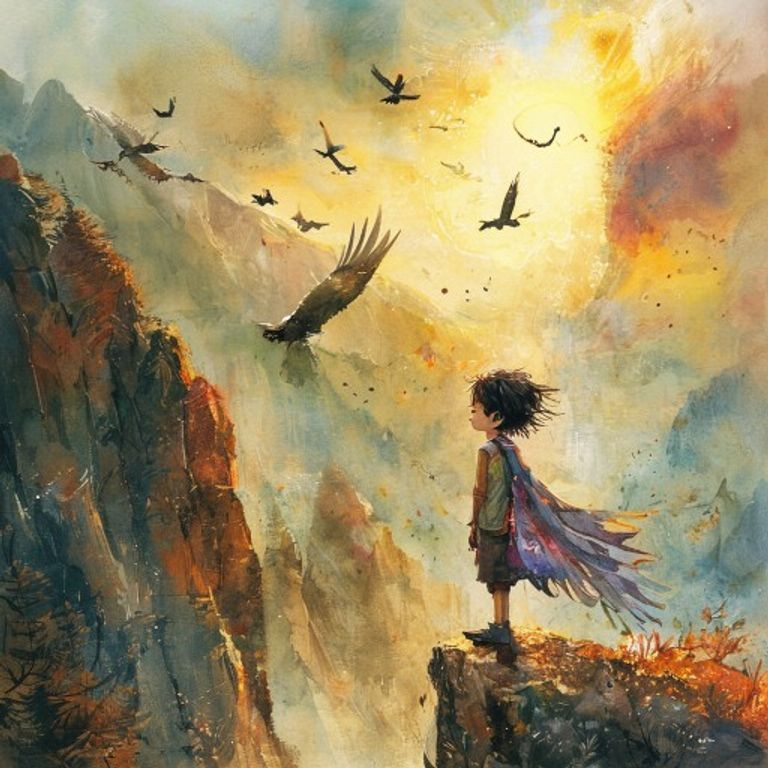
Kael was nine years old, small for his age, with dark hair that the wind always tangled and eyes the color of storm clouds. His father had been a wind-rider, the best in a generation, until a gust caught him wrong and sent him tumbling into the rocks below. Kael had been three when it happened. He remembered nothing of the fall, but he remembered the funeral—every wind-rider in the region had come, their silk wings folded like prayer flags, the sky full of them as they released his father's ashes to the wind he had loved.
"I will be a wind-rider," Kael told his mother, every morning, every evening, every time he saw the eagles wheeling overhead.
His mother, a woman whose hands were rough from weaving the silk wings that kept other people's children alive, would look at him with eyes full of love and terror. "Not every dream must be followed," she would say. "Your father followed his, and the wind took him."
"The wind takes everyone eventually," Kael would reply, repeating the wind-riders' creed. "The question is whether you dance with it before you go."
When Kael turned ten, he was finally allowed to begin training. Not flying—never that, not yet—but training. The old master, a wind-rider named Orin who had survived forty years in the sky and walked with a limp that made him look like he was still compensating for invisible currents, agreed to take him as a student.

"Self-discipline," Orin said on the first day, before Kael had even touched a silk wing. "That is what I teach. The flying is easy. Any fool can jump off a cliff and trust to luck. But to ride the wind, to truly ride it, you must master yourself. And that is harder than mastering the sky."
The training began at dawn, before the sun had cleared the eastern peaks. Kael would run up the mountain paths, his legs burning, his lungs screaming in the thin air. Orin would walk beside him, never running, never breathing hard, his limp somehow keeping perfect pace.
"Faster," Orin would say. "The wind does not wait for those who hesitate."
Kael would push himself, his vision tunneling, his heart hammering against his ribs like a bird trying to escape its cage. And when he reached the top, gasping, barely able to stand, Orin would say: "Again."
"I can't," Kael would gasp.
"You can," Orin would reply. "Your body is lying to you. It always lies. It wants comfort. It wants rest. It wants to give up. Self-discipline is the ability to tell your body no, to tell your mind no, to do what must be done even when every fiber of your being screams for you to stop."
They would run the path again. And again. And again.
After the running came the exercises. Kael would hang from bars, strengthening his arms and shoulders, building the muscles that would one day hold the wing-straps for hours at a time. He would do balance drills on narrow beams, his arms outstretched, his bare feet gripping the wood while Orin threw pebbles at him to test his focus.
"The wind will buffet you," Orin would say, tossing another pebble. "It will try to knock you off balance. You must be so centered that a hurricane could not move you."
Kael would wobble. He would fall. He would bruise his knees and scrape his palms and once, memorably, he would break his wrist when he landed wrong on a stone.
His mother wanted to end the training then. "He is too young," she said to Orin, her voice tight with fear. "He is too small. He is your friend's son—will you send him to the same fate?"
Orin looked at her with eyes that had seen too many young people fall from the sky. "I will not send him to any fate," he said. "I will teach him to choose his own. And the choosing requires discipline. If he quits now because of a broken wrist, he will learn to quit every time something breaks. A heart. A dream. A wing. Self-discipline is not about never falling. It is about always rising."
Kael did rise. He healed. He trained. He grew.
At eleven, he began practicing with the small wings—training wings, no larger than a heron's span, that would carry him only a few feet above the ground if he ran fast enough into the wind. He would run along the cliff edge, the training wing strapped to his back, and feel the lift, the magical moment when his feet barely touched the earth, when he was almost, almost flying.
But the true test came when Orin introduced the Waiting.
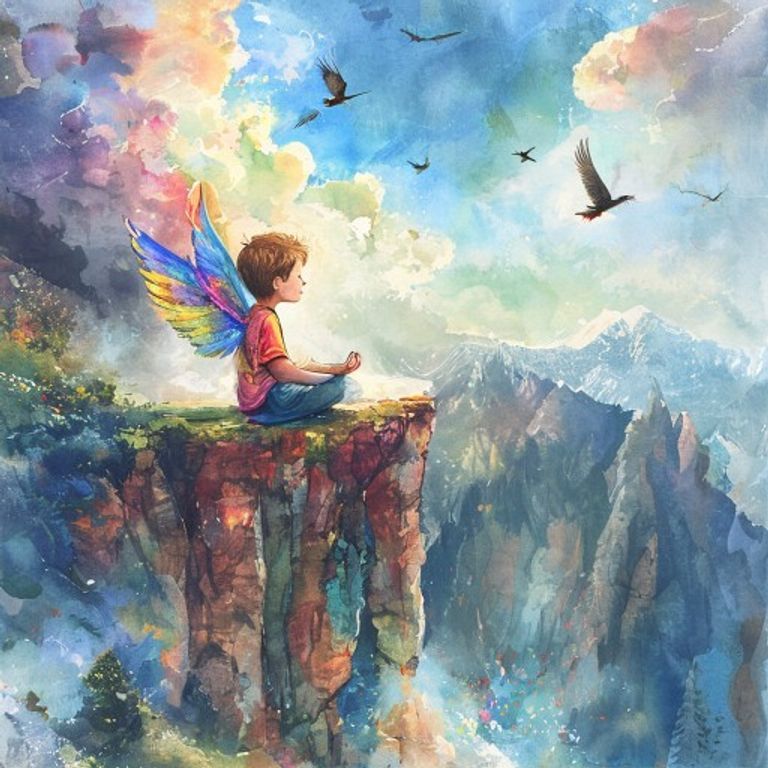
The Waiting was a discipline so simple it seemed absurd. Kael would sit on the cliff edge, his legs crossed, his training wing beside him, and he would wait. For hours. Sometimes all morning. Sometimes from dawn until dusk.
"What am I waiting for?" Kael asked, the first time.
"The right wind," Orin said.
"But the wind is always blowing."
"The wind is always blowing," Orin agreed. "But it is not always right. There are winds that lift you and winds that kill you. There are currents that carry you to the clouds and currents that smash you against the rocks. The ability to wait—to sit still when every part of you wants to jump—is the difference between a wind-rider and a dead fool."
Kael hated the Waiting. He was a boy of action, of energy, of running and jumping and doing. Sitting still was torture. His legs would twitch. His mind would race. He would imagine himself leaping off the cliff, the wind catching him, the sky welcoming him.
"The wind is perfect now," he would say, feeling the breeze on his face.
"It is not," Orin would reply, without looking up from his carving.
"But I feel it—"
"You feel your desire," Orin would interrupt. "Not the wind. Desire lies. Desire tells you that you want something so badly that the moment must be right. But the moment does not care about your desire. The moment simply is. Self-discipline is the ability to separate what you want from what is true. To wait. To watch. To know."
Kael would sit. He would watch the eagles. He would count his breaths. He would tell himself: I will not jump. I will not jump. I will not jump. And sometimes, despite all his discipline, he would still want to jump so badly that his hands shook.
Months passed. Kael grew stronger. His runs became longer. His balance became steadier. His Waiting became—if not comfortable, then at least possible. He could sit for two hours now without moving, watching the wind, feeling its patterns, learning its moods.
On the morning of his twelfth birthday, Orin came to him before dawn.
"Today," the old master said, "you fly."
Kael's heart leaped. "Truly?"
"Truly. But not because you are ready. No one is ever ready. You will fly because you have learned what you needed to learn. Not about the wind. About yourself."
They climbed to the highest cliff, the one called Eagle's Rest, where the wind-riders had launched for a hundred years. The training wing was gone. In its place was a real silk wing, Kael's mother's weaving, the fabric dyed the deep blue of mountain twilight.
Kael strapped himself in. The wing felt enormous, a creature with its own will, straining against the straps, eager for the sky.
Orin stood beside him, looking at the wind, feeling it with a face that had read the sky for forty years. "The wind is right," he said. "But the wind is not the test. You are the test. Can you wait, even now, at the edge of your dream? Can you breathe? Can you center yourself? Can you remember that flying is not about jumping—it is about being so prepared that the wind invites you?"
Kael breathed. He felt his heart, still hammering, but slower now. He felt his hands, still trembling, but steadier. He looked at the clouds, at the eagles, at the vast blue that had called to him since he was three years old.
"I am ready," he said. And for the first time, he believed it.
He ran. Five steps, ten, the cliff edge rushing toward him, the wind roaring in his ears. And then—he jumped.
Not the desperate leap of a boy who wanted to fly. The controlled launch of a wind-rider who had mastered himself. His body knew what to do, the thousands of hours of training translating into instinct, into grace. The wind caught him, lifted him, and he was—
Flying.
The ground fell away. The cliffs became small. The village became tiny squares of thatched roof and winding paths. Kael soared, the thermal carrying him upward in a spiral, the eagles circling nearby, curious about this new creature in their domain.
He did not try to do too much. He did not try to impress. He simply rode the wind, feeling its currents, responding to its shifts, his body and mind working in perfect harmony. He had waited for this moment for three years. He had trained for this moment for two. And now that it was here, he found that the moment was not the point. The point was who he had become in the waiting.
He stayed aloft for twenty minutes that first flight. Orin, watching from below, smiled for the first time in years.
Kael became a wind-rider, as his father had been. He flew for decades, performing acrobatics that made the crowds cheer, riding thermals that carried him to the edge of the clouds. He taught students of his own, passing on Orin's lessons about self-discipline, about the Waiting, about the difference between wanting to jump and knowing when to fly.
And every time he stood at the edge of Eagle's Rest, every time he felt the wind and the desire and the discipline warring within him, he would remember the first time. The fear. The trembling. The choice to wait, to center himself, to become ready.
"The wind is always there," he would tell his students. "It will always call to you. But you do not answer because the wind calls. You answer because you are ready. And readiness is not a moment. It is a practice. It is the run when you want to stop. It is the balance when you want to fall. It is the Waiting when you want to jump. Self-discipline is not the denial of joy. It is the preparation for it. The wind will lift you, but only if you have built the wings. And the wings are built in the dark hours, the hard hours, the hours when no one is watching and no one is cheering. That is where the flight begins. Not on the cliff edge. In the quiet, patient, disciplined work that makes the cliff edge possible."
Moral of the Story: Self-discipline is not about denying yourself joy. It is about preparing yourself for it. Kael wanted to fly from the moment he could look up at the sky. But wanting was not enough. He had to run when his legs burned. He had to balance when he wanted to fall. He had to wait when every fiber of his being screamed to jump. The wind was always there, calling to him. But he could not answer until he was ready. And readiness is built in the quiet hours, the hard hours, the hours when no one is watching. That is where discipline lives. Not in the moment of triumph, but in the thousand moments before it, when you choose to keep going even though you want to stop. The wing that carries you to the clouds is woven from every morning you got up when you wanted to sleep, every exercise you completed when you wanted to quit, every temptation you resisted when you wanted to give in. Self-discipline is the loom on which dreams are woven. And the sky belongs to those who do the weaving.
Age Range: 4-8 years | Reading Time: ~10 minutes | Core Value: Self-Discipline