The Phoenix Engine: A Story About Creativity
The Phoenix Engine: A Story About Creativity
In the town of Emberfall, where the chimneys coughed smoke like old men clearing their throats and the cobblestones were worn smooth by centuries of footsteps, there lived a girl named Mira who saw things differently.
Not differently in the way that children sometimes see monsters in closets or castles in clouds. Mira saw connections. She looked at a broken umbrella and saw the ribs of a whale. She looked at a pile of rusted gears and saw a mechanical bird waiting to be born. She looked at the world and saw not what it was, but what it could become.
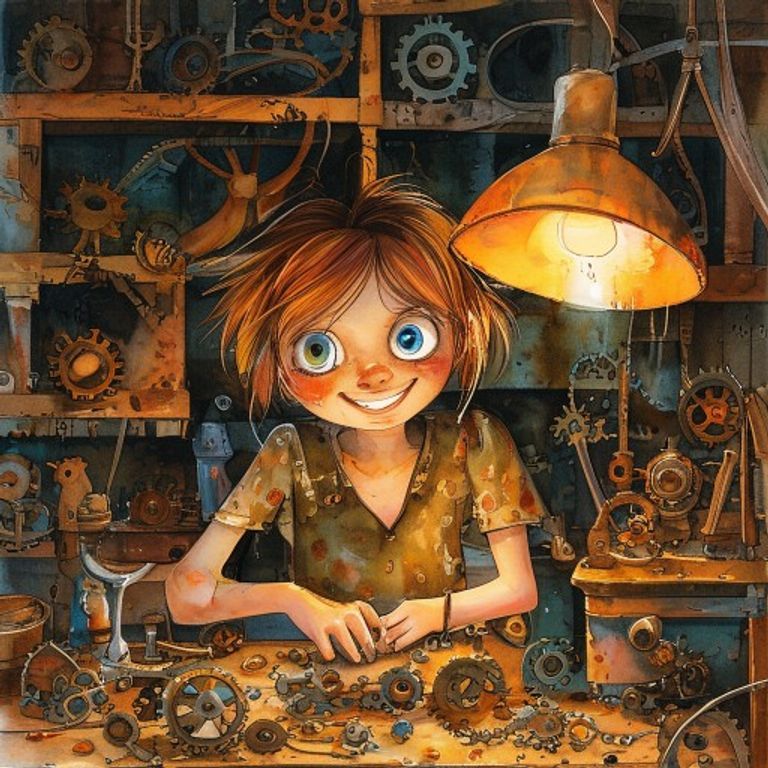
She was eleven years old, with hair the color of burnt copper that she kept chopped short because long hair "got in the way of thinking." Her eyes were mismatched—one the blue of old denim, one the green of moss on stone—and people in Emberfall found this unsettling. They found Mira unsettling in general. She talked to objects. She collected rubbish. She spent hours in her father's abandoned workshop, hammering and soldering and muttering to herself, emerging covered in grease and grinning like she'd discovered treasure.
"That child has too much imagination," the baker's wife would say, watching Mira drag a wagon of scrap metal past the shop.
"Imagination won't fill her belly," the blacksmith would grunt.
"Imagination won't find her a husband," the seamstress would cluck.
Mira didn't care. She had her workshop, her scraps, her visions. She didn't need a husband. She needed springs.
The trouble began—or perhaps the magic began—when the Emberfall Council announced the Grand Invention Fair. It happened every five years, and the winner received the Silver Cog, a medal that came with enough prize money to open a proper workshop and, more importantly, the respect of a town that had lost its sense of wonder.
"This is your chance," Mira's mother said, squeezing her daughter's grease-stained hands. Her mother was a practical woman, a laundress with red hands and a tired smile, but she believed in Mira's strange gift. "Show them what you see."
Mira threw herself into her project. She didn't sleep. She barely ate. She filled her father's workshop with drawings and prototypes and half-finished contraptions that whirred and clicked and sometimes exploded in showers of sparks.
The other contestants were predictable. The blacksmith's son built a better plow. The seamstress's daughter designed a faster loom. The baker's apprentice created a machine that kneaded dough automatically. Useful things. Sensible things. Things that made life easier without challenging anyone's idea of what life should be.
Mira's invention was none of these things.
She called it the Dream Engine, and it was beautiful and terrifying and completely useless by any practical measure. It was a machine the size of a carriage, cobbled together from clockwork and copper tubing and glass lenses and a piano's worth of ivory keys. When you turned the crank, it did not plow or weave or bake. Instead, it told stories.
The keys played notes that corresponded to words. The gears turned in patterns that painted scenes on the glass lenses. The copper tubing whistled like wind through hollow reeds, creating atmospheres—ocean sounds for sea tales, crackling static for fireside stories, the soft hum of bees for summer adventures. And the whole contraption, when wound and played, would generate a unique story every time, based on the patterns of the gears and the choices of the player.
"It doesn't do anything," the blacksmith's son sneered when Mira demonstrated it at the preliminary judging. "It doesn't make food or clothes or tools. It just... makes noise."
"It makes meaning," Mira replied, her mismatched eyes flashing. "It makes wonder. It makes the heart remember that life is more than survival."
The judges were divided. Two of them—a retired schoolteacher and a traveling scholar—were enchanted. The other three, including the mayor, found it frivolous. "Creativity is all well and good," the mayor said, stroking his beard, "but Emberfall needs practical solutions. We need progress, not fairy tales."
Mira was allowed to compete in the final round, but she was given the worst booth, the smallest funding, and the earliest time slot when most of the town was still asleep.
She did not give up. She worked harder. She refined the Dream Engine, adding new features—a scent diffuser that could make the stories smell like salt air or pine forests or her mother's fresh bread. A temperature regulator that could make the booth feel warm like sunshine or cool like starlight. She made the machine not just tell stories, but surround the listener in them.
The night before the fair, disaster struck. Someone—Mira never knew who, though she had her suspicions—broke into her workshop and smashed the Dream Engine's central mechanism. The gears lay scattered like broken teeth. The glass lenses were shattered. The copper tubing was twisted beyond repair.
Mira stood in the ruins, her heart a cold stone in her chest. Months of work. Years of dreaming. Destroyed in one night of cruelty.
She could have given up. No one would have blamed her. She was just a girl with strange eyes and strange ideas. The town expected her to fail.
But Mira looked at the wreckage and saw something the vandal had not seen. She saw possibility.
The broken gears could be reforged into new shapes. The shattered glass could be melted and blown into new lenses. The twisted copper could be woven into something unexpected. The Dream Engine as she had imagined it was dead. But something else could rise from its ashes.
She worked through the night. She worked through the next day. She did not sleep, did not eat, did not stop. Her mother brought her tea and bread and worried glances, but Mira barely noticed. She was creating, and creation was its own nourishment.
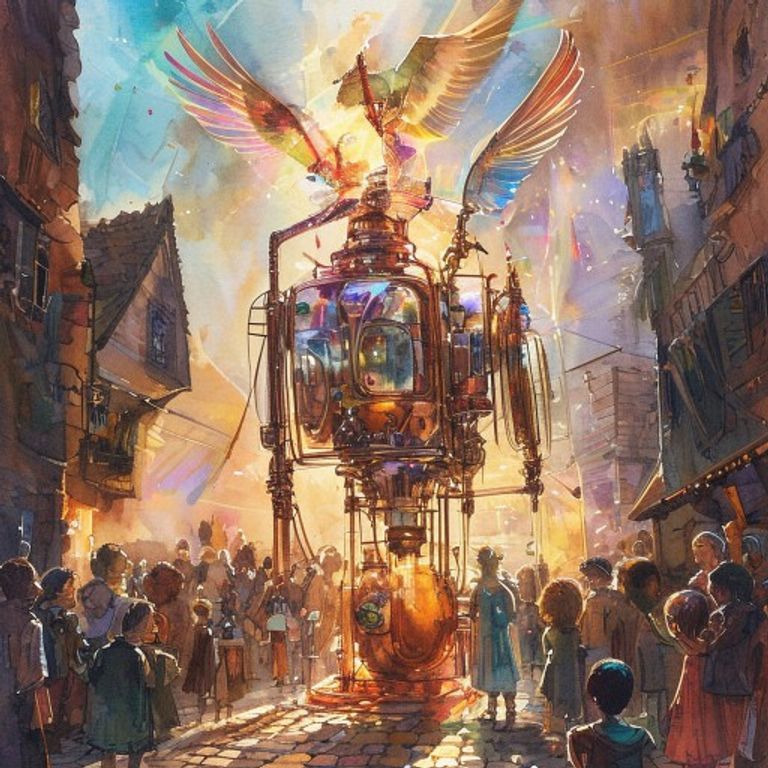
When the Grand Invention Fair opened, Mira was not in her assigned booth. She was in the town square, her contraption set up beneath the old clock tower, and a crowd had already gathered.
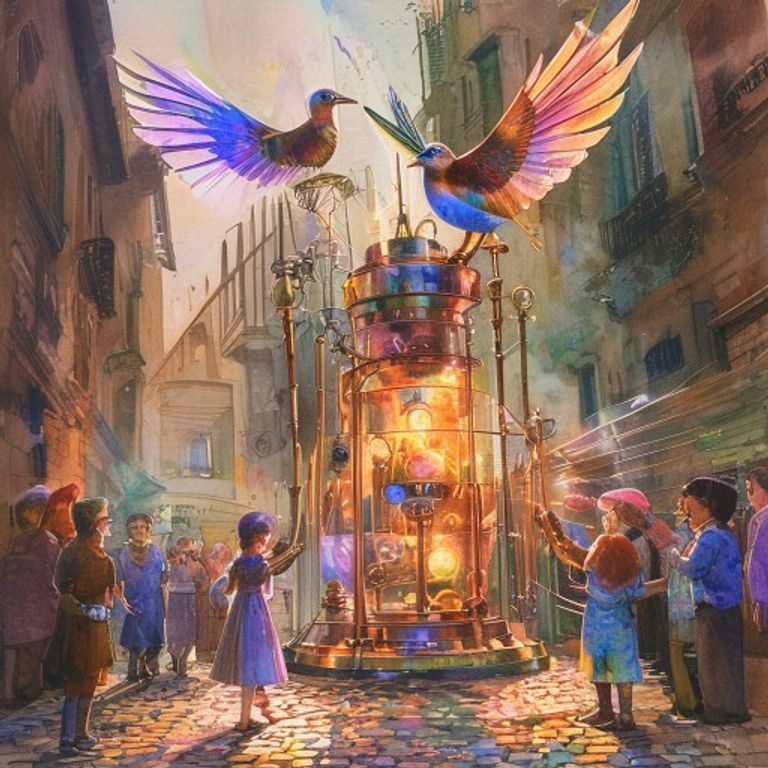
The Dream Engine—no, she had renamed it the Phoenix Engine—was unlike anything anyone had seen. It was smaller now, more intimate, shaped like a nest of copper and glass and light. The broken gears had been welded into abstract sculptures that spun as the machine worked. The shattered glass had been melted into prisms that cast rainbow patterns across the cobblestones. The twisted copper had become the body of a mechanical bird that perched atop the machine, its wings spreading as stories were told.
And the stories—oh, the stories were different now. Before, they had been pleasant tales, gentle adventures. Now they were deeper, stranger, more true. Mira had poured her heartbreak into the machine, and it sang of loss and renewal, of destruction and creation, of the fire that burns and the green that grows after.
A child turned the crank. The Phoenix Engine began to hum. The mechanical bird spread its wings. Light poured through the prisms, painting the square in colors that had no names. And a story emerged—spontaneous, unplanned, alive—about a girl who built a machine from broken things and taught a town to see beauty in the ruins.
The crowd was silent. Then a child began to cry, not from sadness but from the overwhelming beauty of being understood. An old man wiped his eyes, remembering the wife he had lost and the love that still remained. A young couple held hands, suddenly aware of the fragile miracle of their connection.
The mayor, drawn by the crowd, pushed to the front. He looked at the Phoenix Engine, at the tears on his constituents' faces, at the girl with mismatched eyes who had built something that made no sense and yet made all the sense in the world.
"It doesn't do anything practical," he said, but his voice lacked conviction.
"It does the most practical thing there is," Mira replied, her voice steady despite her exhaustion. "It reminds us why we live. We don't live to plow faster or bake more bread. We live to feel wonder. To be moved. To create and be created in return. This machine doesn't make life easier. It makes life larger."
The mayor looked at the crying child, the weeping old man, the young lovers. He looked at the mechanical bird, its copper wings catching the sun. He looked at Mira, her face streaked with grease and her eyes burning with the fire of someone who had refused to surrender her vision.
"The Silver Cog," he said slowly, "has never been awarded for something like this."
"Then maybe," Mira said, "it's time it was."
She won. Not because the judges were unanimous—two still voted for the automatic plow—but because the crowd demanded it. They had felt something they had forgotten they could feel. They had been reminded that Emberfall was not just a collection of workshops and markets and sensible people doing sensible things. It was a place where magic could happen, where a girl with mismatched eyes could build a machine from broken dreams and make the whole town weep with joy.
Mira opened her workshop with the prize money. She called it the Phoenix Foundry, and it became a place where broken things were healed, where discarded objects found new purpose, where children came to learn that creativity was not a luxury but a necessity.
Years later, when Mira was an old woman with copper hair turned silver and mismatched eyes still bright behind spectacles, a young girl came to her with a box of broken pottery.
"I see birds," the girl said shyly. "In the shards. I see wings."
Mira smiled, the same grin she had worn as a grease-stained child dragging scrap metal through the streets. "Then let's build them," she said. "Let's show the world what broken things can become."
And in the workshop that had started with a dream and survived destruction, two pairs of mismatched eyes bent over broken clay, seeing not what was, but what could be.
Moral of the Story: Creativity is not about making things that are practical or sensible or easy to understand. It is about seeing connections that others miss. It is about looking at a broken umbrella and seeing a whale's ribs. It is about building machines that tell stories when the world says you should build machines that plow fields. Mira's Phoenix Engine did not make life easier. It made life larger. It reminded people that wonder is not a luxury—it is the reason we bother to survive at all. Creativity is not a gift that some have and others lack. It is a way of looking at the world, a refusal to accept that things are only what they appear to be. So when someone tells you that your imagination is frivolous, that your dreams are impractical, remember the girl with mismatched eyes who built a machine from broken things and taught a whole town to see the rainbows in the ruins. The world does not need more sensible machines. It needs more dreamers brave enough to build what only they can see.
Age Range: 4-8 years | Reading Time: ~10 minutes | Core Value: Creativity