The Great Gathering: A Story About Diversity
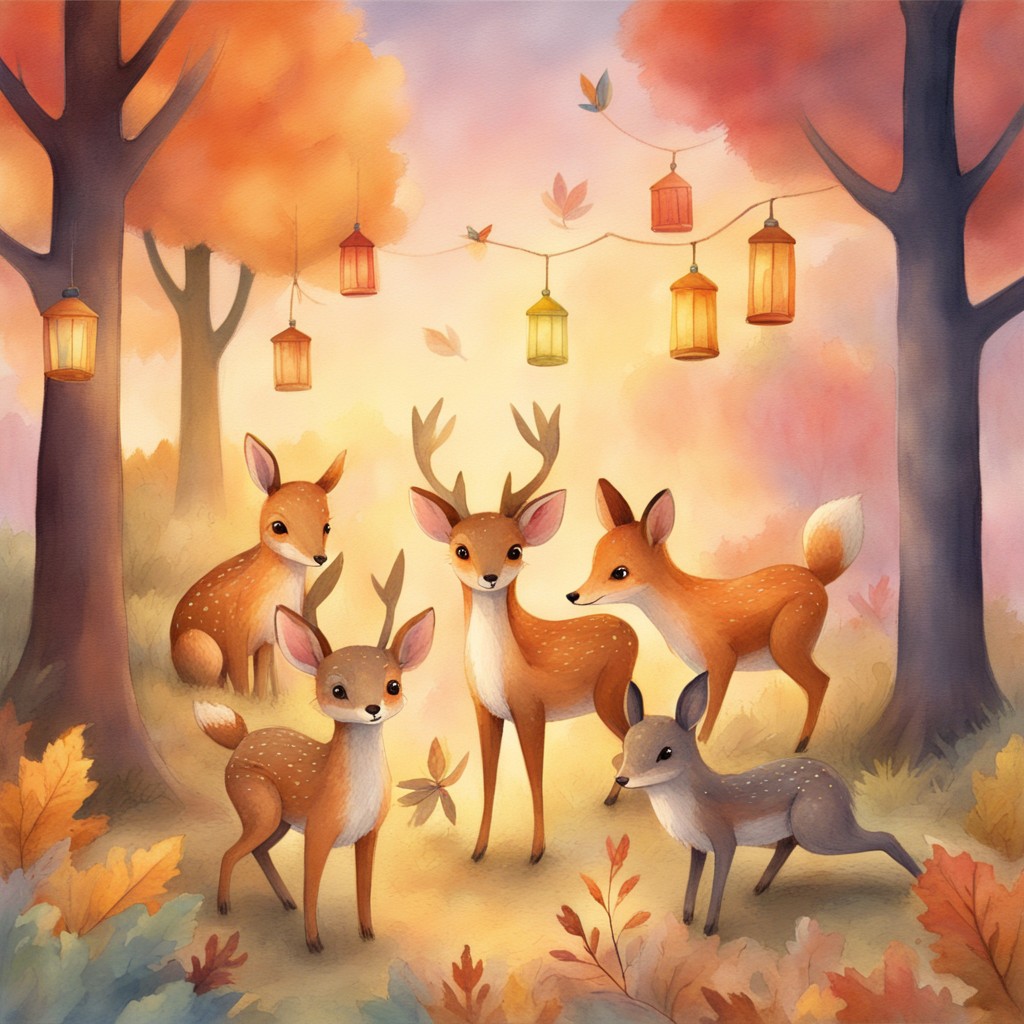
In the heart of the Whispering Woods, where ancient oak trees stretched their branches toward the sky like welcoming arms, there lived a magical clearing known as Harmony Hollow. Every autumn, when the leaves turned into brilliant shades of gold, crimson, and amber, the animals of the forest gathered here for the Great Feast—a celebration that had been passed down through generations.
This year, however, something was different. Young Juniper, a curious fawn with spots that looked like tiny star maps scattered across her back, had been chosen as the Feast Keeper. It was an enormous honor, but as she stood at the edge of the hollow watching the early arrivals, her heart fluttered like a caged butterfly.
"Welcome, welcome!" called Barnaby, the wise old owl who had organized the feast for as long as anyone could remember. He adjusted his spectacles—fashioned from two perfectly round dewdrops—and spread his speckled wings wide. "Juniper, my dear, come and meet everyone."
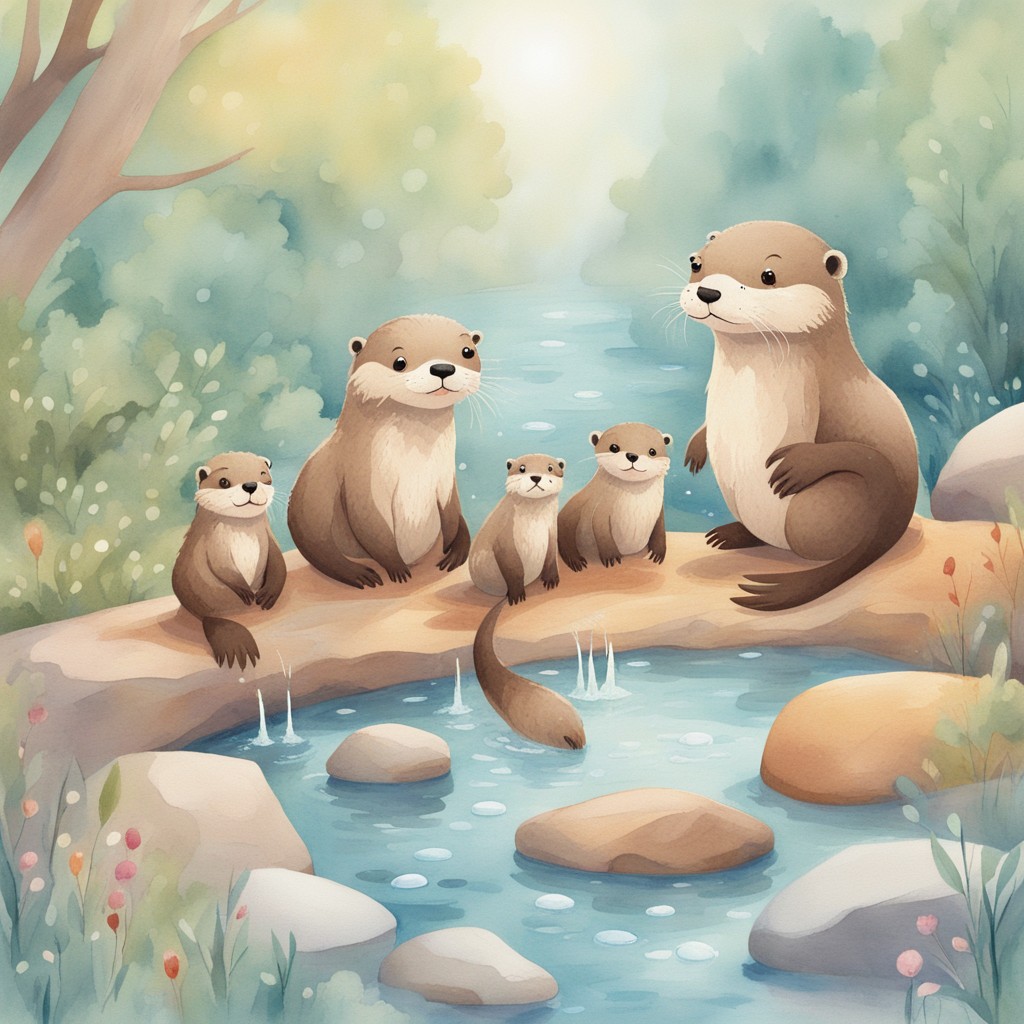
The hollow was already filling with creatures of every shape and size. Near the bubbling brook that cut through the clearing, the Otter family—slippery, chattering, and always laughing—were arranging smooth river stones into colorful patterns. Mrs. Otter had bright eyes that sparkled with mischief, while her children kept sliding off the stones and splashing into the water, sending rainbow droplets everywhere.
"We're making the welcome path!" called little Pip, the smallest otter, twirling in the water. "Every stone is different, just like us!"
Juniper watched, fascinated. The stones were indeed all different—some round and speckled like quail eggs, others jagged and striped like tiger fur, some smooth as silk and others rough as tree bark. Together, they formed a beautiful mosaic that led from the forest edge to the center of the hollow.
"Beautiful, isn't it?" said a gentle voice beside her. Juniper turned to find Mabel, a tortoise whose ancient shell bore patterns that looked like maps to forgotten places. Mabel moved slowly, deliberately, her eyes kind and knowing. "The stones don't match, but that's what makes the path special. If they were all the same, it would be quite boring."
As more guests arrived, Juniper's eyes grew wider and wider. The Weaver family—spiders of every size—were spinning delicate webs between branches, each web a different pattern. Grandmother Weaver created lacy, spiral designs that caught the morning light and turned it into prisms of color. Her grandson, a tiny bold jumper, made geometric patterns that looked like perfect snowflakes.
"I wish I could make webs," Juniper whispered, watching the spiders work.
"And I wish I could run through meadows like you," Grandmother Weaver replied, her many eyes twinkling. "But then who would weave the sunset catchers? We each have our gifts."
By midday, the hollow was alive with activity and music. The Cricket Choir, dozens of crickets of varying sizes, had tuned their wings and begun to play. Some crickets made high, tinkling sounds like wind chimes. Others produced deep, rhythmic thrums that made the ground feel like it was gently humming. Together, they created a symphony that no single cricket could make alone.
"See how the deep voices need the high ones?" Barnaby explained to Juniper, tapping his wing along with the rhythm. "And the high notes need the low ones to keep from floating away. Different sounds, but together they make magic."
The food preparations were underway, and Juniper had never seen such variety. The Squirrel family had gathered nuts from every corner of the forest—plump acorns, buttery walnuts, sweet chestnuts, and rare pine nuts that tasted like sunshine. The Bee family brought honey: dark, rich buckwheat honey; light, floral clover honey; and wildflower honey that changed flavor with every season.
"Try this," said Beatrice, a round, fuzzy bee with stripes that looked like they were painted by a joyful child. She offered Juniper a drop of amber honey on a leaf. "It's from the linden flowers near the old well."
The honey tasted like summer warmth and gentle breezes. Then Benny, a younger bee with unusually dark stripes, offered another taste—this one sharp and spicy, almost like cinnamon. "Fireweed honey," he buzzed proudly. "Grows where the lightning struck last year."
Each honey was different. Each was wonderful in its own way. Juniper's taste buds danced with flavors she never knew existed.
As the sun began to dip toward the treetops, painting the sky in watercolors of pink and orange, the animals gathered in a great circle. Juniper stood nervously in the center, her duties as Feast Keeper officially beginning.
"Welcome, friends old and new," she began, her voice shaky at first. "I... I wasn't sure how to make this feast special. I thought maybe everything should match. The same food. The same decorations. The same music. But then..."
She looked around at the incredible scene. The otters' stone path gleamed with a thousand colors. The webs caught the sunset and scattered light like living jewels. The cricket orchestra played in perfect harmony despite—or because of—their differences. The table groaned with foods from every corner of the forest, each dish unique and precious.
"But then I realized," Juniper continued, her voice growing stronger, "that the most beautiful things aren't the same. They're different. Together."
A murmur of agreement rippled through the crowd. Old Barnaby nodded, his eyes glistening with pride.
"Look at us," Juniper said, emboldened by the warmth in the hollow. "We're big and small. Fast and slow. We fly and swim and crawl and run. We make different sounds, different homes, different families. Some of us sleep at night, some during the day. Some eat plants, some eat fish, some eat both."
She walked toward the food table, her hooves clicking softly on the stone path. "This honey tastes nothing like that honey. But both are sweet. These nuts are all different shapes, but all fill our bellies. These webs are all different patterns, but all catch the light."
A brave young rabbit named Remy hopped forward. He was pure white with red eyes, unlike his brown and gray cousins, and had always felt self-conscious about looking so different.
"I always thought being different was bad," Remy said quietly. "The other rabbits blend into the bushes. I stand out like a snowball in summer."
Mabel the tortoise slowly approached, her shell catching the last rays of sunlight and turning the ancient patterns into gold. "Child, I am slower than every creature here. I cannot climb trees or swim rivers. My home is heavy on my back. But without me, who would remember the old paths? Who would carry the stories of fifty summers?"
"And I," said a gruff voice, "am too big to fit in burrows, too heavy to climb branches." It was Boris, the gentle brown bear who lived in the cave beyond the ridge. He lumbered into the circle, his massive paws leaving soft prints in the moss. "But when winter comes and the river freezes, my weight breaks the ice so smaller creatures can drink. When fallen trees block the path, my strength clears the way."
One by one, the animals shared their differences and how those differences helped the community.
The bats, who saw the world through echoes rather than light, described the insect pests they caught each night—pests that would destroy the gardens if left unchecked.
The ants, tiny enough to crawl into cracks and crevices, explained how they cleaned up food that others dropped, keeping the forest healthy.
The birds with their different beaks—some long for reaching nectar, some strong for cracking seeds, some sharp for catching fish—showed how each played a vital role in the forest's balance.
Even the mushrooms, neither plant nor animal, spoke through their fungal network about how they connected trees across vast distances, sharing nutrients and warnings beneath the soil.
Juniper felt tears pricking her eyes, but they were happy tears. "I was worried about being different too," she admitted. "My spots look like they're from the night sky. I thought maybe I wasn't a proper fawn."
"Not a proper fawn?" exclaimed her mother from the crowd, stepping forward with love in her eyes. "You, my star-child, are exactly who you're meant to be."
Barnaby the owl flew to a low branch so all could see him. "My friends, diversity is not just about looking different or acting different. It's about needing each other. The forest doesn't work if everyone is the same. If all creatures were fast runners, who would tend to the slow-growing things? If all could fly, who would care for the roots of the world? If all were night creatures, who would wake with the sun?"
He turned his great head, taking in the gathering with his wise eyes. "Our differences are not flaws to fix. They are gifts to share. The otter's playfulness teaches the serious mole to laugh. The tortoise's patience teaches the hurried hare to rest. The cricket's song teaches the silent fish that music lives everywhere."
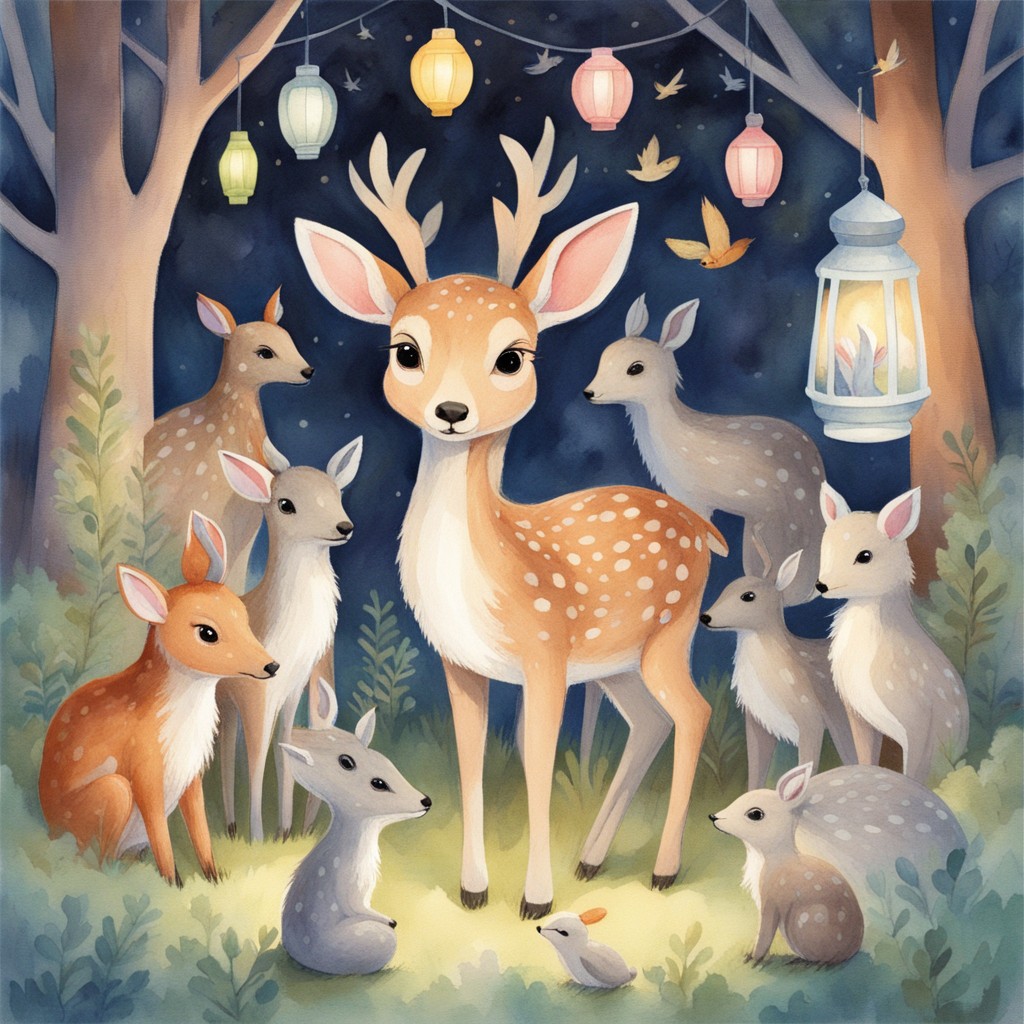
As darkness finally settled over Harmony Hollow, the animals lit the Celebration Lanterns—glowing orbs made by fireflies in glass-like dewdrop spheres, each one a different color: warm gold, cool blue, gentle green, and passionate red. Together, they illuminated the clearing not with harsh uniform light, but with a soft, multicolored glow that made every creature look magical.
The feast began in earnest. Juniper moved from table to table, sampling foods she'd never tried, learning dances from other species, listening to stories told in chirps and growls and clicks and songs. A young fox taught her how to pounce—playfully, of course. A family of ducks showed her how to waddle-walk that made everyone laugh until their sides ached. The spiders wove her a crown of silver thread that caught the lantern light and made her spots truly look like captured stars.
By the firelight, a hedgehog named Hazel shared poems she'd written about autumn leaves—poems no other creature could have created, for only a hedgehog who spent her nights curled among fallen foliage could know those intimate secrets.
Edgar, the elk with antlers so vast and intricate they looked like forest branches themselves, told tales of distant mountains and the winds that carried whispers from faraway places. No small creature could have experienced those high altitudes and broad views.
As the moon rose high and the feast began to quiet into contented murmurs, Juniper found herself at the center of the circle once more. But this time, she wasn't nervous. She was surrounded by friends who looked nothing like her, sounded nothing like her, lived lives completely different from hers—and yet they had welcomed her, taught her, fed her, played with her, and shown her that her differences were not barriers but bridges.
"The Great Feast isn't about the food," Juniper said softly, her voice carrying in the gentle night air. "It's not about the decorations or the music or the games."
She looked at the otters curled together by the stream, the bats sharing jokes with the crickets, the old tortoise telling bedtime stories to wide-eyed kittens, the bear gently letting a tiny mouse ride on his broad back.
"The Great Feast is about us. All of us. Together. Different. And because we're different, we're whole."
Barnaby the owl wiped a tear from his dewdrop spectacles. "Well spoken, young Feast Keeper. Well spoken indeed."
And as the animals drifted off to sleep under the stars—some in burrows, some in trees, some in nests, some simply curled in soft moss—each one dreamed sweet dreams of a forest where every creature had a place, every voice had value, and every difference made the world more beautiful.
In the soft moonlight, Juniper's spotted coat gleamed like the night sky she resembled. And for the first time, she didn't wish to look like any other fawn. She wished only for every creature in the world to feel as accepted, as needed, and as loved as she felt in this moment.
Because in Harmony Hollow, diversity wasn't just celebrated.
It was home.
THE END
Moral of the Story: Our differences are not mistakes to be fixed, but gifts to be shared. When we welcome diverse voices, talents, and perspectives, we create something more beautiful and stronger than any single one of us could create alone. Every creature—every person—has something unique to contribute to the community tapestry. True diversity means not just tolerating differences, but recognizing that we need each other's differences to thrive.