The Little Listener: A Story About Empathy
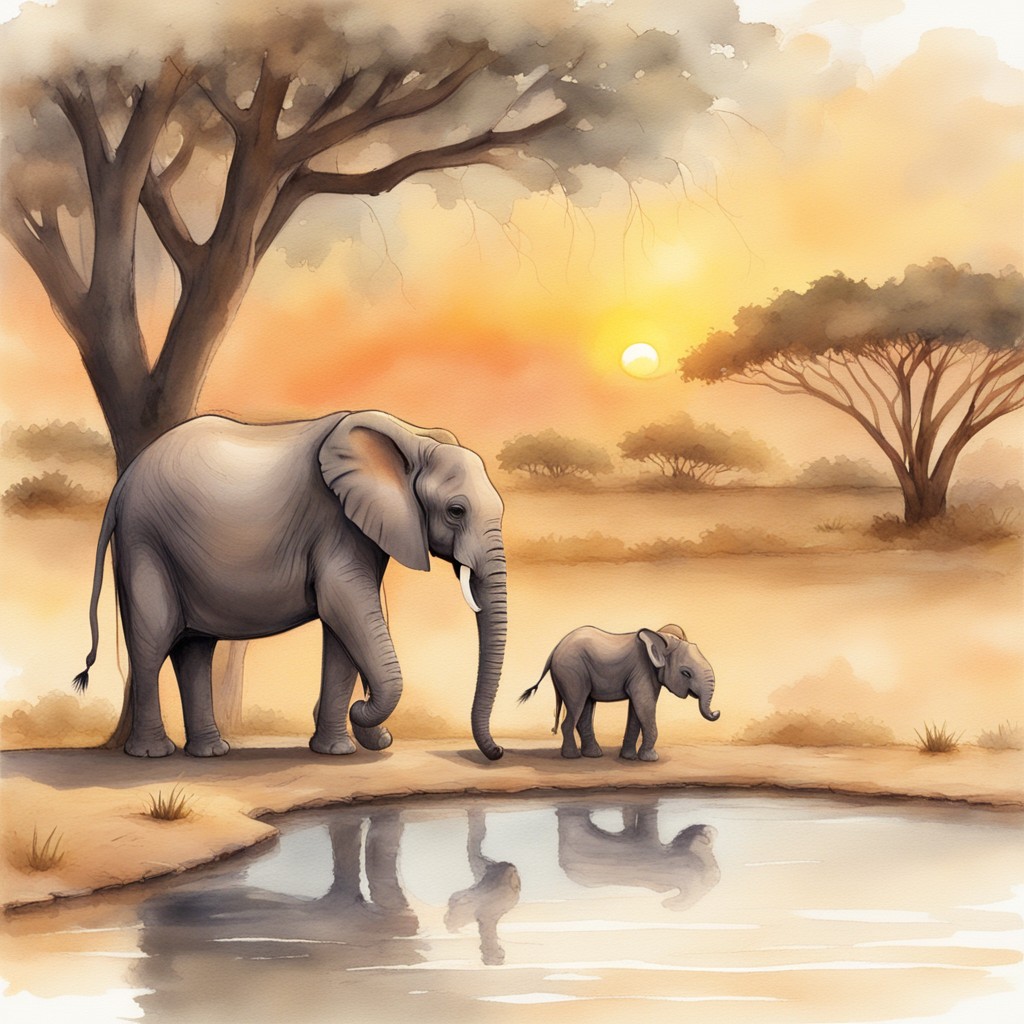
On the golden savanna, where the grass stretched like a sea of amber under the endless African sky, there lived a young elephant named Kibo.
Kibo was not the biggest elephant in his herd. He was not the strongest, nor the fastest, nor the one with the longest tusks. But Kibo had something that made him special—something that even the oldest, wisest elephants noticed and admired.
Kibo had big ears.
Not just physically big, though they were impressive—broad and fan-shaped, able to catch the faintest breeze on a hot day. But Kibo's ears were special in another way too. He used them to listen. Really listen. Not just to the rumbling calls of his herd or the distant roar of lions. Kibo listened to feelings.
The savanna was home to countless creatures. Zebras with their striped coats flicked their tails at flies near the watering hole. Giraffes moved like living sculptures, their long necks bending to browse acacia trees. Lions dozed in the shade of baobabs, dreaming of the hunt. Hyenas laughed in the twilight. Birds sang from every bush and tree.
And among them all, the elephants moved like gentle mountains, their massive feet pressing softly into the earth, their trunks swaying like living ropes, their eyes—deep, dark, ancient—seeing everything.
Elephants were known for their wisdom. They remembered every watering hole, every salt lick, every path through the grasslands. They remembered droughts and floods, good years and bad. They passed this knowledge from mother to daughter, from aunt to niece, in a chain of memory that stretched back longer than any other creature could imagine.
But Kibo's gift was different from memory. His gift was understanding.
The first time Kibo realized he was different, he was very young—just a calf, still wobbly on his legs, still learning which plants were safe to eat and which were poison.
He was playing near the watering hole, splashing in the muddy shallows with two other calves, when he noticed a zebra foal standing alone at the edge of the grass. The foal was small, smaller than the others, with a stripe pattern that was slightly different—more brown than black, as if a painter had been running low on ink.
The other zebras were drinking, flicking their ears, swishing their tails. They seemed not to notice the little foal at all.
But Kibo noticed.
There was something about the way the foal stood—too still, too quiet, his ears flat against his head, his eyes fixed on the ground. He wasn't drinking. He wasn't playing. He was just... standing.
Kibo felt something strange in his chest. A tightness. A heaviness. It wasn't his own feeling—he was happy, splashing in the mud, warm in the afternoon sun. But the feeling was there anyway, as real as the ground beneath his feet.
"What's wrong with him?" Kibo asked his mother, Jade, pointing with his small trunk toward the zebra foal.
Jade looked, her wise eyes narrowing. "He is different, Kibo. The other zebras do not accept him easily."
"Why?"
"Because he looks different. His stripes are not like theirs. And some creatures... some creatures do not like what is different."
Kibo didn't understand. The foal was just a baby. He hadn't done anything wrong. He was just standing there, small and alone, while the world moved around him.
The tightness in Kibo's chest grew stronger.
"I'm going to talk to him," Kibo announced.
"Kibo," Jade said gently, "zebras and elephants do not usually speak to each other. We are too different."
"But he's sad," Kibo said. "I can feel it."
Jade looked at her son, surprised. She had seen many things in her long life, but she had never seen a calf so young who could sense the feelings of another species. "Go, then," she said. "But be gentle. And remember—not everyone wants to be helped. Sometimes, they just want to be seen."
Kibo didn't fully understand his mother's words, but he walked toward the zebra foal anyway, his small feet sinking slightly into the mud.
"Hello," Kibo rumbled, his voice too deep for such a small body. "I'm Kibo."
The zebra foal jumped, startled. His eyes widened, showing the whites around the edges. He was ready to run.
"Don't be scared," Kibo said, stopping a respectful distance away. "I just... I saw you standing here. And you looked sad. Are you sad?"
The foal stared. No one had ever asked him that before. No one had ever noticed his sadness. They had noticed his different stripes, yes. They had teased him for them, excluded him from games, whispered when he walked past. But no one had ever asked how he felt.
"I'm Stripe," the foal said finally, his voice barely louder than a breeze. "And yes. I'm sad."
"Why?"
Stripe looked at the ground. "Because I don't belong. My stripes are wrong. The other zebras say I'm not a real zebra. They won't play with me. They won't let me drink near them. They say I bring bad luck."
Kibo felt the sadness now, sharp and clear. It wasn't his sadness, but it felt real—like drinking from a bitter water hole. He wanted to make it go away, not because it made him uncomfortable, but because Stripe shouldn't have to feel it alone.
"Your stripes are beautiful," Kibo said. "They're like the earth and the grass mixed together. I've never seen stripes like them."
"That's the problem," Stripe said. "No one has. I'm different."
"Different isn't bad," Kibo said, though he wasn't sure where the words came from. "Different is just... different. I'm different too. I'm smaller than the other elephant calves. My ears are too big. My trunk is crooked. But my mother says that's what makes me me."
Stripe looked up, meeting Kibo's eyes for the first time. "You really think my stripes are beautiful?"
"I really do," Kibo said. And he meant it. He could see the beauty now—not despite the difference, but because of it. Stripe's stripes told a story that no other zebra could tell. They were unique, like the patterns on Kibo's own wrinkled skin.
"Do you want to walk with me?" Kibo asked. "I'm going to find some sweet grass near the acacia trees. My mother says it's the best in the savanna."
Stripe hesitated. "But... I'm a zebra. You're an elephant. We don't walk together."
"Why not?" Kibo asked.
Stripe had no answer. No one had ever asked him that either.
"Okay," Stripe said. "I'll walk with you."
And so they did. An elephant calf and a zebra foal, walking side by side across the golden grass, two creatures who shouldn't have been friends, finding connection in the simple act of understanding.

Word spread across the savanna.
The other zebras whispered about Stripe walking with an elephant. The other elephant calves teased Kibo about his "striped friend." Even the giraffes looked down from their great height, curious about the strange pair.
But Kibo didn't care. And slowly, neither did Stripe.
Because Kibo had shown him something powerful: that his feelings mattered. That his sadness was seen. That his difference didn't make him less—it just made him himself.
And Kibo learned something too. He learned that understanding someone's feelings—really understanding them, not just noticing them but feeling them alongside—was the most powerful thing any creature could do.
As Kibo grew, his gift grew with him.
He became known across the savanna as the Little Listener—the elephant who heard not just words, but hearts. Creatures came to him from miles around, drawn by whispers of his strange and wonderful ability.
A lioness came to him, her usually proud stride faltering, her golden eyes dimmed with worry. Her cubs were sick, and the pride's healer had given up hope. Kibo sat with her for hours, listening to her fears, her memories, her love for her children. He didn't try to fix anything. He just listened. And when the lioness left, her step was lighter, her burden shared.
"You didn't solve her problem," his aunt Taza observed. "Her cubs are still sick."
"No," Kibo agreed. "But she doesn't carry the worry alone anymore. Sometimes, that's enough."
A meerkat came to him, trembling with guilt. He had abandoned his post while guarding the burrow, and a hawk had taken his cousin. The colony blamed him. He blamed himself. Kibo listened to his guilt, his shame, his fear. He didn't tell the meerkat it wasn't his fault. He just sat with him in the feeling, letting him know he wasn't alone in his pain.
"How do you do it?" the meerkat asked, his small paws clutching Kibo's trunk. "How do you make the hurt feel smaller?"
"I don't make it smaller," Kibo said gently. "I just make it shared. When someone carries pain alone, it feels like the world. When someone carries it with you, it feels like what it is—just a feeling, passing through."
A young giraffe came to him, her long neck bent with loneliness. She was too tall to play with the other young giraffes, who found her gangly and awkward. She spent her days alone, eating leaves no one else could reach, watching the world from a height that felt like isolation.
Kibo didn't tell her to find shorter friends. He didn't suggest she try to fit in. He simply said, "That sounds hard. Being lonely when you're surrounded by others."
The giraffe burst into tears—great, silent tears that rolled down her long face and splashed onto the grass below. "No one understands," she whispered.
"I do," Kibo said. And he did. He felt her loneliness as if it were his own—the ache of being seen but not known, of being present but not included, of being different in a world that wanted everyone the same.
They sat together until sunset, two strange creatures sharing a feeling that needed no words. And when the giraffe left, she walked taller, her loneliness lighter for having been witnessed.
But Kibo's greatest test came during the Great Drought.
The rains failed for two seasons. The watering holes dried up. The grass turned to dust. The acacia trees dropped their leaves and stood like skeletons against the white sky. Creatures grew thin and desperate. The strong took what they could. The weak suffered in silence.
The elephants, with their memory of past droughts, knew where to find water. Deep underground springs, hidden riverbeds, places where moisture lingered beneath the cracked earth. They could survive. They had before.
But Kibo saw the suffering of others. The zebras, frantic and dehydrated. The giraffes, their long legs trembling. The lions, their ribs showing through their golden coats. The meerkats, emerging from burrows that had become ovens.
He went to his mother, Jade, now old and wise, the matriarch of the herd.
"Mother," he said, "we know where the water is. But the others don't. They're suffering."
Jade looked at her son, her eyes heavy with the weight of leadership. "Kibo, we cannot save everyone. We barely have enough for ourselves."
"But we have enough," Kibo said. "I know where the spring is, near the old baobab. I know the hidden riverbed by the red rocks. I know the water that collects in the elephant graveyard caves. We have knowledge that could save them."
"And if we share it?" Jade asked. "What then? They will drink our water. They will eat the grass near our springs. They will bring their hunger and their desperation, and we will have less."
"Yes," Kibo said. "We will have less. But they will have something. And isn't that what matters?"
Jade was silent for a long time. She remembered Kibo as a calf, walking with the strange-striped zebra. She remembered his questions, his tears for others, his impossible ability to feel what others felt.
"You have always been different," she said finally. "Not just in how you look, but in how you love. Most creatures love their own. You love... everyone."
"I don't love everyone," Kibo admitted. "But I feel them. And when I feel them, I can't ignore them. Their pain becomes mine. Their hope becomes mine. We're all connected, Mother. The zebra and the lion. The meerkat and the giraffe. The elephant and the bird. We're all part of the same savanna. And when one suffers, we all suffer—even if we don't know it."
Jade placed her trunk on her son's head—a gesture of blessing, of pride, of love. "Then show them," she said. "Show them where the water is. But Kibo... be careful. Desperate creatures are not always grateful creatures."
"I'm not doing it for gratitude," Kibo said. "I'm doing it because it's right. Because I can feel their thirst, and I can't drink while they suffer."
Kibo walked across the parched savanna, his big ears catching every sound, his heart feeling every pain.
He found the zebras first, their stripes dulled by dust, their lips cracked, their foals listless. Stripe was among them—grown now, strong and beautiful, his different stripes a badge of honor rather than shame.
"Kibo!" Stripe called, his voice rough with thirst. "What are you doing here? The watering hole is dry."
"I know another," Kibo said. "Follow me."
The zebras hesitated. Elephants and zebras didn't lead each other to water. That wasn't the way of the savanna.
"Why?" Stripe asked. "Why help us?"
"Because I can feel your thirst," Kibo said. "And it hurts me as much as it hurts you."
Stripe looked at his old friend, understanding dawning in his eyes. "You really do feel what others feel, don't you?"
"I do," Kibo said. "And right now, I feel a lot of thirsty zebras. Come. The water is this way."
They followed him—first the zebras, then the giraffes who saw the zebras moving, then the meerkats who emerged from their burrows, then the lions who padded silently behind, too proud to ask for help but too thirsty to refuse it.

Kibo led them to the hidden spring near the old baobab. The water was cool and clear, bubbling up from deep underground. The creatures drank—zebras and giraffes, meerkats and lions, all sharing the same water, all surviving because one elephant had felt their pain and chosen to act.
The drought ended, as droughts do.
The rains returned, first as scattered drops, then as steady showers, then as great thunderstorms that filled the watering holes and turned the grass green again. The savanna bloomed. Life returned. The creatures grew strong and healthy.
But something had changed.
The zebras no longer ran from the lions. The lions no longer hunted the zebras without thought. The giraffes bent their long necks to share shade with smaller creatures. The meerkats stood guard for everyone, not just their own colony.
Because Kibo had shown them something that no drought could destroy: that understanding each other's feelings was more powerful than fear, more lasting than hunger, more important than survival.
He had shown them empathy.
Years later, when Kibo was fully grown, he became the greatest leader the savanna had ever known.
Not because he was the biggest elephant. Not because he was the strongest. Not because he had the longest tusks or the loudest call.
But because when any creature was in pain—any creature, of any kind—Kibo felt it. And because he felt it, he acted. He helped. He listened. He understood.
The other elephants came to respect his gift, though they didn't fully share it. They learned from him, trying to listen better, to feel more, to care beyond their own kind.
"How do you do it?" young elephants would ask. "How do you feel what others feel?"
"I don't know," Kibo would say. "I was born with big ears, and I learned to use them. But the real listening happens here." He would tap his chest with his trunk. "In your heart. If you quiet your own thoughts, your own fears, your own needs... you can hear others. Their joys. Their sorrows. Their hopes. Their fears. And when you hear them, you can't help but care."
"But it's hard," the young elephants would say. "It hurts to feel what others feel."
"It does," Kibo agreed. "Empathy is not easy. It asks you to feel pain that isn't yours. To carry burdens you didn't create. To care about creatures who may never care back. But it also lets you feel joys that aren't yours. To share in triumphs you didn't earn. To love beyond boundaries. And that... that is worth every hurt."
On warm evenings, when the sun painted the savanna in strokes of amber and rose, Kibo would stand at the edge of the watering hole and watch the creatures drink.
Zebras and giraffes. Lions and meerkats. Elephants and birds. All sharing the same water, all part of the same world.
And sometimes, a zebra with earth-colored stripes would stand beside him, grown old and wise, and they would remember the day they first met—the day one small elephant chose to see the sadness of one small zebra, and changed both their lives forever.
"Do you ever regret it?" Stripe would ask. "Feeling so much? Caring so much?"
Kibo would smile, his big ears fanning slowly in the evening breeze. "Never. Because feeling what others feel is how we know we're alive. It's how we know we're connected. It's how we know we're not alone."
"You're never alone, Kibo," Stripe would say. "You have the whole savanna in your heart."
"And the whole savanna has me," Kibo would reply. "That's what empathy is, my friend. Not just feeling for others. But feeling with them. Walking beside them. Sharing their journey, even when the path is hard."
The two friends would stand in silence, watching the sunset, feeling the peace of a world that understood—truly understood—that every creature mattered, every feeling counted, and every heart was worth listening to.
THE END
Moral of the Story: Empathy is the ability to understand and share the feelings of others. It is not just feeling sorry for someone—it is feeling with them, walking beside them in their joy and their pain. True empathy asks us to look beyond ourselves, to listen with our hearts, and to care about creatures who may be very different from us. When we practice empathy, we don't just help others feel less alone—we discover that we are all connected, that our differences are less important than our shared feelings, and that the world becomes kinder when we choose to understand each other.