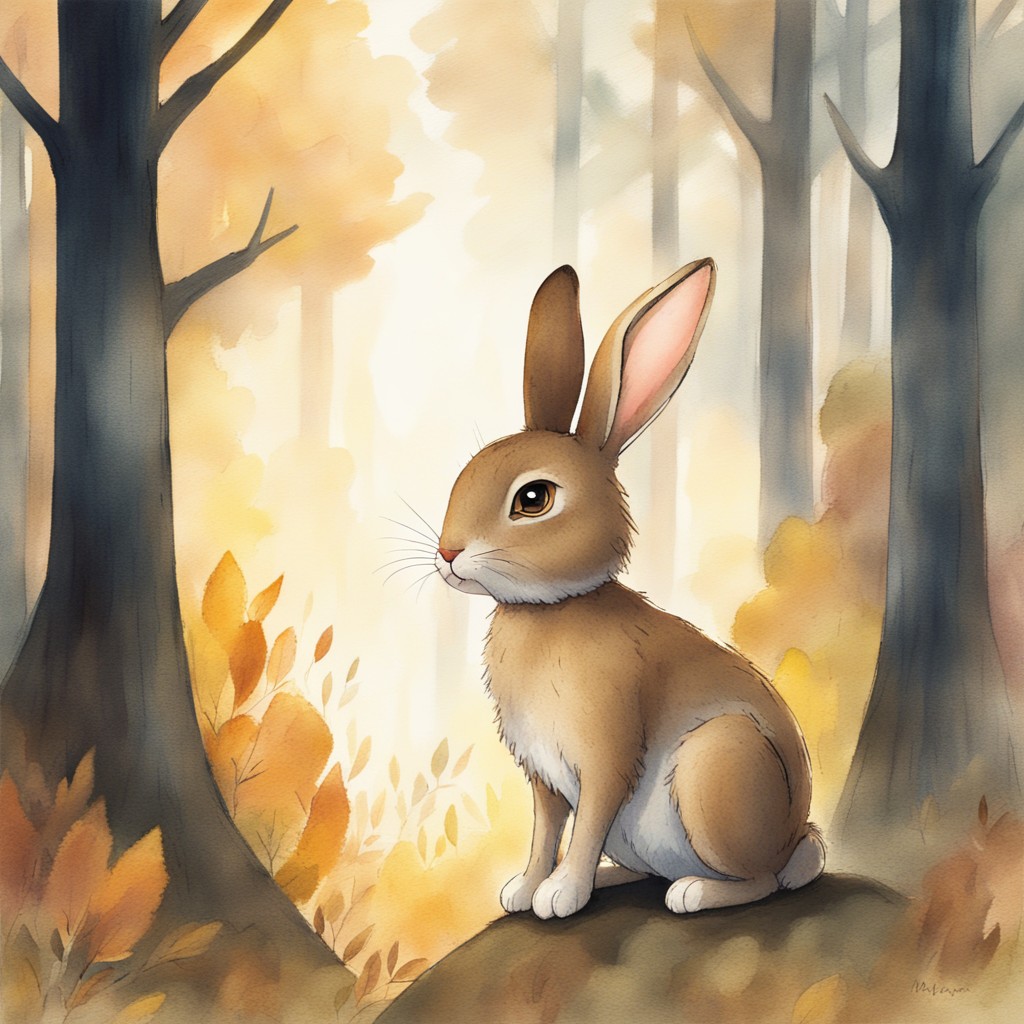
The Whispering Brave: A Story About Courage
Deep within the ancient Whispering Woods, where trees stretched so high their tops disappeared into clouds, and where the forest floor was carpeted in centuries of fallen leaves that crunched like whispers underfoot, there lived a small rabbit named Pip.
Pip was not like the other rabbits.
While his brothers and sisters hopped boldly through the forest, exploring every hollow log and climbing every fallen branch, Pip stayed close to home. He knew every burrow entrance, every safe path, every hiding spot within twenty hops of his family's warren. Beyond that invisible circle, the world grew dark and frightening, full of shadows that might be foxes, sounds that might be owls, and spaces too open for a small rabbit to feel safe.
Pip wasn't a coward, exactly. He told himself he was careful. Sensible. Smart. After all, the forest was full of dangers, and only foolish creatures went looking for trouble.
But in his heart, Pip knew the truth: he was afraid.
Afraid of the dark. Afraid of strange sounds. Afraid of open spaces. Afraid of being alone. Afraid of foxes, and owls, and weasels, and all the other creatures that rabbits were supposed to fear. Most of all, he was afraid of his own fear—that trembling feeling in his chest, the racing of his heart, the way his legs wanted to run even when there was nowhere to run to.
The warren where Pip lived was called Bramble Burrow, built into a hillside covered in blackberry bushes that provided both food and protection. It was a good home, with ten connecting tunnels, three emergency exits, and a large central chamber where the rabbits gathered to eat, sleep, and tell stories.
Pip's mother, Sorrel, was the wisest rabbit in Bramble Burrow. She had survived six winters, raised four litters, and outsmarted predators that would have made other rabbits freeze in terror. She had a calm, steady presence that made every rabbit feel safer just by being near her.
Pip's father, Rowan, was a bold explorer who mapped the entire eastern half of the Whispering Woods. He knew where the best clover grew, which hollow trees housed friendly owls, and which paths to avoid during fox hunting season. He returned from his expeditions with stories that made the young rabbits' eyes grow wide with wonder.
But Pip didn't want stories. He wanted to stay home.
"You're missing so much," Rowan would say, nuzzling his son. "The forest isn't just danger, Pip. It's beauty. It's adventure. It's life."
"I'm happy here," Pip would reply, though his voice was smaller than he wished.
"Are you?" Sorrel asked one evening, her dark eyes seeing more than Pip wanted to reveal. "Or are you just less afraid here?"
Pip didn't answer. He couldn't. Because his mother had named the thing he couldn't name himself.
The trouble began on a perfect autumn morning.
The air was crisp and golden, smelling of fallen leaves and distant rain. The mushrooms had pushed up overnight, creating circles of white and brown dots across the forest floor. The squirrels were busy burying nuts. The birds were calling farewell songs before their journey south. And the rabbits of Bramble Burrow were preparing for their annual Winter Gathering—a feast where every rabbit family contributed food to share through the cold months.
Pip's job was simple: gather dandelion greens from the meadow just beyond the blackberry hedge. It was safe, familiar, and close to home. Pip had done it a hundred times.
He hopped through the tunnel, emerged into the morning light, and began gathering. The dandelions were plentiful, their leaves broad and tender. Pip filled his little woven basket quickly, enjoying the warmth of the sun on his fur and the gentle breeze that carried scents of wood smoke and apples.
Then he heard the scream.
It was a rabbit scream—high, sharp, terrified. It came from deeper in the forest, beyond the meadow, beyond the familiar paths, beyond the safe circle Pip had always stayed within.
Pip froze. His heart hammered against his ribs. His ears swiveled, trying to locate the sound. Every instinct screamed at him to run home, to hide, to burrow deep where nothing could find him.
Then he heard the voice.
"Help! Someone, please!"
It was Thistle, one of the younger rabbits, barely eight weeks old. Thistle was adventurous, curious, and constantly wandering beyond the safe zones. Everyone had warned her. Everyone had predicted this moment.
"Help me! I'm stuck!"
Pip's paws trembled. His breath came in short gasps. The fear was overwhelming—a physical force that pinned him to the ground.
Run home, the fear whispered. You're not brave. You're not strong. You're just a small rabbit who can't even leave the meadow. What can you do? You'll only make things worse. Hide. Hide now.
Pip looked toward Bramble Burrow, so close, so safe, so tempting.
Then he looked toward the forest, dark and mysterious and frightening.
And he took a step.

Moving forward was the hardest thing Pip had ever done.
Every hop felt like pushing through water. His legs wanted to turn around. His heart wanted to pound out of his chest. His mind kept showing him terrible images—foxes with sharp teeth, owls with cruel talons, weasels with sinuous bodies and hungry eyes.
But Thistle was still calling. And Pip kept moving.
The forest grew darker as he left the meadow behind. The trees crowded closer together, their branches weaving a canopy that filtered the sunlight into scattered coins of gold. The undergrowth thickened, clutching at Pip's fur. The sounds changed—birds became scarcer, insects louder, and somewhere in the distance, water dripped with hollow, echoing plinks.
"Thistle?" Pip called, his voice barely louder than a whisper. "Thistle, where are you?"
"Here! I'm here!"
The voice came from ahead and to the left. Pip followed it, pushing through ferns that towered over his head, crawling under fallen logs that smelled of moss and decay, squeezing between rocks that pressed close on both sides.
He found Thistle in a hollow at the base of an ancient oak tree. She had fallen into a narrow gap between the oak's massive roots and a tangle of old wire fencing—relics from human days long past. Her leg was twisted at an awkward angle, and she was shivering with pain and fear.
"Pip!" she gasped, relief flooding her small face. "You came!"
"I came," Pip said, and was surprised to find that it was true. He was here. Despite the fear, despite the danger, despite every screaming instinct to run away.
"I was chasing a blue butterfly," Thistle said, her voice wobbling. "I know I shouldn't have gone so far. I'm sorry. I'm so sorry."
"We'll talk about butterflies later," Pip said, examining the wire. It was old and rusty, but still strong enough to hold a small rabbit. Thistle's leg was caught between two strands, and any movement made her whimper.
"I'll get you out," Pip said.
"How?"
Pip didn't know. He was small, not strong. He had no tools, no help, no plan. The fear that had followed him here was now joined by panic—sharp, desperate panic that made his thoughts scatter like startled birds.
I can't do this, the panic whispered. I'm not brave enough. I'm not strong enough. I should have gotten help. I should have told the others. I'm going to fail, and it will be my fault.
Pip closed his eyes. He breathed. He remembered something his mother had told him once, late at night when he couldn't sleep:
"Courage isn't the absence of fear, Pip. It's the decision that something matters more than your fear."
Thistle matters, Pip thought. More than my fear. More than my comfort. More than my safety.
He opened his eyes. "Thistle, I need you to stay very still. This might hurt, but I'm going to get you free."
"Okay," Thistle whispered, closing her eyes tight.
Pip studied the wire. It was thin enough that a determined rabbit might bend it, given time and leverage. He found a fallen stick, wedged it under the lower strand, and pushed with all his weight. The wire creaked. It bent slightly. Pip pushed harder, his small muscles burning, his paws slipping on the damp leaves.
"It's moving!" Thistle gasped.
"Almost," Pip grunted. "Almost... there!"
The wire sprang up, creating just enough gap. Pip grabbed Thistle and pulled, gentle but firm, sliding her free from the metal trap. She tumbled into the leaves, her injured leg folding beneath her, but she was free.
"You did it!" Thistle cried, tears of relief streaming down her fur. "You saved me!"
Pip collapsed beside her, trembling with exhaustion and the aftermath of terror. But beneath the trembling, something else was growing. Something warm. Something strong.
He had been afraid. More afraid than he'd ever been. But he had done it anyway.

Getting Thistle home was another challenge.
She couldn't hop on her injured leg, and Pip wasn't strong enough to carry her far. The journey back to Bramble Burrow would take nearly an hour under good conditions. With an injured rabbit to support, it might take three times as long.
And they were deep in the forest now, far from safe paths, exposed to any predator that might be hunting.
The fear returned, but it was different now. It was still there—Pip's heart still raced, his ears still swiveled at every sound—but it wasn't paralyzing. It was... manageable. Like a river he could wade through rather than a flood that swept him away.
"We need to move slowly," Pip said, helping Thistle to her three good legs. "Lean on me. Take your time. We'll rest when you need to."
"What if something comes?" Thistle asked, her voice small.
"Then we'll hide," Pip said. "I know lots of good hiding spots."
It wasn't entirely true—Pip knew hiding spots near home, not here—but the words made Thistle feel better. And somehow, they made Pip feel better too.
They moved through the forest like a strange, two-bodied creature. Thistle hopped on her good legs, leaning heavily against Pip. They paused every few minutes for Thistle to rest. They listened for danger. They watched for movement in the shadows.
An hour passed. Then two.
The sun began to dip toward the treetops, painting the forest in shades of amber and rose. Pip's muscles ached. His paws were scratched and sore. His fear had settled into a constant, background hum rather than a screaming alarm.
"Pip?" Thistle asked during one of their rests, nestled in the hollow of a fallen log.
"Yeah?"
"Why did you come? I know you were scared. Everyone knows you're scared of the forest."
Pip thought about the question. "Because... because you needed help. And I was there."
"But you were so afraid."
"I was," Pip agreed. "I still am, a little. But being afraid doesn't mean I can't do things. It just means... it just means I have to do them while being afraid."
Thistle was quiet for a moment. "I think that's braver than not being scared at all."
Pip smiled, the first real smile he'd felt in hours. "Maybe it is."
They reached the meadow just as the sun touched the horizon, painting the sky in strokes of purple and gold. The blackberry hedge was visible now, and beyond it, the warm lights of Bramble Burrow.
Pip had never been so happy to see home.
"Almost there," he said, helping Thistle up for the final stretch. "Can you make it?"
"I can make it," Thistle said, though her voice was faint with exhaustion. "Because you're with me."
They emerged from the meadow into the clearing around Bramble Burrow. Pip's family was there, along with half the warren, all gathered and worried. Sorrel saw them first, her eyes widening with relief and something else—something that looked like pride.
"Pip! Thistle!" Rowan bounded forward, nuzzling them both. "We were so worried! Thistle's mother said she went missing, and then you didn't come back from the dandelion patch..."
"Thistle was hurt," Pip said, his voice cracking with exhaustion. "Deep in the forest. I found her. We came back together."
Sorrel approached, her calm presence washing over them like cool water. She examined Thistle's leg with gentle expertise. "Sprained, not broken. She'll heal with rest." She looked at Pip, really looked at him, and her eyes were glistening. "You went into the forest alone. Deep into the forest. To find her."
"I did," Pip said.
"You were afraid," Sorrel said. It wasn't a question.
"Terrified," Pip admitted.
"But you went anyway."
"She needed help." Pip paused, then added something he'd never said before, something he was only beginning to understand: "And I needed to know I could."
That evening, the rabbits of Bramble Burrow held an impromptu celebration.
It wasn't planned like the Winter Gathering, but it was just as joyful. The rabbits brought food—clover, dandelions, berries, nuts. They gathered in the central chamber, warm and safe, while autumn rain pattered softly against the earth above.
Thistle rested on a bed of soft moss, her leg wrapped in healing herbs, surrounded by her grateful family. She kept looking at Pip with wide, admiring eyes.
"Tell us what happened," the young rabbits begged. "Tell us about the forest."
So Pip told them. He told them about leaving the meadow despite his fear. About following Thistle's voice into the dark woods. About finding her trapped in the wire. About bending the metal and pulling her free. About the long, frightening journey home.
"Weren't you scared?" one of the youngest rabbits asked.
"The whole time," Pip said honestly.
"Then how did you do it?"
Pip thought about the question. "I think... I think courage isn't about not being scared. I think it's about being scared and doing what needs to be done anyway. It's about deciding that something matters more than your fear."
He looked at his mother, who smiled.
"Thistle mattered more than my fear," Pip continued. "And I mattered too. I needed to know that I could be brave, even if I was afraid. That I could help, even if I was small. That I could face the forest, even if it scared me."
Rowan stepped forward, his bold explorer's heart full. "My son," he said, his voice thick with emotion, "you have shown more courage today than I have in all my expeditions. Because I go into the forest without fear. But you went with fear, and you conquered it not by defeating it, but by refusing to let it defeat you."
"Does this mean you'll explore the forest now?" Thistle asked hopefully.
Pip laughed. "Maybe. Slowly. Carefully. When I'm ready. But yes, I think it does. Because I know now that the forest isn't just danger. It's also where butterflies live. And where friends need help. And where I discovered that I'm braver than I thought."
Sorrel nuzzled her son. "The forest will always have dangers, Pip. But it will also always have you. And that's what makes it less frightening."
In the days that followed, Pip changed.
Not dramatically. Not all at once. He didn't become a bold explorer overnight, and he still preferred familiar paths to mysterious ones. But the invisible circle that had kept him close to home grew larger. First to the edge of the meadow. Then to the old apple tree. Then to the stream crossing. Then to the fern grove where he'd once been too frightened to enter.
Each step was still scary. Each new place still made his heart race. But Pip had learned something precious: fear was a feeling, not a fate. It could be felt and moved through, like wading through a cold stream to reach the warm sand on the other side.
He taught this lesson to the other young rabbits, the ones who were also afraid. He didn't tell them to stop being scared—he told them that being scared was okay. That courage wasn't about fearlessness. It was about moving forward despite the fear.
"Feel the fear," he would tell them, "then do it anyway."
And they did. One by one, the frightened rabbits of Bramble Burrow began venturing further, trying new things, facing their own fears. Not because they weren't afraid, but because Pip had shown them that fear didn't have to win.
Years later, when Pip was grown, he became the guardian of Bramble Burrow. Not because he was the biggest or the strongest—he was still a small rabbit—but because he was the one the others trusted when things were frightening.
When a storm flooded the tunnels, Pip was the one who stayed calm, who directed the evacuation, who found the safe routes.
When a fox was spotted nearby, Pip was the one who organized the watch, who kept everyone safe without panic.
When young rabbits were afraid of their first winter, of their first thunderstorm, of their first journey beyond the meadow, Pip was the one they came to for comfort and courage.
"How do you do it?" they would ask. "How are you so brave?"
And Pip would smile, his eyes crinkling at the corners like his mother's, and say:
"I'm not brave because I'm not afraid. I'm brave because I am afraid, and I choose to help anyway. Courage isn't the absence of fear. It's the whisper that says, 'I see your fear, and I raise you one act of love.'"
On summer evenings, when the light turned golden and the forest glowed, Pip would sit at the entrance to Bramble Burrow and watch the butterflies dance over the meadow. Sometimes they were blue, the same color that had led Thistle into the forest so long ago.
He no longer saw the forest as dark and frightening. He saw it as beautiful and wild, full of mystery and wonder. He saw the places where he'd been afraid, and he smiled, because those were the same places where he'd learned to be brave.
And when young rabbits sat beside him, trembling at the thought of their own adventures, Pip would put a paw on their shoulder and say:
"The forest is big, and the world is wide, and there will always be things that frighten you. But you are bigger than your fear. You are stronger than your doubts. And somewhere out there, past the place where you want to stop, is the person you're meant to become."
"How do you know?" they would ask.
And Pip would smile. "Because I met him once, deep in the forest, when I was more afraid than I'd ever been. And he was braver than I ever imagined."
THE END
Moral of the Story: Courage is not the absence of fear—it is the decision that something matters more than our fear. True bravery is not about being fearless; it's about feeling afraid and choosing to act anyway. Every act of courage, no matter how small, builds our strength. And often, the most courageous thing we can do is not to conquer fear for ourselves, but to face it for someone else who needs us.