The Crow Who Redirected the River: A Story About Creativity
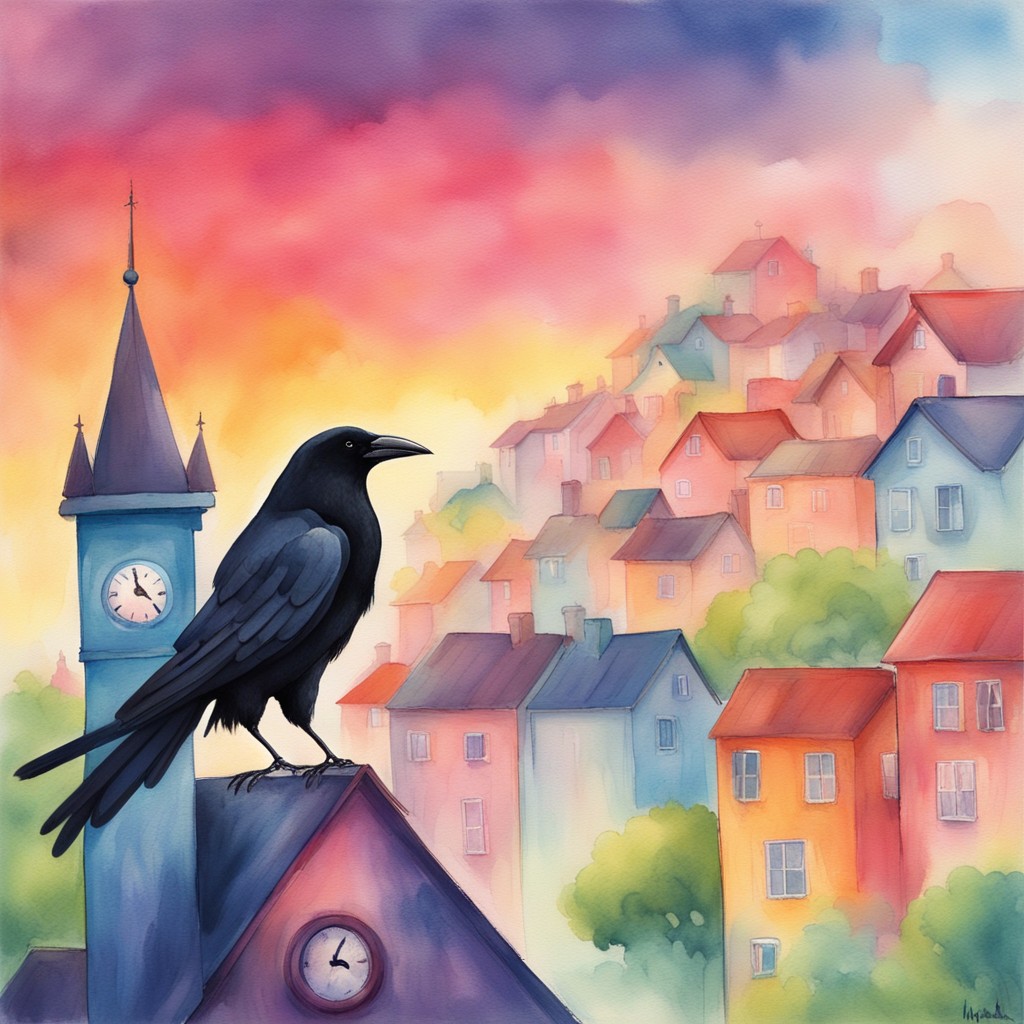
In the village of Kaleidoscope, where every house was painted a different color and the streets wound like ribbons through gardens of impossible flowers, there lived a young crow named Inky. He was not the biggest bird in the village, nor the strongest, nor the most admired. His feathers were a simple glossy black, his voice was a rough caw rather than a melodious song, and his attempts at flying acrobatics usually ended with him tumbling into the village fountain.
But Inky had something that made him special—something that no other creature in Kaleidoscope possessed.
He saw the world differently.
Where others saw a broken branch, Inky saw a bridge. Where others saw a tangled mess of discarded yarn, Inky saw a net for catching falling fruit. Where others saw a cracked clay pot, Inky saw a perfect home for a family of ladybugs. His mind was constantly swirling with ideas, connections, possibilities—like a kaleidoscope turning, always revealing new patterns from the same pieces.
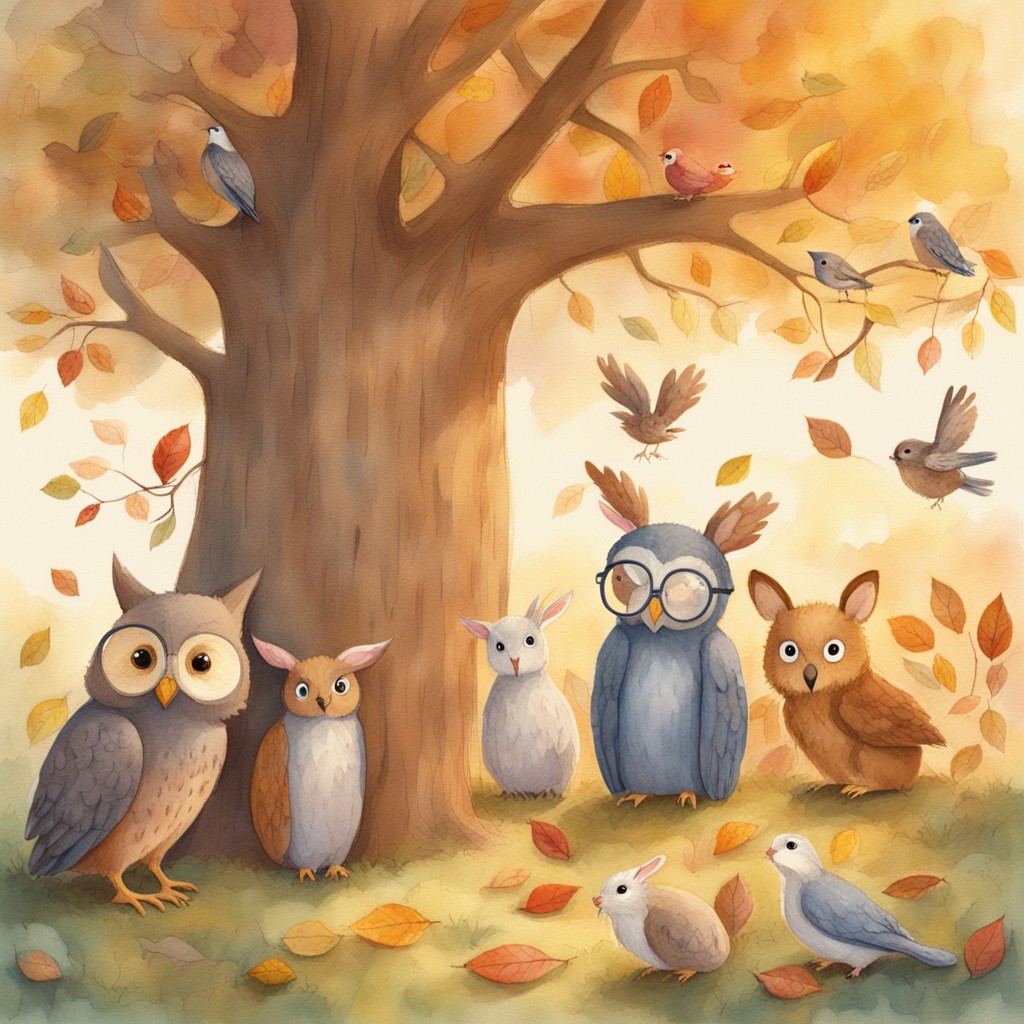
The other animals didn't always understand Inky. When he built a water slide for the ducklings using old gutter pipes and a wheelbarrow, the grown ducks complained that it was "untraditional." When he crafted musical instruments from bamboo stalks and acorn caps, the village orchestra said his music was "too unusual." When he designed a catapult to help the squirrels harvest nuts from the tallest trees, the elder squirrels called it "unnecessary complication."
"Why can't you just do things the normal way?" his mother would sigh, watching Inky dismantle their perfectly good nest to add a rotating sunroof.
"Because the normal way is boring," Inky would reply, his dark eyes sparkling with mischief. "And because maybe the normal way isn't the best way. Maybe it's just the way everyone got used to."
Kaleidoscope had a problem. A big problem. And it was getting bigger every day.
The village was built in a valley between three hills, and for as long as anyone could remember, a clear stream had run through its center, providing fresh water for drinking, washing, and watering the magnificent gardens that made Kaleidoscope famous throughout the land. But three weeks ago, something had changed.
A landslide on the northern hill had blocked the stream's source. The water that had flowed freely for centuries now pooled behind a wall of mud and rock, forming a lake that grew larger with every rainfall. Meanwhile, the stream through the village had dwindled to a trickle, then a damp line of mud, then nothing at all.
The gardens were wilting. The fountain sat dry and silent. The animals were forced to carry water in buckets from a distant well, a journey that took half a day and left everyone exhausted.
The Village Council, comprised of the oldest and most respected animals, met daily to find a solution. They sent strong badgers to dig through the landslide, but the pile was too massive. They sent clever moles to tunnel under it, but the rock layer beneath was too deep. They sent messenger birds to nearby villages asking for help, but the other villages had their own problems and couldn't spare the workers.
"We must accept our fate," declared Elder Bramble, a tortoise who had served on the Council for eighty years. "The stream is gone. We must learn to live with less water, or we must move the village to a new location."
Move the village! The very idea made the animals gasp. Kaleidoscope was their home. Generations of rabbits had burrowed beneath its gardens. Generations of birds had nested in its painted eaves. Generations of foxes had prowled its colorful streets. They couldn't just leave.
But what else could they do?
Inky listened to the Council's deliberations from his perch on the village clock tower. He understood the problem. The landslide blocked the stream. The water was trapped. The village had no water. It seemed impossible.
But Inky's mind didn't see impossible. It saw pieces. Pieces that could be rearranged. Pieces that could form a new pattern.
He flew to the northern hill and circled the landslide. It was enormous—a jumble of boulders, tree trunks, and mud that stretched across the entire stream valley. The badgers had been right: digging through it would take months, maybe years. And the village didn't have months.
But as Inky circled, he noticed something. The landslide had created a natural dam, and behind it, the water was rising. If the dam held, the lake would eventually overflow and the water would return to the village naturally. But the dam was unstable—made of loose rock and mud, it could collapse at any moment, sending a wall of water crashing down that would destroy everything in its path.
Inky flew back to the village, his mind racing with ideas.
That night, while the village slept, Inky gathered his materials. Not new materials—he couldn't afford those. But the village was full of discarded things, broken things, forgotten things. And Inky saw treasure in all of them.
He collected lengths of rusted chain from the blacksmith's scrap pile. He gathered sturdy branches from the woodcutter's discard heap. He found sheets of torn canvas from the old circus tent. He collected clay pots, copper pipes, glass bottles, and coils of frayed rope.
The other crows thought he was crazy. "You're building another one of your ridiculous contraptions," said his cousin Jet, shaking his head. "Why don't you just help carry water buckets like everyone else?"
"Because carrying buckets doesn't solve the problem," Inky said, his beak full of wire. "It just makes the problem take longer to become a disaster."
For three days and three nights, Inky worked. He didn't sleep. He barely ate. He was driven by a vision that only he could see—a solution that existed in his mind like a half-remembered dream, waiting to be made real.
The other animals watched with skepticism and concern. Inky's creation looked like chaos. Pipes connected to pots. Ropes wound around wheels. Canvas stretched between branches. It was perched at the edge of the dry stream bed, a tangle of discarded objects that seemed to serve no purpose.
"He's lost his mind," whispered the rabbits.
"He's wasting his time," muttered the badgers.
"He should be helping with the water buckets," scolded the ducks.
Only Inky's little sister, a tiny crow named Pip who still had gray fuzz on her wings, believed in him. She brought him berries when he forgot to eat. She guarded his materials when he needed to rest his wings. She sat with him through the cold nights, listening to him explain his vision in excited caws and gestures.
"I don't understand," Pip said one night, looking at the contraption that looked more like a bird's nest designed by a mad scientist than anything useful. "How does it work?"
Inky smiled, his eyes bright despite his exhaustion. "It works like this: water flows downhill. That's a rule. But rules can be... redirected. I'm not trying to break the rule. I'm trying to use it differently."
He explained his plan. The landslide had created a lake. The lake was getting fuller. Eventually, it would overflow. But instead of letting the water crash down and destroy the village, Inky would catch it. His contraption—a series of channels and pipes and wheels—would capture the overflow, slow it down, and direct it gently back into the village stream.
"But that's impossible," Pip said. "The water will be too strong. It'll break everything."
"If we try to stop it, yes," Inky agreed. "But I'm not going to stop it. I'm going to guide it. Like a shepherd guiding sheep. The water wants to flow. I'm just going to show it where to go."
Pip looked at her brother with new admiration. "You're going to redirect the river."
"I'm going to redirect the river," Inky confirmed.
The rains came on the fourth night. Not gentle spring showers, but a fierce storm that hammered the hills and sent torrents of water rushing toward the blocked stream. The lake behind the landslide swelled rapidly, its surface rising inch by inch, foot by foot, threatening to overwhelm the unstable dam of rock and mud.
The village animals huddled in their homes, listening to the thunder, fearing the worst. Elder Bramble ordered an evacuation. Families packed their belongings, preparing to flee to the high hills.
But Inky stood at his contraption, soaked to the bone, adjusting a pipe here, tightening a rope there. Pip stood beside him, holding a lantern that flickered in the wind.
"Inky, please," their mother called from the doorway of their nest. "Come with us. Your contraption won't hold. Nothing can hold that much water."
"It doesn't need to hold it," Inky called back. "It just needs to guide it."
The landslide dam burst at dawn. Not with a slow overflow, but with a roar that shook the hills. A wall of water—mud-brown and tree-trunk thick—surged down the valley, carrying boulders like pebbles, snapping ancient trees like twigs.
The animals on the high ground watched in horror. Their village was about to be destroyed. Their homes, their gardens, their lives—all about to be washed away.
But then something extraordinary happened.
The water hit Inky's contraption. For a moment, it seemed the structure would collapse—the force was so immense, the pressure so overwhelming. The pipes groaned. The ropes stretched. The wheels spun wildly.
But the contraption held. Not by resisting the water, but by channeling it. The main flow was caught by a massive canvas funnel, directed into a series of clay pots that acted as buffers, then channeled through copper pipes that wound like a snake down the hillside. The pipes fed into a wheel made of branches and chain, which spun with the water's force, powering a pump that lifted a portion of the flow into a higher channel. That channel directed water into the village's old stream bed, while the excess was safely diverted around the village into the lower meadows.
It was chaos. It was madness. It was beautiful.
The water that reached the village didn't arrive as a destructive flood. It arrived as a stream—strong, yes, but controlled. It filled the dry stream bed. It spilled into the fountain. It watered the gardens. And the excess flowed harmlessly into the meadows, where it would eventually seep into the ground and replenish the wells.
Inky's contraption—built from scraps, guided by imagination, powered by creativity—had saved the village.
The animals stood in silence, watching the water flow gently through their streets. Then, slowly, they began to cheer. The rabbits hopped in celebration. The ducks quacked with joy. The badgers danced (which was not a graceful sight, but no one cared).
Elder Bramble made his way to Inky, moving as fast as his ancient legs could carry him. He looked at the young crow—soaked, exhausted, covered in mud—and then at the contraption that had seemed so foolish just days before.
"Inky," the old tortoise said, his voice trembling with emotion. "We told you it was impossible. We told you to carry buckets. We told you to be normal. And you... you showed us that impossible is just a word for things we haven't imagined yet."
Inky smiled, too tired to speak. But Pip spoke for him.
"My brother doesn't see problems," she said proudly. "He sees pieces. And he knows that if you rearrange the pieces, you can make something new."
In the weeks that followed, the village changed. Not the buildings or the streets—these remained as colorful and winding as ever. But the animals changed. They began to look at the world differently.
When the baker's oven broke, the rabbits suggested using sun-heated stones instead of fire. When the old bridge cracked, the squirrels proposed a rope walkway that swayed but didn't break. When winter came and firewood grew scarce, the moles designed underground heating tunnels that used the earth's warmth.
Inky's creativity had spread like ripples in a pond, touching every animal in Kaleidoscope. They had learned that there was always another way, always a new pattern, always a solution waiting to be discovered by someone brave enough to look at the pieces differently.
One evening, as Inky and Pip sat by the restored fountain, watching the water dance in the sunset light, Pip asked a question.
"Inky, how did you know it would work? Everyone else said it was impossible. Even I wasn't sure. How did you keep going?"
Inky thought for a long moment, watching the water catch the golden light.
"I didn't know it would work," he admitted. "Not for certain. But I knew that if I didn't try, it definitely wouldn't work. And I knew that every problem is just a puzzle with pieces we haven't found yet."
He turned to his sister, his dark eyes warm with love.
"Creativity isn't about being right, Pip. It's about being willing to be wrong. It's about trying things that might not work, because the things that do work are hiding among them. It's about looking at a pile of junk and seeing treasure, because treasure is just junk that someone figured out how to use."
Pip nodded, understanding. "So creativity is... courage?"
"Creativity is courage," Inky agreed. "And imagination. And persistence. And a little bit of madness. But mostly, it's just refusing to believe that the way things are is the only way they can be."
He dipped his wing in the fountain, sending ripples across the surface. The ripples caught the light, creating patterns that shifted and danced—like a kaleidoscope turning, always revealing new beauty from the same water.
"The world is full of pieces, Pip. Broken pieces, discarded pieces, forgotten pieces. And every piece is waiting for someone creative enough to see what it could become. That's the magic of creativity. Not creating something from nothing—but creating something new from something old. Not breaking rules—but bending them until they show you a path no one else saw."
Pip looked at her brother with admiration that would last a lifetime. "I want to be creative too, Inky. Like you."
Inky laughed, a rough but happy sound. "You already are, little sister. You helped me when everyone else laughed. You believed in the impossible. That's the most creative thing of all—believing that what doesn't exist yet could exist tomorrow."
And so Inky's contraption remained, not as a monument to one crow's genius, but as a reminder to every animal in Kaleidoscope that creativity lives in all of us. It waits in the corners of our minds, ready to turn problems into possibilities, scraps into solutions, and impossibilities into "I never thought of that."
All it asks is that we look at the world with eyes that see not just what is, but what could be.
And in the village of Kaleidoscope, where every house was painted a different color and the streets wound like ribbons through gardens of impossible flowers, the animals learned to look. And they discovered that when creativity flows, like water finding its path, there is no problem too big, no challenge too difficult, and no dream too impossible to achieve.
The End
This story is part of the Core Values Series - a collection of bedtime stories that teach children important life values through magical tales.
Related Stories: