The Orchard of Endless Bounty: A Story About Generosity
In a valley where three rivers met and the hills rolled like waves of green velvet, there stood an apple orchard unlike any other in the world. It was called the Orchard of Endless Bounty, and legend said that long ago, a star had fallen from the sky and buried itself in the earth right where the oldest tree now stood.
That tree was named Grandmother Granny—not because she was grumpy (she wasn't), but because she was a granny smith apple tree, the oldest and wisest tree in the entire orchard. Her trunk was thick as a cottage, her bark deep with the wrinkles of centuries, and her branches stretched so wide that they cast shade over half the orchard on summer afternoons.
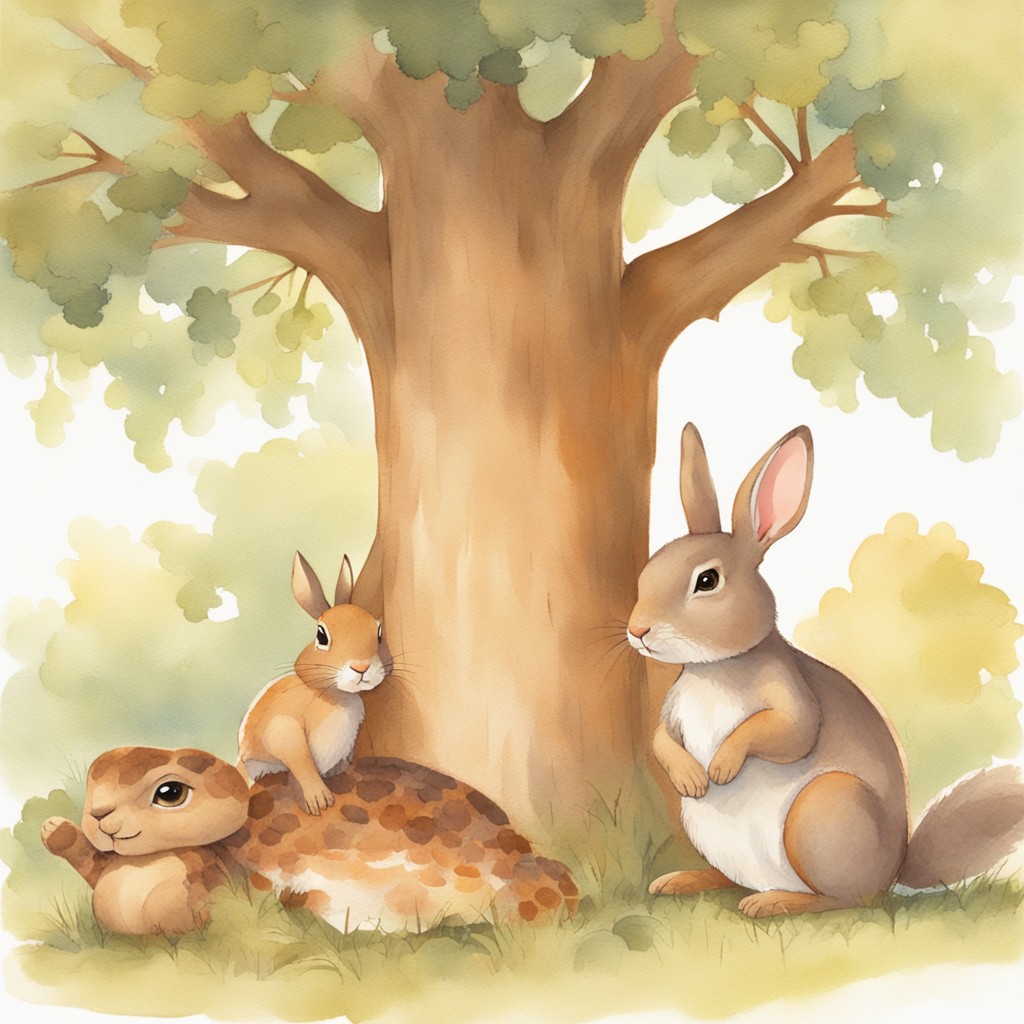
Every autumn, Grandmother Granny produced the most magnificent apples anyone had ever tasted. They were enormous—bigger than a rabbit's head—with skin that gleamed like polished jade and flesh so sweet that one bite could make a grumpy badger smile. Other trees produced good apples, fine apples, lovely apples. But Grandmother Granny's apples were magical.
And here is what made them truly special: Grandmother Granny gave them all away.
Every single one.
In the hollow of Grandmother Granny's roots lived a young rabbit named Thistle. He was small for his age, with fur the color of autumn wheat and ears that stood up a little too straight, making him look permanently surprised. Thistle had made his home with Grandmother Granny since he was a baby, when a flood had washed away his family's burrow and the old tree had sheltered him in her roots.
Thistle loved Grandmother Granny with all his heart. Every morning, he swept her fallen leaves into neat piles for the compost. Every afternoon, he chased away bark beetles that tried to nibble her trunk. Every evening, he sat against her bark and told her about his day—about the butterflies he'd raced, the dandelions he'd tasted, the clouds that looked like ships sailing to faraway lands.
"Grandmother," Thistle said one crisp autumn morning, as they watched the first apples beginning to blush with ripeness, "why do you give away every single apple? You never keep even one for yourself."
Grandmother Granny's leaves rustled with laughter, a sound like wind chimes made of silver.
"Oh, my little root-dweller," she said, her voice deep and warm, like honey poured over sunshine. "Let me tell you a story about what happened long ago, when I was young and foolish and kept all my apples for myself."
Many, many autumns ago, when Grandmother Granny was just a sapling no taller than a fawn, she had discovered she could make the most delicious apples in the valley. The other trees produced small, tart fruit. But Granny's apples were sweet as summer rain, crisp as morning frost, and so juicy that one bite sent rivers of nectar down your chin.
At first, she shared them. A squirrel would ask for one, and she would drop it gladly. A family of finches needed breakfast, and she would shower them with windfalls. A traveling hedgehog, weary from the road, would rest in her shade, and she would offer him the finest apple on her lowest branch.
But as the seasons passed, something changed in Granny's heart. She began to count her apples. She began to compare. She began to think: Why should I give away what is mine? Why should others enjoy the fruits of MY branches, the sweetness of MY labor?
So she stopped sharing.
When the squirrel came, she held her branches high. When the finches chirped for breakfast, she rustled her leaves to scare them away. When the hedgehog trundled by, tired and hungry, she pretended to be asleep.
"These are MY apples," she told herself. "I worked hard to grow them. I pulled water from the earth. I turned sunlight into sugar. They belong to ME."
And so her apples hung heavy on her branches, hundreds of them, thousands of them, perfect and untouched. They grew riper and riper, heavier and heavier, until her branches bent low with the weight of all that uneaten sweetness.
But something strange began to happen. Without creatures eating them, without seeds being carried to new ground, without the cycle of giving and receiving that made the orchard alive, Granny's apples began to change. They grew too ripe. They fermented on the branch. They fell to the ground and rotted, drawing flies and sour smells, staining the earth with wasted sweetness.
Worse still, Granny felt herself growing weaker. Her leaves lost their shine. Her bark grew dull. She couldn't understand why—she had all the apples she could ever want, yet she felt empty, hollow, like a drum with no song inside.
One day, a wise old owl named Alder landed on her highest branch. He was ancient, with feathers the color of moonlight on water and eyes that seemed to hold the wisdom of a hundred winters.
"Young tree," Alder hooted, his voice gentle but firm, "do you know why you grow apples?"
"Because I am an apple tree," Granny said proudly. "It is what I do."
"But WHY?" Alder pressed. "Why do apple trees exist at all?"
Granny had no answer.
"You grow apples," Alder said, "not to keep, but to give. The squirrel takes your apple and plants the seed in distant soil. The finch carries a piece to a new valley. The hedgehog's droppings fertilize the earth. Your generosity creates life beyond your own branches. When you hoard your gifts, you break the cycle. The apples rot. The seeds don't travel. And you, dear tree, lose your purpose."
Granny thought about this for a long time. She looked at her rotting windfalls, her empty branches where creatures no longer perched, her dull bark and thinning leaves.
"But if I give them all away," she whispered, "what will I have left?"
Alder spread his wings, preparing to fly. "You will have something far more valuable than apples, young tree. You will have connection. You will have purpose. You will have love. And those things, unlike apples, only grow when shared."
That very autumn, Granny began to give again. At first, it felt strange—like opening a door she had locked long ago. But then something wonderful happened.
A squirrel named Nutkin came, hesitantly, expecting to be turned away. When Granny dropped him the finest apple on her lowest branch, his eyes grew wide with joy. He chattered his thanks, buried the seeds in three different meadows, and promised to tell everyone that Granny was sharing again.
A family of finches returned, tentatively at first, then with growing confidence. They sang songs in her branches—songs so beautiful that travelers would stop in the valley just to listen. Their droppings enriched her soil. Their songs brought her joy she had forgotten existed.
The hedgehog came back, this time with his grandchildren. They feasted on her windfalls, and in exchange, they ate the slugs that had begun damaging her bark. She grew stronger, healthier, more alive than she had ever been.
And something miraculous happened: the more she gave, the more she grew. Her branches stretched wider. Her roots dug deeper. Her apples grew even sweeter, even larger, even more numerous. Because now she wasn't just growing apples—she was growing community, growing connection, growing love.
By the time Alder returned the following spring, Granny was unrecognizable. She was twice as tall, three times as wide, her bark gleaming with health, her leaves thick and vibrant. Birds nested in her branches. Rabbits made homes in her roots. Deer slept in her shade. She had become the heart of the orchard, the center of a vast web of life that stretched across the entire valley.
"I understand now," Granny told Alder, as he perched on her strongest branch. "The apples were never mine to keep. They were mine to give."
The old owl nodded, his golden eyes glowing with approval. "Generosity is not losing what you have, young tree. It is discovering what you truly are."
Grandmother Granny finished her story, and Thistle sat in silence for a long moment, his small nose twitching with emotion.
"So that's why you give them all away," he said finally. "Not because you have to, but because..."
"Because giving is how I grow," Grandmother Granny finished. "Because the joy of sharing is sweeter than any apple. Because when I fill others' bellies, I fill my own heart."
Thistle thought about this. "But Grandmother, what about you? Don't you ever want to keep something for yourself?"
Grandmother Granny's branches swayed, and a perfect apple—the most beautiful one on the tree—dropped softly into Thistle's paws.
"I do keep something, my little one," she said. "I keep the love of my friends. I keep the songs of the birds in my branches. I keep the memory of every creature I have fed, every seed I have sent into the world, every life I have touched. Those things don't rot. They don't wither. They grow stronger with every passing season."
Thistle held the apple, its skin gleaming like emerald starlight. "What should I do with this one?"
"That is yours to decide," Grandmother Granny said. "But I will tell you a secret: the happiest creatures in this valley are not the ones who have the most. They are the ones who give the most."
Thistle thought about this as he hopped through the orchard that afternoon. He passed a family of mice who were struggling to carry enough seeds back to their winter stores. Without hesitation, he placed the apple on their path. Their squeaks of joy made his heart feel lighter than air.
He passed a young deer, new to the valley, who looked thin and lost. Thistle guided her to Grandmother Granny's shade, where the old tree dropped two perfect apples at her feet. The deer's grateful eyes shone with tears.
He passed a crow with a broken wing, unable to fly to the best trees. Thistle gathered windfalls from across the orchard, piling them within the crow's reach. The crow cawed his thanks, and Thistle felt a warmth spread through his chest that no apple could ever match.
That evening, as the sun painted the orchard in shades of gold and rose, Thistle returned to Grandmother Granny's roots. He was tired, hungry, and happier than he had ever been.
"I didn't keep any apples for myself today," he admitted. "I gave them all away."
"And how do you feel?" Grandmother Granny asked.
Thistle considered this. "Full," he said finally. "I feel full. But I didn't eat anything."
Grandmother Granny's leaves rustled with delight. "That, my little root-dweller, is the magic of generosity. When you give without expecting anything in return, you receive something far more nourishing than food. You receive joy. You receive connection. You receive the knowledge that you have made the world a little brighter, a little kinder, a little more beautiful."
She dropped another apple—her finest one, reserved just for him.
"But even givers must receive sometimes," she said gently. "Accepting a gift is its own kind of generosity. It allows others the joy of giving."
Thistle took the apple, and as he bit into its sweet, crisp flesh, he understood at last. Generosity wasn't about losing something. It was about participating in the endless, beautiful cycle of giving and receiving that made the orchard—and the world—come alive.
Years passed. Thistle grew from a small rabbit into a wise elder, known throughout the valley for his kindness. He never forgot Grandmother Granny's lessons. He shared his food, his home, his time, his heart. And in return, he received more love, more friendship, more joy than he could have ever imagined.
When Grandmother Granny finally grew so old that her trunk hollowed and her branches could no longer bear fruit, the entire valley gathered to honor her. Squirrels who had eaten her apples as babies brought their own children to hear her story. Finches whose grandparents had sung in her branches composed new songs in her honor. Deer who had slept in her shade stood vigil through the night.
And at the center of it all was Thistle, now old and gray himself, telling the story of the young tree who learned that the greatest gift is the gift of giving.
"Grandmother Granny taught me," he said to the gathered creatures, his voice trembling with emotion, "that we do not have because we keep. We have because we share. Our hands were made not to grasp, but to give. Our hearts were made not to hoard, but to overflow."
He looked up at Grandmother Granny's ancient trunk, still standing proud despite her age, and smiled through his tears.
"And though she can no longer give apples, she continues to give something even more precious. She gives us her example. She gives us her wisdom. She gives us the knowledge that a life lived in generosity is a life lived in abundance."
The wind blew through the orchard, and Grandmother Granny's last leaves rustled one final time, a sound like gentle applause, like whispered love, like the universe itself saying: Well done, generous heart. Well done.
And somewhere in the valley, in a meadow far from the orchard, a young apple sapling pushed through the soil, reaching for the sun, ready to begin its own journey of endless giving.
The End
This story is part of the Core Values Series - a collection of bedtime stories that teach children important life values through magical tales.
Related Stories: